Best Waterproofing Solutions for Concrete Block Surfaces
Waterproofing concrete blocks is essential for preventing moisture intrusion, protecting foundations, and extending the life of masonry structures. The following products offer deep penetration, flexible film-forming barriers, and breathable protection to guard against water, dampness, and related damage. The selections emphasize indoor and outdoor applications on poured concrete, block walls, and masonry surfaces commonly found in basements, garages, and exterior walls.
Summary of Selected Products
- RadonSeal Standard Concrete Sealer – RadonSeal
- Stormdry Brick Sealer – Stormdry
- Liquid Rubber Basement and Foundation Repair Sealant – Liquid Rubber
- Eco Advance Siloxane Waterproofer Concentrate – Eco Advance
- CHIMNEYRX Advanced Water Repellent – CHIMNEYRX
RadonSeal Standard Concrete Sealer, 5-Gallon

RadonSeal presents a five-gallon bucket of a clear, waterborne sealer designed to penetrate cementitious materials. The product is marketed to reduce moisture, dampness, and radon gas intrusion, while strengthening and waterproofing poured concrete surfaces, heavy blocks, grout, and related masonry. The formulation emphasizes long-term protection with a focus on indoor and outdoor applications.
Key features include a deep-penetrating formula that helps minimize moisture intrusion, which can contribute to spalling, cracking, and surface degradation over time. By reducing moisture migration, RadonSeal can enhance the durability of basements, driveways, and slabs that rely on concrete blocks for structure.
Potential strengths in concrete block projects include its clear appearance, compatibility with a range of cementitious substrates, and the intent to create a moisture-reducing barrier without altering surface aesthetics. As with any penetrating sealer, effectiveness depends on proper surface preparation and multiple coats where needed.
Stormdry Brick Sealer – Clear Masonry Waterproofing

Stormdry Brick Sealer is a cream-based, penetrating waterproofing treatment designed for brick, stone, mortar, cement, and related masonry. It claims 25-year protection and a breathable barrier that allows the masonry to dry while repelling penetrating damp. The product is appropriate for exterior walls and interior masonry where long-term moisture resistance is desired.
The key advantage for blockwork is the breathable yet durable barrier that reduces moisture ingress without sealing in moisture trapped within. The single-coat application is marketed to preserve the thermal and moisture properties of wall cavities, aiding in damp control and mold prevention in basements or crawl spaces behind block walls.
Considerations include compatibility with the surface and the need to avoid limestone or painted surfaces. For block exterior applications, ensure surface conditions are dry, sound, and free of efflorescence prior to treatment to maximize performance.
Liquid Rubber Basement and Foundation Sealant – 5 Gallon

Liquid Rubber offers a flexible, professional-grade coating designed for basement waterproofing and foundation repair. The 5-gallon option provides a durable membrane with high elongation (about 900%), enabling movement without cracking. The product is described as a complete basement waterproofing system, with compatibility for self-leveling concrete and other substrates, and versatile crack filling.
The coating’s flexibility and adhesion make it suitable for concrete foundations, walls, and interior applications where leaks or dampness occur. It also works for external uses such as foundations and planters, forming a lasting barrier that resists active leaks and moisture ingress. Surface preparation and proper priming can influence long-term performance on block walls.
Eco Advance Siloxane Waterproofer Concentrate – 5 Gallons
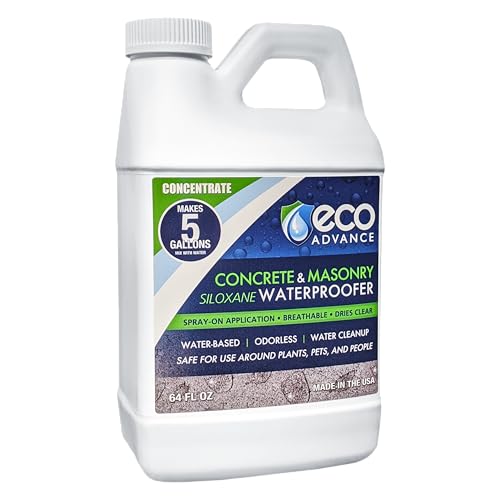
Eco Advance provides a siloxane-based waterproofer concentrate that yields five gallons of ready-to-use protection. The formula targets concrete, brick, stucco, stone, EIFS, pavers, and other masonry surfaces. It is designed to repel water, oils, salts, and chemicals while extending surface life. The concentrate approach offers cost efficiency for larger projects and is suitable for both interior and exterior applications.
Advantages include a durable, long-lasting barrier with broad substrate compatibility and a relatively low odor, waterborne formulation. For concrete blocks, the siloxane barrier can help reduce moisture transfer from exterior to interior spaces while maintaining breathability to prevent condensation-driven issues inside walls.
As with any siloxane treatment, surface cleanliness and even coverage are important. Multiple coats or reapplication intervals may be necessary in harsh climates or high-traffic areas to maintain performance.
CHIMNEYRX Advanced Water Repellent – Masonry Sealer

CHIMNEYRX offers a high-performance polysiloxane-based sealer designed for brick, stone, and concrete masonry. The product emphasizes breathable water repellence with long-lasting protection, suitable for residential and commercial projects. It can be used on outdoor masonry surfaces to prevent water ingress while allowing moisture to escape, reducing the risk of freeze-thaw damage.
The formula is described as versatile, applicable to old outdoor sealers and new masonry, to improve water resistance and fix leaks. For concrete block walls, CHIMNEYRX can act as a protective barrier that helps preserve structural integrity in damp or wet environments. Proper surface preparation and application ensure optimal penetration and effectiveness.
Buying Guide: Key Considerations for Concrete Block Waterproofing
Choosing the right waterproofing product for concrete block depends on the project scope, climate, and substrate condition. Consider the following factors to select the best option:
- Penetration vs. film-forming: Penetrating sealers (siloxanes, penetrating acrylics) reduce moisture migration with less surface alteration, while film-formers (coatings, rubberized membranes) create a continuous barrier that can be more protective but may require maintenance and surface prep.
- Breathability: For block walls, breathable formulations help moisture escape from within the wall, reducing mold risk and paint delamination. Breathing is especially important in basements and crawlspaces with moisture vapor.
- Surface compatibility: Ensure the product is suitable for concrete blocks, mortar joints, and any existing coatings. Some products do not adhere well to lime-based or heavily effloresced surfaces.
- Climate and durability: Consider temperature fluctuations, humidity, and exposure to de-icing salts. Higher durability and elasticity accommodate movement and seasonal freeze-thaw cycles.
- Application method: Sprays, brushes, and rollers each have advantages depending on surface size, texture, and access. Some products require multiple coats for optimum performance.
- Maintenance and reapplication: Some siloxane sealers last several years with little upkeep, while paints or coatings may require reapplication as part of routine maintenance.
- Indoor vs. outdoor use: Exterior applications face weathering and UV exposure; interior applications emphasize vapor control and odor considerations.
When assessing options, compare penetration depth, durability, and the ability to accommodate moisture movement. For concrete block foundations and basement walls, a layered approach—combining a penetrating sealer with a breathable protective coating—can offer robust, long-term protection while preserving wall breathability and reducing dampness.