Best Router Bits for Planing: Top Spoilboard Surfacing Tools for Woodworking
When preparing wood slabs and spoilboards, a quality spoilboard surfacing router bit is essential. This guide highlights five reliable options designed for planing, flattening, and leveling surfaces with precision. Each product features carbide tips, anti-kickback designs, and durable bodies built to handle heavy-duty use. Read on to compare capabilities and find the best router bit for planing your projects.
| Product | Brand | Key Feature |
|---|---|---|
| 3 Wings Wood CNC Spoilboard Surfacing Router Bit | BINSTAK | 2″ cutting diameter, 1/2″ shank, carbide-tipped |
| BINSTAK Extra Large 1-1/2″ Cutting Diameter | BINSTAK | 1/4″ shank, replaceable inserts, 6 wings |
| Slab Flattening Router Bit 2″ Cutting Dia | SICWOOD | 6-wing, replaceable carbide inserts |
| POWERTEC Slab Flattening Router Bit 2″ Diameter | POWERTEC | 1/4″ shank, 2″ cut, carbide edges |
| BINSTAK 1/2″ Shank, 2″ Cutting Diameter | BINSTAK | 4 wings, anti-kickback design |
Below, explore each option with a concise overview, followed by a buying guide to help you choose the right bit for your shop and projects.
BINSTAK CNC Spoilboard Surfacing Router Bit, 1/2 Inch Shank

This 3-wing design uses a 1/2″ shank and a 2″ cut diameter for efficient spoilboard flattening. The carbide-tipped bit, paired with a hardened steel body, provides durability for heavy-duty use. An anti-kickback design helps maintain control, while a Teflon coating reduces resin buildup for easier cleaning. It suits wood slab resurfacing and planing the top surface of spoilboards, with additional trimming and slotting capabilities.
BINSTAK CNC Spoilboard Surfacing Router Bit 1/4″ Shank, 1-1/2″ Cutting Diameter

Featuring a 1/4″ shank and a generous 1-1/2″ cutting diameter, this bit is designed for broad spoilboard surfaces. Its 4-wing carbide blade setup and anti-kickback body contribute to smooth, consistent planing. The bit employs replaceable carbide inserts to extend life while keeping costs lower than full-bit replacements. It is suitable for flattening, resurfacing, and slotting on wooden surfaces.
SICWOOD Slab Flattening Router Bit, 2″ Cutting Dia, 6-Wing
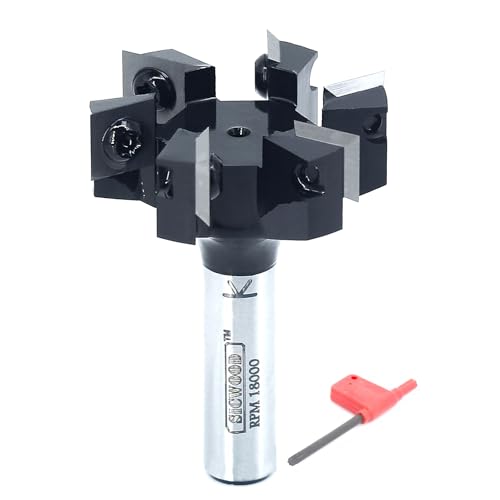
With a 2″ cutting diameter and 6 wings, SICWOOD’s bit emphasizes smoothness and efficiency for flattening large surfaces. Carbide inserts provide sharpness and durability, with a maximum RPM of 18,000. The four-sided inserts enable multiple usable edges, reducing cost per edge and extending tool life. It’s a practical choice for flattening, trimming, and slotting on wooden workpieces.
POWERTEC Slab Flattening Router Bit, 2″ Diameter

POWERTEC’s 2″ diameter cutter uses a 1/4″ shank with a 1/2″ cutting depth, designed for large surface flattening and precise planing. Constructed from hardened steel with tungsten carbide edges, the bit prioritizes durability and clean results. An anti-kickback design helps maintain control during heavy-duty planing tasks, making it a solid option for spoilboard preparation and dado-like grooves where needed.
BINSTAK CNC Spoilboard Surfacing Router Bit, 1/2″ Shank

This 4-wing design uses a 1/2″ shank and a 2″ cut diameter with a half-inch cutting length. The carbide-tipped bit rides on a hardened steel body with an anti-kickback design and a Teflon coating to resist heat and resin buildup. It is engineered for accurate spoilboard resurfacing, planing the top surface, and providing clean edges for subsequent machining operations.
Buying Guide: Key Considerations For Planing And Spoilboard Surfacing
- Shank size and cutting diameter: Match your tool compatibility and the scale of the surface you’re planing. Larger diameters cover more area but require stronger machines.
- Wing count and carbide inserts: More wings (and replaceable inserts) yield smoother finishes and longer life, but check ease of replacement and edge availability.
- Material and coatings: Carbide-tipped bits with heat-resistant coatings reduce resin buildup and extend life in dense hardwoods and routed surfaces.
- Anti-kickback design: Essential for maintaining control during heavy planing tasks, especially on spoilboards and large panels.
- Replaceable inserts vs. brazed blades: Inserts can lower long-term costs and allow edge re-use; brazed blades may offer simpler setups but at higher replacement costs.
- RPM compatibility: Ensure your router’s RPM range aligns with the bit’s maximum rating to prevent premature wear or glazing.
- Application versatility: Look for bits that handle flattening, resurfacing, trimming, slotting, and grooving to maximize tool utility in a single setup.
- Maintenance and cleaning: Bits with coatings that resist resin buildup simplify cleanup after heavy planing sessions.
- Availability of spare inserts: If selecting an insert-based design, confirm the availability of replacement inserts to avoid downtime.
- Budget vs. lifespan: Higher-quality inserts and coatings typically yield longer service life, justifying higher upfront costs for frequent users.
When selecting a spoilboard surfacing router bit, consider your typical project size, material types, and machine capabilities. For frequent slab flattening, opting for larger diameter bits with replaceable inserts can provide quicker stock removal and easier maintenance. If you prioritize cost efficiency, models with replaceable inserts offer long-term value and consistent results across multiple workpieces.