Best Table Saw Alignment Tool for Precise Setup and Safe Cuts
Achieving pristine table saw accuracy requires a reliable alignment tool that accurately gauges blade, fence, and miter slot relationships. This guide highlights five top-rated table saw alignment tools, comparing precision, setup ease, and compatibility across common slot sizes. Each option is designed to help woodworkers validate parallelism, minimize runout, and improve overall cut quality without guesswork.
| Product | Brand | Key Strength | Slot Fit |
|---|---|---|---|
| GOINGMAKE Table Saw Gauge Dia Indicator | goingmake | 0.01mm accuracy with stable base | 3/4″ miter slot |
| Woodpeckers Table Saw Gauge | Woodpeckers | Auto-adjusts to miter slot; includes storage | Standard miter slot |
| AltitudeCraft Precision Table Saw Alignment Gauge | AltitudeCraft | 0.001″ dial indicator; CNC aluminum | 3/4″ miter slot |
| ALLmeter Digital Table Saw Gauge | ALLmeter | Digital readout; high resolution | Fits 3/4″ groove width |
| XUNTOP Digital Table Saw Alignment Gauge | XUNTOP | 0.0005″ resolution; robust design | 3/4″ groove width or larger |
Below, five detailed product sections provide concise insights to help you choose the right tool for your shop setup, followed by practical buying considerations.
GOINGMAKE Table Saw Gauge Dia Indicator

The GOINGMAKE gauge provides 0.01 mm accuracy with a stable base, facilitating precise alignment between the table saw blade and miter slot. It helps ensure the rip fence runs parallel to the miter slot and includes an extra support base to reduce movement during calibration. Two adjustable rings in the miter bar minimize slop and ensure a snug fit. Setup is straightforward: slide the gauge into the miter slot, adjust rings to remove play, and align the dial indicator to measure blade or fence deviation. It is designed to fit most 3/4″ wide table saw slots and is compatible with band saws and router tables in common shop configurations.
Peachtree A-Line It Deluxe, Digital Dial Indicator
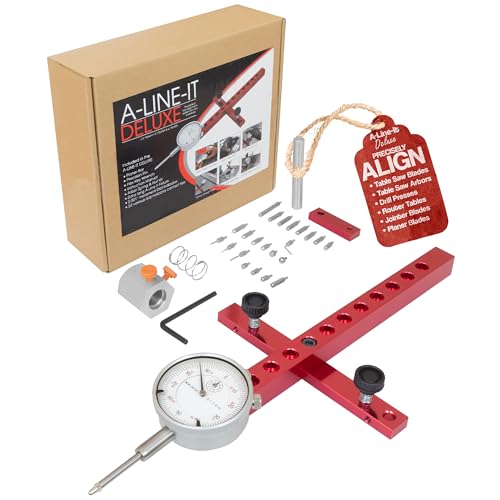
The A-LINE-IT DELUXE provides a digital dial indicator for precise alignment of blade, fence, and arbor runout. It emphasizes machine-wide accuracy without overspending. A key feature is the self-adjusting “Smart Bar” that remains tight in a miter slot of varying width, increasing efficiency by reducing the need for constant shim adjustments. This kit helps identify blade straightness, fence run-out, arbor run-out, and flange run-out, making it a comprehensive option for professional shops seeking repeatable results. The device is designed for durable, repeatable performance across frequent table saw calibrations.
Woodpeckers Table Saw Gauge

Woodpeckers offers an auto-adjusting gauge that adapts to the width of the miter slot, simplifying the alignment process. The kit includes a dial indicator and a fitted storage case, helping protect and organize components. Its simple pin-based system auto-adjusts to slot width, ensuring consistent contact against the blade or fence. The included case makes it easy to transport or store, which is convenient for shops with limited workspace or frequent tool changes. This option focuses on ease of use without sacrificing measurement precision for efficient setup.
Peachtree A-Line It Basic

The A-LINE-IT Basic is a starter kit designed for hobbyists and small shops. It includes hardware, a hex wrench, and assembly instructions to guide users toward optimal performance and accuracy. The self-adjusting “Smart Bar” remains snug in various slot sizes, reducing the need for frequent adjustments. The kit includes a precision 1″ dial indicator with readings in .001″ increments for accurate measurement of blade run-out and fence alignment. It’s a practical entry point for reliable alignment workflows without specialized training.
ALLmeter Digital Table Saw Gauge
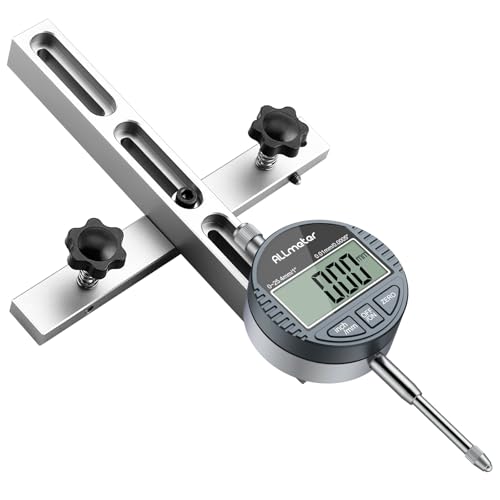
ALLmeter combines a high-precision digital dial indicator with a CNC machined aluminum bar for rigidity and durability. It offers a 0-1 inch range with 0.01 mm (0.0005″) resolution, providing real-time measurements to calibrate blade and fence alignment accurately. The tool’s design includes a long 18 cm dial gauge rod and six adjustment holes, enabling versatile mounting across different machines. It is specifically noted as suitable for 3/4″ (19 mm) grooves, with optional screw-based adjustments for wider grooves. This makes it ideal for precise, repeatable setup in busy workshops.
AltitudeCraft Precision Table Saw Alignment Gauge

AltitudeCraft emphasizes rugged, CNC-machined 6061 aluminum construction with a hard anodized finish for durability. It features a 0.001″ dial indicator for exact blade, fence, and sled alignment, contributing to smoother cuts and tighter joints. The tool is designed to fit standard 3/4″ miter slots and includes adjustable ball screws to eliminate play, providing zero-wobble alignment for repeatable performance. It targets professional shops and serious hobbyists seeking long-term reliability in precision setups.
Buying Guide: Key Considerations for Choosing a Table Saw Alignment Tool
- Accuracy and resolution: Look for tools offering 0.01 mm (or 0.001″) increments to ensure tight tolerances for blade-to-fence alignment.
- Slot compatibility: Confirm the tool fits common miter slots (3/4″ or 19 mm) and accommodates groove width variations without excessive shimming.
- Stability and build quality: CNC-machined aluminum or similar rigid construction reduces flex and drift during measurement.
- Ease of setup: Self-adjusting bars or smart mounting systems save time and reduce guesswork during calibration.
- Included accessories: A durable storage case, dial indicators, and the necessary hardware simplify long-term maintenance.
- Versatility: Consider whether the tool measures blade runout, fence runout, and arbor alignment to cover multiple setup needs.
- Audience fit: Choose based on your workshop size, frequency of calibrations, and whether you’re a hobbyist or professional.
- Budget and value: Compare features against price, prioritizing essential capabilities for your typical projects.
All options presented prioritize precise alignment with a focus on repeatable results and safer, cleaner cuts. When selecting a tool, weigh the balance between setup ease, measurement accuracy, and compatibility with your specific table saw model and groove width. A well-chosen alignment tool helps standardize calibration routines and can improve downstream woodworking outcomes across various projects.