Best Spray Foam for Mice: Barriers and Pest Prevention
The following guide highlights top spray foams used to block mice by sealing gaps, cracks, and entry points around homes. Each option combines expanding polyurethane foam with durable seals to deter rodents while supporting insulating performance. This article objectively compares features, durability, and ease of use to help American homeowners choose effective barriers against mice. A concise buying guide follows with key considerations and practical comparisons.
| Product | Brand | Key Benefit | Approx. Coverage (per can) |
|---|---|---|---|
| Tomcat Rodent Block Expanding Foam Barrier | Tomcat | Pesticide-free rodent barrier that fills gaps | 12 oz |
| Loctite Tite Foam Gaps & Cracks | Loctite | High-density, durable seal for gaps up to 1 inch | 12 fl oz |
| DAP Mouse Shield Foam Sealant | DAP | Pest blocker sealant with interior/exterior use | 12 oz |
| Akfix 895 PestBlocker Insulation Spray Foam | Akfix | Resilient gap filler with strong adhesion | 2×12 oz |
| PAMAZY Upgraded Rodent Barrier Kit | PAMAZY | Steel wool plus spray foam for larger openings | Kit (3.2″x7.5’) |
Tomcat Rodent Block Expanding Foam Barrier
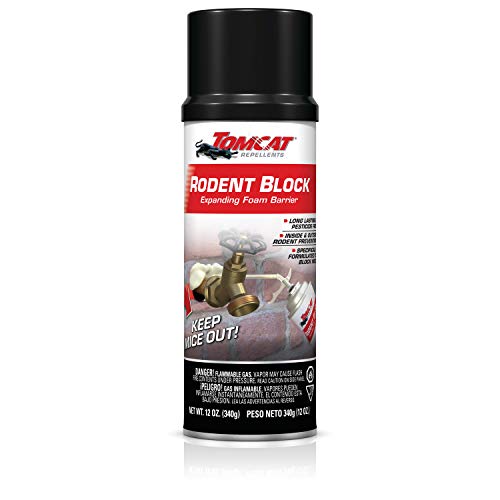
Tomcat Rodent Block Expanding Foam Barrier is designed to seal gaps and cracks that could let mice enter living spaces. The product is described as pesticide-free, offering a non-toxic option for blocking entry points. It creates a long-lasting, airtight bond to a variety of building materials and provides water resistance to help maintain the seal in damp environments. This makes it suitable for use around foundations, plumbing penetrations, and other typical rodent entry zones. The foam’s expanding action helps fill irregular spaces that are common in older homes, contributing to a protective barrier against mice.
Loctite Tite Foam Gaps & Cracks

Loctite Tite Foam Gaps & Cracks is a polyurethane expanding foam that fills, seals, and insulates gaps up to 1 inch. Its high-density composition provides durability and a uniform cell structure, helping maintain a strong seal over time. The foam is designed to withstand UV exposure and general building movement, making it suitable for exterior and interior gaps around windows, doors, and utility penetrations. Its expansion property helps create a continuous barrier that discourages mice from finding new paths into living spaces.
DAP Mouse Shield Foam Sealant

DAP Mouse Shield Foam Sealant is designed for interior and exterior use as a pest-blocking seal. It acts as an air-seal and insulator while being resistant to pests, with EPA-registered guidance for use in preventing mouse intrusion. The product’s formulation aims to deter rodents and other pests like birds and insects by filling gaps around garages, attics, and foundation openings. Its broad application makes it a versatile choice for sealing multiple entry points in and around the home.
Akfix 895 PestBlocker Insulation Spray Foam

Akfix 895 PestBlocker is a two-pack spray foam designed to seal gaps and cracks as a barrier against intrusions. It emphasizes powerhouse adhesion and expansive coverage, suitable for sealing holes around pipes, outlets, and other entry points. The product is positioned as a reliable gap sealer with a focus on resilience and energy efficiency, helping to block mice while contributing to overall insulation and environmental control within the home.
PAMAZY Upgraded Rodent Barrier Kit

PAMAZY Upgraded Rodent Barrier Kit combines premium steel wool with a polyurethane spray foam to create a durable barrier for larger entry points. The kit includes inner steel wool and foam sealant, designed to fill gaps thoroughly while making it difficult for rodents to chew through the barrier. The steel wool fibers are described as thick and flexible, allowing them to adapt to a variety of gap sizes. The combination with spray foam aims to provide a long-lasting solution for mice control and overall home protection.
Buying Guide
Key considerations when choosing spray foam barriers for mice:
- Coverage and gap size: Match foam density and expansion to typical gaps in walls, foundations, and entry points; larger gaps may benefit from dual-layer approaches with steel wool in combination with foam.
- Durability and weather resistance: Exterior-use products should resist UV light and moisture; interior products should maintain adhesion as buildings settle.
- Safety and odor: Look for products labeled as low- or zero-odor when used indoors; confirm EPA registrations or pest-control endorsements where relevant.
- Ease of application: Consider nozzle size, curing time, and ease of shaping for irregular openings; some kits include accessories for cutting or trimming foam after curing.
- Compatibility with materials: Ensure compatibility with wood, concrete, brick, and metal surfaces to prevent poor bonding or material damage.
- Combination approaches: For large openings, pair steel wool with foam to enhance chew resistance and seal integrity over the long term.
- Indoor air quality: Maintain proper ventilation during application and ensure cured foam meets safety guidelines for living spaces.
Choosing the right combination of foam and reinforcement depends on the size of gaps, the climate, and the home’s construction. Homeowners may consider starting with interior gaps around plumbing and electrical penetrations, then addressing exterior openings near foundations and soffits. Regular inspection and maintenance help sustain the barrier against mice over seasons and years.