Best Rooftop Solar Panels for Your Home or RV: Top Picks for 2026
Choosing the right solar panel for a rooftop installation involves analyzing efficiency, durability, mounting options, and system goals. This guide highlights five standout rooftop-friendly panels, covering residential roofs, RVs, boats, and off-grid setups. Each option prioritizes N-Type technology, bifacial designs, anti-shading features, and robust construction to maximize energy harvest and lifespan.
| Product | Brand | Type | Notes |
|---|---|---|---|
| Callsun N-Type 16BB 400W Bifacial (2-Pack 200W) | Callsun | Bifacial / 400W pair | Anti-shade + dual-module design |
| Renogy ShadowFlux 200W N-Type | Renogy | N-Type / 200W | Anti-shading technology |
| JJN 550W Bifacial Panels (2-Pack) | JJN | Bifacial / 550W pair | High output, easy installation |
| HQST N-Type 200W Bifacial | HQST | N-Type / 200W | Long life, IP65 rated |
| STAR 870W Panels (2-Pack 435W) | STAR | Monocrystalline / 870W | Full-screen, maintenance-free |
Callsun N-Type 16BB 400W Bifacial (2-Pack)

The Callsun 400W bifacial system uses N-Type 16BB cells to deliver up to 25% efficiency. The bifacial design captures sunlight from both sides, boosting total output by up to 30% under favorable conditions. A twin-cell anti-shade concept splits the panel into two independent halves, maintaining energy generation even when one side experiences shading. This design helps reduce power loss in partially shaded rooftops and improves reliability for RVs, campers, and home rooftops.
Renogy ShadowFlux 200W N-Type Panel

Renogy’s ShadowFlux technology emphasizes shading resistance by design, reducing hot-spot risk and maintaining steady output when parts of the panel are shaded by trees or buildings. Built with advanced N-Type cells and 16BB busbars, this 200W panel achieves strong efficiency while minimizing micro-crack risk. Its compact form makes it a practical choice for rooftop installations where space is at a premium, including RVs, boats, and small off-grid homes.
JJN 550W Bifacial Panels (2-Pack)

JJN’s 550W bifacial panels leverage a double-sided design to harvest energy from front and rear surfaces, potentially increasing efficiency by up to 30%. The higher wattage per panel allows installers to reduce the number of modules and mounting hardware, lowering installation complexity and costs. The system supports flexible configurations (12/24/48V) and is well-suited for residential rooftops, off-grid homes, and RV setups seeking higher output per footprint.
Rvpozwer 200W N-Type Panel

Rvpozwer’s 200W N-Type module emphasizes efficiency with 25% conversion and 18BB cell design for durability and longevity. The panel includes pre-drilled mounting holes for straightforward installation on varied rooftops, including RVs, farms, and boats. The N-Type construction helps resist performance declines in hot climates and harsh environments, supporting reliable off-grid operation over time.
Callsun N-Type 16BB 200W (2-Pack, Silver)

This Callsun 200W per panel setup uses N-Type 16BB cells to deliver up to 25% efficiency with lightweight, modular design. The bifacial backsheet captures reflected and diffuse sunlight, and the dual-module parallel arrangement maintains output if one half is shaded. Ideal for rooftop installations on vans, boats, and cabins where space optimization and shading resilience matter.
Renogy Solar Panels 640 Watts (2x320W)

Renogy’s 640W kit pairs two 320W panels using 18BB busbar configuration to deliver high efficiency and strong daily outputs. The system’s EL safety standards and corrosion-resistant framing ensure durability for rooftop installations on homes, RVs, boats, or off-grid properties. The enhanced heat resistance and lower temperature coefficient help maintain energy generation under heat stress.
STAR 870W Panels (2-Pack)
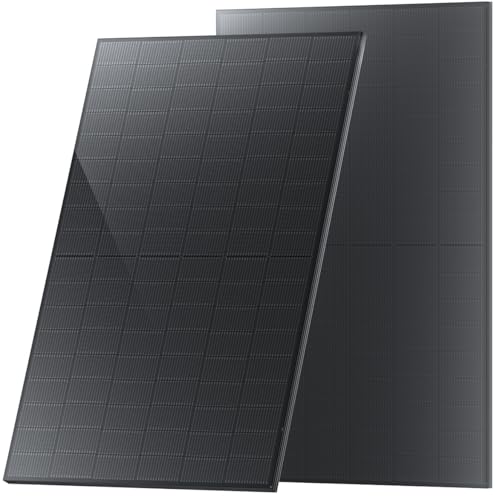
STAR’s full-screen, frameless design reduces dust and water buildup, supporting maintenance-free operation. The 870W duo provides substantial power for larger rooftop systems, RVs, or off-grid homes. With 25% high-efficiency cells and robust certifications (ETL, ISO 9001, CE), these panels deliver dependable performance in various weather conditions, while the frame-free look simplifies installation and cleaning.
Buying Guide
Key considerations when selecting rooftop solar panels include panel wattage and system size, efficiency and cell technology, shading tolerance, mounting compatibility, durability, and warranty. For tight roof spaces or high-power needs, high-wattage bifacial panels can reduce the number of modules required and improve output in sunny climates. N-Type cells generally offer better performance at higher temperatures and longer lifespans, though they can come at a premium price. Shading-prone rooftops benefit most from anti-shading or dual-module designs that isolate shaded sections from generating the rest of the array. Durability features, such as IP ratings and robust frames, are crucial for marine or RV applications. Finally, compatibility with charge controllers and inverters, as well as the supplier’s warranty terms, influence long-term reliability and total cost of ownership.
Installation considerations vary by use case. Residential rooftops typically require standardized mounting rails and tilt angles to maximize sun exposure. RVs and boats benefit from lighter, modular panels with simple pre-drilled mounting holes and compact footprints. Off-grid setups might prioritize higher wattage per footprint and reduced wiring complexity. Users should assess local shading patterns, roof orientation, and daily sun hours to estimate energy production accurately. When possible, consult with a licensed installer to ensure optimal placement, electrical codes compliance, and safety.
In sum, the best rooftop solar panels balance efficiency, durability, and installation practicality for the intended environment. The five options highlighted here—Callsun, Renogy, JJN, HQST, and STAR—offer a mix of bifacial and N-Type technologies, with features designed to maximize power capture across varied rooftop scenarios.