Best Metal Cutting Blades for Quick, Clean Results
When choosing metal cutting blades, you want tools that deliver fast cuts, long life, and reliable performance across metal types—from soft steel to hardened alloys. This guide highlights top metal cutting blades suited for different saws and applications, backed by listed features that influence durability and cutting speed. Use this overview to compare options for demolition, fabrication, or DIY metal work, and follow the buying guide to select the right blade for your project.
| Product | Brand | Key Benefit |
|---|---|---|
| DEWALT 14″ Chop Saw Blade, Metal Cut-Off Wheel | DEWALT | Long life with aggressive cutting action |
| DEWALT Reciprocating Saw Blades, Straight Back | DEWALT | Bi-metal durability and versatility |
| EZARC Carbide Reciprocating Saw Blade R678HM | EZARC | Carbide life for tough metals |
| Diablo Steel Demon Cermet II D0748CF | Diablo | Enhanced wear and cooler cuts |
| Diablo Steel Demon Cermet II D1472CF | Diablo | Triple chip action for metal |
Note: This selection focuses on blades designed for metal cutting with features aimed at longevity, heat resistance, and faster performance across common power tools. Prices are not included in this guide to keep the focus on performance and suitability for various metal cutting tasks.
DEWALT 14″ Chop Saw Blade, Metal Cut-Off Wheel

The DEWALT 14″ Chop Saw Blade uses a high performance aluminum oxide grain designed for long life and fast cutting. Its high grain concentration supports aggressive cutting action with smoother wheel operation, while a proprietary material mix promotes durable, long-life performance. This blade is well-suited for cutting through soft metals and structural metal work where quick cycle times matter.
DEWALT Reciprocating Saw Blades, Straight Back

This DEWALT set features bi-metal blades designed for flexibility and a long-lasting cutting edge. Made in the U.S. with global materials, the hardened teeth provide durability for demanding metal cutting tasks. The straight-back design presents a reliable choice for cutting through metal sheets, pipes, and other profiles where a steady performance is required.
TOLESA Heavy Metal Cutting Reciprocating Blades

TOLESA’s 9-inch, 14TPI bi-metal blades are tailored for metal cutting tasks such as pipe, rebar, and profiles. The blades feature a sturdy cobalt edge for effortless cutting through sheet metal and metal pipes. With a thin-wall design and set teeth, they minimize heat buildup and improve cutting efficiency for heavy metal work, delivering faster cuts in thick metals compared with standard bi-metal blades.
EZARC Carbide Reciprocating Blade R678HM
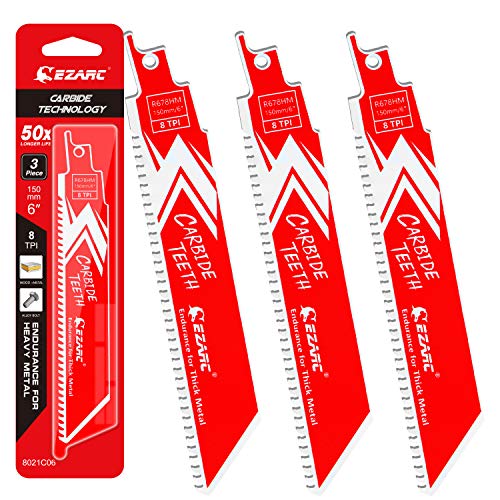
EZARC’s R678HM ends the compromises between speed and blade life by using carbide technology. This blade is designed for thick metals and tough alloys, offering up to 50 times longer life than bi-metal options and eight teeth per inch for steady performance. It excels in high-stress metal cutting applications where standard blades wear quickly.
Diablo Steel Demon Cermet II D1472CF

Diablo’s D1472CF uses Cermet II teeth for longer life and superior wear resistance, with high heat tolerance. The blade design improves cutting speed and overall productivity, delivering cooler, faster cuts compared with conventional grinding discs. It’s particularly effective for mixed metal cutting, including higher alloy steels and stainless steels.
Diablo Steel Demon Cermet II D0748CF

Diablo’s D0748CF features Cermet II teeth and a Perma-Shield coating for increased durability. The triple-chip grind produces precise, burr-free cuts with fewer sparks, and the design supports faster metal cutting with reduced risk of heat-related damage. It’s suited for mid-range metal cutting tasks where clean edges and reliability matter.
Buying Guide: Key Purchase Considerations
- Material compatibility: Choose blades designed for the specific metals you cut—steel, stainless steel, cast iron, or alloys. Carbide and Cermet II teeth offer longer life in tougher metals, while standard high-speed blades may suffice for softer metals.
- Tooth design and count: Higher tooth counts generally yield smoother cuts but slower speeds, while lower counts cut faster but with rougher edges. For metal, performance often comes from specialized tooth geometry (e.g., triple chip, alternate-tooth patterns).
- Blade coating and heat management: Coatings like Perma-Shield reduce friction and heat buildup, extending blade life and reducing edge damage during aggressive cuts.
- Durability and construction: Bi-metal blades offer flexibility and durability for demolition and rough cuts. Carbide-tipped and Cermet blades are preferred for prolonged life in hard metals but usually cost more.
- Tool compatibility: Ensure the blade fits your saw—diameter, arbor size, and mounting type matter. Some blades are designed for specific saws (chop saws, recipro blades, oscillating tools) and require compatible arbors or adapters.
- Cutting speed vs. edge quality: For fabrication and finish work, you may prioritize a blade that delivers cleaner edges even if it cuts slightly slower. For demolition, prioritize speed and durability to reduce blade changes.
- Cost of ownership: Longer blade life translates to fewer replacements and lower long-term costs, especially in high-volume or professional environments. Balance blade price against expected usage.
- Safety considerations: Use blades with appropriate coatings and ensure proper cooler operation to avoid overheating. Always follow tool manufacturer guidelines for safe operation and replacement intervals.
In summary, selecting the right metal cutting blade depends on the metal type, the cutting tool, and the desired balance between speed, edge quality, and blade life. The blades listed here provide a range of options—from economical choices for general metal cutting to high-performance carbide and cermet blades for tougher metals and longer life. Use the buying guide to align blade choice with your project demands and tool compatibility.