Best Spray Foam and Insulation for Basement Walls to Boost Comfort
Basement walls often face drafts, moisture, and temperature swings. The right spray foam and insulation kit can seal gaps, reduce energy waste, and improve sound control. This guide highlights five top Amazon products designed to retrofit basement walls, focusing on reliability, coverage, and safety. Each option targets different project scales—from small walls to larger basement cavities—so you can compare by coverage, application thickness, and included safety gear.
Summary table of chosen products (no links):
| Product | Brand | Approx. Coverage | Notes |
|---|---|---|---|
| BEEST FullStop Spray Foam Kit 240 Board Ft | BEEST | 240 sq ft | Large kit with gun, cleaner, safety gear |
| BEEST FullStop Spray Foam Kit 120 Board Ft | BEEST | 120 sq ft | Mid-size option with essential tools |
| Bigrizy Guard Spray Foam Kit 32.8 oz | BIGRIZY GUARD | ~20 board ft | Compact can with professional gun and cleaner |
| Bigrizy Guard Complete DIY Kit 240 Board Feet | BIGRIZY GUARD | 240 board ft | Includes 12 cans, gun, cleaner |
| Sprayman Spray Foam Kit 240 Sq Ft | SPRAYMAN | 240 sq ft | Includes gun and cleaner; Fire rated |
BEEST FullStop 240 Board Ft Kit

The BEEST FullStop 240 board foot spray foam kit targets walls and ceilings with a robust thermal barrier. It achieves an R-Value around 8.14 at a 2-inch thickness, making it suitable for basement walls that face humidity or temperature swings. The kit includes 12 spray foam cans, a heavy-duty spray gun, a solvent-based cleaner, gloves, goggles, and a coverall—covering both safety and convenience for DIY projects. Its recommended application temperature of 68–77°F supports consistent expansion and gap sealing, helping to create a continuous insulating layer across irregular basement surfaces.
Features support reliable performance: high coverage, a one-component formula, and a focus on sound reduction as well as thermal resistance. For basements needing a solid air seal around wiring penetrations or rim joints, this kit provides a straightforward solution with a reputable R-value target. Use during mild-to-warm days or when you can maintain stable indoor temperatures to maximize foam expansion and adhesion.
BEEST FullStop 120 Board Ft Kit

This mid-size BEEST kit delivers the same core benefits as the larger version, with an R-Value near 8.14 at a 2-inch thickness. Ideal for smaller basement sections or zone-specific insulation, its six cans and included tools provide a compact, user-friendly option for DIY installers. The system is designed to seal gaps and cracks in walls, ceilings, and uneven surfaces, helping to curb drafts and reduce disruptive sound transmission in multi-room basements.
The included Pro X gun, cleaner, and safety gear support safer, cleaner applications, while the 68–77°F operating window helps ensure consistent foam expansion. This makes it a practical choice for finished or partially finished basements where managing climate during installation is feasible.
Bigrizy Guard 32.8 oz Can Kit
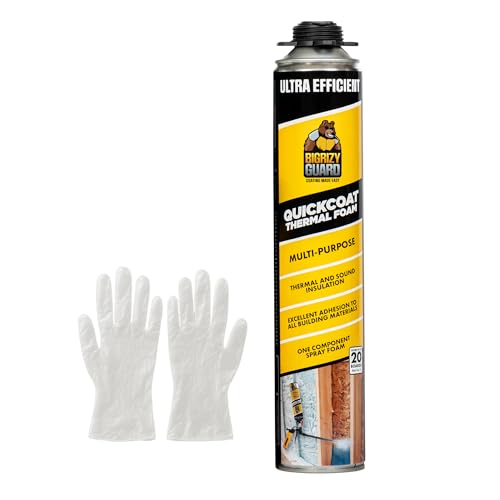
The Bigrizy Guard 32.8 oz can provides a compact option for targeted basement sealing. It offers a high R-value estimate around 8.24 for a 2-inch layer and is designed to seal holes, gaps, and cracks across walls, ceilings, and other hard-to-reach areas. The kit is positioned as a reliable alternative to traditional insulation methods, delivering a monolithic barrier that resists sagging and maintains performance over time. It’s well-suited for tight spaces or spot repairs in basement corners, around pipes, or near foundation walls.
Note that this single-can approach may be best for smaller projects or for topping up existing insulation, rather than full-wall retrofits. When used with a compatible gun and cleaner, homeowners can achieve precise, controlled expansion in tricky basement nooks without compromising safety or finish quality.
Bigrizy Guard 240 Board Feet Kit

This complete kit expands up to 240 board feet, offering 12 cans with a professional PTFE-coated spray gun and a large solvent-based cleaner. Coverage is suitable for larger basement walls or multiple rooms, delivering a consistent, airtight seal that helps reduce drafts and moisture intrusion. The kit emphasizes a crack-and-gap filling formula, designed to expand evenly and resist moisture, key factors for basement environments.
With the included safety gear and a nozzle setup designed for vertical spraying, this option supports both new installations and retrofit projects. The resulting monolithic layer assists in maintaining indoor humidity levels and thermal stability, particularly useful in basements that serve as living spaces or storage areas.
Sprayman 240 Sq Ft Foam Kit

The Sprayman kit targets both thermal and acoustic protection for walls and attics. It delivers a 240 sq ft coverage profile with a closed-cell polyurethane foam designed to meet Class-A fire rating requirements. The kit includes a gun and cleaner, enabling straightforward application for basement walls facing heat transfer or moisture concerns. The two-nozzle system supports vertical and ceiling spraying, helping to form a consistent seal across irregular surfaces.
Its energy-saving claim aligns with insulation performance goals, and the foam’s adhesive properties simplify bonding to various substrates common in basements, including concrete and masonry. For homeowners seeking a balanced approach to insulation and fire safety, Sprayman offers a reliable solution with a clear installation workflow.
Buying Guide
When choosing a spray foam or insulation kit for basement walls, consider the following factors to match your project needs without overpaying:
- Coverage and scale: Basements vary in size. Choose a kit that matches wall area and desired thickness. Larger kits reduce the need for multiple purchases but require more careful handling and safety planning.
- R-value and performance: Look for products with R-values around 8 per 2-inch layer for good overall performance in cool climates. Pay attention to the recommended application thickness and temperature range to achieve the stated R-value.
- Material and foam type: Closed-cell foams offer higher R-values and moisture resistance, while open-cell foams provide bulk insulation with sound advantages. Basements with moisture concerns often benefit from closed-cell formulations.
- Application equipment: A reliable spray gun and compatible cleaner simplify cleanup and ensure consistent foam distribution. Safety gear—gloves, goggles, and a coverall—helps protect installers during messy applications.
- Ventilation and climate control: Maintain the recommended ambient temperature during installation to avoid poor expansion or gaps. In some basements, temporary climate control may be needed.
- Moisture considerations: If your basement has active moisture or water intrusion, use a primer or moisture-control barrier before or after insulation as recommended by the manufacturer.
- Fire safety and codes: Check local building codes for insulation materials and fire ratings. Some products are explicitly rated for Class-A fire performance, which can be important for living spaces in basements.
- Long-term maintenance: Consider re-entry times, cure times, and any required reapplication intervals. Some kits include cleaners or protective gear that reduces ongoing maintenance costs.
- DIY vs. contractor: DIY kits are cost-effective for smaller projects, but larger basement retrofits may benefit from professional installation to ensure uniform coverage and compliance with local codes.
Comparative quick tips
- For large basement walls with tight budgets, a multi-can kit with a precision gun offers the best balance of cost and coverage.
- If moisture control is paramount, prioritize closed-cell formulations with proven moisture resistance and higher R-values per inch.
- For smaller projects or targeted gaps, single-can options provide flexibility without excessive waste.