Best R19 Insulation Options for Crawl Space and Basement Areas
Are you insulating a crawl space with R-19 insulation or seeking alternatives for moisture-prone areas? This guide highlights five practical options that cover unfaced fiberglass, moisture barriers, and reflective foil strategies. Each product is chosen for suitability in crawl spaces, basements, or crawlspace encapsulation projects. The buyer is guided toward choices based on moisture control needs, ease of installation, and long-term performance in tight, damp environments.
The quick comparison table below summarizes key points for the top picks. It helps you decide which is best for your situation—whether you need unfaced fiberglass for deeper wall cavities, a heavy-duty vapor barrier for moisture control, or a reflective foil system to reduce radiant heat transfer.
| Product | |||
|---|---|---|---|
| Owens Corning R-19 Unfaced Fiberglass Insulation | Unfaced Fiberglass | Crawl spaces with separate moisture control needs | No built-in vapor barrier |
| TWCUSEP Crawl Space Encapsulation Moisture Barrier | Moisture Barrier / Vapor Barrier | Full encapsulation and radon protection | Very large roll may be overkill for small spaces |
| Basement CRAWLSPACE Poly-AIR 6MM Foil Insulation | Reflective Foil Insulation | Reflective radiant barrier and vapor barrier in one | May require careful detailing at seams |
| 2000SF Crawlspace Encapsulation Underlayment | Vapor Barrier / Underlayment | Non-toxic, waterproof encapsulation base | Not a typical insulation R-value product |
| SmartSHIELD Reflective Insulation Rolls | Reflective Foam Core Insulation | Radiant barrier and vapor control in one | Thin foam core may have temperature limits in extreme climates |
Owens Corning R-19 Unfaced Fiberglass Insulation

Best for: Homeowners who want a straightforward insulation solution in crawl spaces where moisture is managed separately. This product provides 6.5 inches of thickness for deeper wall cavities and comes in a single bag covering 77.5 square feet (8 batts at 9.69 sq ft per batt).
Why selected: Unfaced design minimizes bulk and allows installation in spaces where a separate vapor barrier is already planned or installed. The 6.5-inch depth supports deeper framing while maintaining installation flexibility.
Limitations: It lacks an integrated vapor barrier, so you must ensure an appropriate moisture-control strategy elsewhere. Use with a dedicated vapor barrier or encapsulation system as needed.
TWCUSEP Crawl Space Encapsulation Moisture Barrier

Best for: Projects prioritizing moisture control and radon protection, especially in crawl spaces that require robust vapor barriers. This roll is designed for large-scale encapsulation use.
Why selected: A heavy-duty 14-mil thick vapor barrier delivers strong tear resistance and a durable moisture seal, suitable for sealing crawl spaces where humidity and radon mitigation are concerns.
Limitations: Its very large size (12 feet by 700 feet) can complicate handling in smaller spaces. Small projects may not require this scale.
Basement CRAWLSPACE Poly-AIR 6MM Foil Insulation

Best for: Encapsulation projects that benefit from a high-reflectivity radiant barrier and a built-in vapor barrier. Suitable where HVAC efficiency is a goal.
Why selected: The product claims 96% reflectivity and 0.04% emissivity, with 100% vapor barrier performance. This combination can cut radiant heat gain and reduce condensation risks in crawl spaces.
Limitations: Some installations may require additional fastening or sealing at seams to maintain barrier integrity in irregular spaces.
2000SF Crawlspace Encapsulation Underlayment

Best for: Environments requiring a non-toxic, waterproof base layer that supports encapsulation in crawl spaces with moisture concerns.
Why selected: Emphasizes non-toxic and waterproof attributes, making it a practical base layer for encapsulation projects where safety and moisture resistance are priorities.
Limitations: Not a traditional insulation with a high R-value, so it should be used in conjunction with other insulating or sealing materials when thermal performance is a priority.
SmartSHIELD -3mm Reflective Insulation Roll
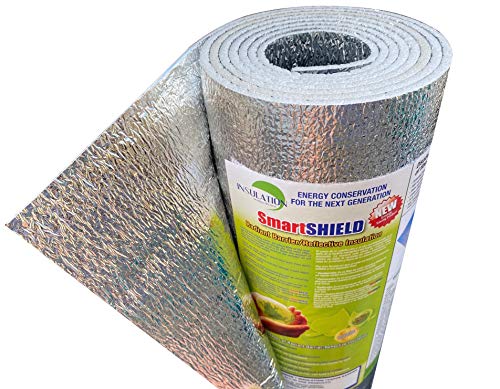
Best for: Projects needing a compact radiant barrier with a strong reflective surface and an effective vapor barrier, suitable for multi-layer applications in crawl spaces.
Why selected: Claims to reflect 95% of radiant energy, providing a strong barrier against heat transfer. The 3mm foam core adds structure while keeping weight manageable.
Limitations: A thinner core may offer less physical protection in rugged crawl spaces; ensure proper installation at seams and edges to maximize performance.
SmartSHIELD -5mm 16” X 50ft Reflective Insulation

Best for: Crawl spaces needing a robust radiant barrier combined with vapor control, while maintaining a cleaner white appearance.
Why selected: R17 performance with a reflective barrier, offering a balance between radiant heat reduction and moisture control. The white finish adds a neat look and can reduce visual clutter in certain installations.
Limitations: The 5mm foam core may limit physical protection in very irregular spaces; plan for tight fitting around obstacles and joints.
Buying Guide: Key Considerations For R19 Crawl Space Insulation
What matters most when selecting insulation for a crawl space? Consider moisture control, thermal resistance, ease of installation, and the shape of your space. If you need a simple unfaced option, an unfaced fiberglass product can fit deeper wall cavities when paired with a separate vapor barrier. For full encapsulation, a dedicated moisture barrier is essential. Reflective foil products help reduce radiant heat transfer but should be installed with proper seams and venting in mind.
- Moisture Management: Do you need a dedicated vapor barrier, or will an integrated system suffice?
- R-Value and Thickness: Is the thickness adequate for your wall framing or crawl space height?
- Installation Terrain: Are you working in tight spaces, or do you have a large area to cover?
- Durability: Will the material withstand damp conditions without tearing or sagging?
- Compatibility: Does your existing encapsulation system align with the product’s barrier properties?
Choosing By Scenario
- New crawl space construction: A combination of moisture barrier and insulation with proper vapor control yields best long-term performance.
- Retrofit with existing moisture control: Use unfaced insulation where you can install a separate vapor barrier over existing encapsulation.
- High humidity climates: Focus on vapor barriers and reflective radiant barriers to reduce heat transfer and condensation risk.
Installation Tips
- Cut to fit snugly around joists and obstructions; leave slight compression where necessary to seal gaps.
- Seal all seams with compatible tape or edging to prevent moisture intrusion.
- Follow local building codes for crawl space encapsulation and ventilation requirements.
FAQ
What does R-19 imply for crawl space insulation?
R-19 indicates a thermal resistance level. In crawl spaces, it’s often used in wall cavities or where additional depth is needed, typically in conjunction with a moisture barrier.
Is unfaced fiberglass suitable for crawl spaces?
Yes, but it should be paired with a separate moisture barrier or encapsulation system to control humidity and condensation.
Do reflective foil insulations reduce cooling costs?
Reflective foils reduce radiant heat transfer, which can lower cooling load, especially in exposed, unconditioned spaces.
When should I choose a complete vapor barrier?
When a crawl space requires robust moisture control and potential radon mitigation, a complete vapor barrier or encapsulation system is advisable.
Are large rolls practical for small crawl spaces?
Large rolls can be difficult to handle in small or irregular spaces. Choose products in sizes that fit your project dimensions to minimize waste.