Best Fasteners for Cement Board: Top Options for Installers
Answering your search for reliable cement board fasteners, these picks cover common installation needs for tile backer, shower surrounds, and floor projects. They cater to both wood and metal framing, with corrosion resistance and self-piercing tips. Best for professional contractors who want efficiency, best for DIYers aiming for long-lasting holds, and best for projects with moisture exposure.
Summary of selected products:
| Product | Type | Size | Best For |
|---|---|---|---|
| VCTGAM 1-5/8 Inch Hi-Lo Fasteners | Hi-Lo backer screws | 1-5/8 inch | Wood or metal stud cement board installs |
| Hard-To-Find Fastener 8 x 1-1/4 Self-Piercing | Cement board screws | 8 x 1-1/4 inch | Moisture-prone areas, quick pilot-hole-free drives |
| Hard-To-Find Fastener 8 x 1-5/8 Self-Piercing | Cement board screws | 8 x 1-5/8 inch | Heavy-duty backer board to studs |
| Rock-On 23321#9 2-1/4″ | Serrated head cement board screw | 2-1/4 inch | Flush seating in tile/backer installs |
| Jake Sales 10×1-1/4 Sharp Point | Torx/Star cement board screw | 1-1/4 inch | Drill-point for metal studs, varied backer boards |
VCTGAM 1-5/8 Inch Hi-Lo Fasteners
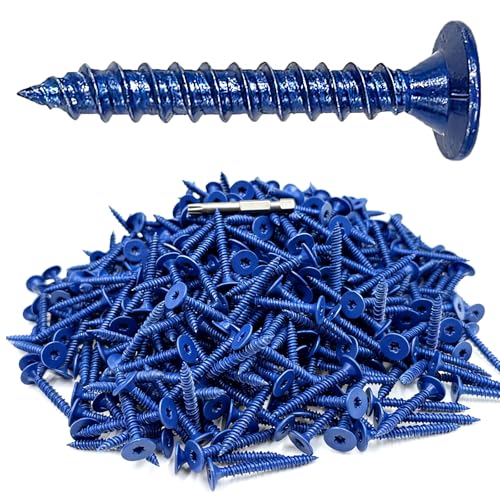
Best for: Projects using wood or metal studs where tile backer boards attach to walls, ceilings, and floors. The 1-5/8″ length provides reliable bite in typical 1/4″ to 1″ backer boards, and the Hi-Lo design helps reduce splitting in soft or knotty wood. Choose this if you need a large, contractor-grade pack for bigger tile jobs.
Why selected: This product balances an adaptable length with board compatibility and a generous 550-piece pack, supporting efficient spacing up to 8″ on center. Aimed at bathroom remodels and light commercial installs, it helps maintain stable installations with fewer fasteners.
Caution: Verify substrate compatibility; excessive driving depth can occur if set too aggressively on very hard subfloors or misaligned studs.
Hard-To-Find Fastener 8 x 1-1/4 Self-Piercing

Best for: DIYers and professionals needing fast, pre-pilot-free installation in cement board projects. The 8 x 1-1/4 size is common for attaching 1/2″ to 1/4″ backer boards to wood studs where moisture resistance matters.
Why selected: The durable steel construction and ceramic coating deliver corrosion resistance in wet environments, enhancing long-term performance in showers and kitchens.
Caution: Ensure correct orientation with the self-piercing tip to avoid underdriving or overdriving, which can affect board seating.
Hard-To-Find Fastener 8 x 1-5/8 Self-Piercing

Best for: Heavier backer boards and projects demanding a longer screw for secure anchorage into studs. The 1-5/8″ length is a common choice when thicker boards or deeper studs are used.
Why selected: Its corrosion resistance and self-piercing design support faster installs with consistent seating, ideal for tile and cement board installations in damp areas.
Caution: Avoid using excessive force in soft framing members to prevent bending or cam-out of the star/torx drive.
Rock-On 23321#9 2-1/4″ Cement Board Screws

Best for: Projects requiring a longer fastener for thicker backer boards or deeper studs, with a serrated head for flush seating and easy driving.
Why selected: Serrated hi-low thread and a sharp point support immediate pick-up and reduce slippage during installation, making it a solid choice for challenging substrates.
Caution: The longer length requires careful pre-planning to avoid penetrating through the other side of dense studs or subsurfaces.
Jake Sales 10×1-1/4 Sharp Point

Best for: Drilling-point screws designed for cement board fastening to metal studs and various backer boards. The Torx/Star drive reduces cam-out and supports steady, precise drives.
Why selected: These screws combine heat-treated steel with ceramic coating for corrosion resistance, supporting long-term performance in tile or shower installs.
Caution: Confirm compatibility with your stud material; some metal studs may require specific drill-point alignment to avoid misalignment during installation.
Buying Guide
What to consider when choosing cement board fasteners
- Board thickness and stud type: Match screw length to the combined thickness of board and stud. Longer screws provide more bite for thicker backer boards, especially on metal studs.
- Material and coating: Ceramic coatings resist corrosion in moisture-prone areas. Steel screws offer strong holding power in dry or damp environments.
- Head design and drive: Serrated heads, Hi-Lo threads, and star/torx drives improve seating and reduce cam-out during driving.
- Installation speed: Self-piercing points eliminate pre-drilling, saving time on larger tile projects.
- Quantity and packaging: For larger remodels, choose contractor packs to minimize reordering interruptions.
Common scenarios and recommendations
- Shower remodels with cement board: Prefer corrosion-resistant, self-piercing screws in lengths 1-1/4″ to 1-5/8″ depending on board thickness.
- Wood stud walls: Hi-Lo or standard cement board screws in the 1-5/8″ to 2″ range provide secure anchorage with minimal splitting risk.
- Metal studs: Look for drill-point or self-piercing screws with compatible Torx/Star drive for steady seating and reduced cam-out.
Frequently asked questions
- Q: Do I need self-piercing screws for cement board installations?
A: Self-piercing screws save time by creating their own pilot hole, which speeds up installation and reduces pre-drilling work. - Q: What screw length should I use for standard backer boards?
A: Common lengths range from 1-1/4″ to 1-5/8″ for typical 1/4″ to 1/2″ backer boards on wood studs; longer lengths may be needed for thicker boards or metal studs. - Q: Are ceramic coatings necessary?
A: Ceramic coatings increase corrosion resistance in moisture-prone environments, extending screw life in showers and bathrooms. - Q: Which drive type is best for beginners?
A: Torx/Star drives reduce cam-out and are easier to control, especially on harder substrates. - Q: How many screws do I need for a tile-backered wall?
A: It depends on board size and spacing, but common practice is about 8 inches on center for studs, with more around edges and corners for stability. - Q: Can I mix different brands?
A: Mixing is generally acceptable if screw lengths and thread types are appropriate for the board and stud, but consistency simplifies installation and performance).