Best Up Pump for Basement Bathroom: Top Macerator Picks for Safe Basement Waste Removal
Answering the common buyer intent: when upgrading a basement bathroom, a reliable upflush or macerator pump is essential for moving wastewater to your main sewer line without extensive remodeling. The right pump works for toilets, sinks, showers, and occasionally laundry, depending on capability. The selections below are chosen for different needs—compact spaces, higher lift, multiple inlets, and quieter operation—so you can pick the best fit for your basement layout and fixture count.
| Product | Best For | Key Benefit |
|---|---|---|
| Ensurix 1200W Macerator Pump | Basement bathroom with multiple fixtures | High lift, smart PCB control |
| Sink Sewage Pump 300W Under-Basin | Under-basin basements and tight spaces | Compact footprint, versatile inlets |
| 750pro Macerator Pump | Mid-to-large basement setups | High flow, two outlets |
| VEVOR 700W Macerator Pump | Basement with several fixtures | Three inlets, strong head |
| VEVOR 500W Utility Sink Pump | Small basements, single toilet or sink | Good power in compact package |
Ensurix 1200W Macerator Pump – 2800GPH
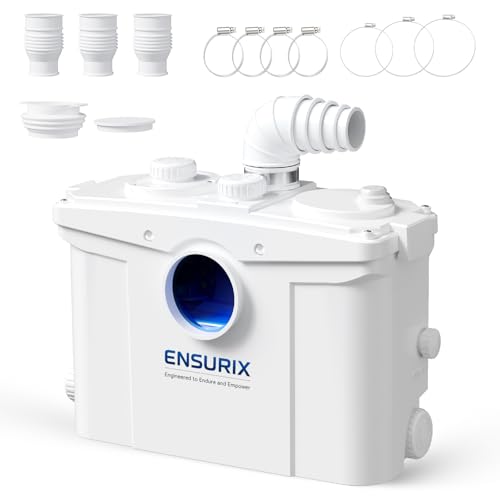
The Ensurix macerator combines powerful pumping with smart control. It uses a 1.6HP motor to lift waste 28 feet vertically and up to 280 feet horizontally, delivering up to 2800 GPH. This makes it suitable for basements where the vertical rise to the main line is substantial. It is ideal for buyers who plan to install a full bathroom—toilet, sink, and perhaps a shower—in a basement with limited floor access for plumbing runs.
- Best for homes needing strong vertical lift and rapid drainage.
- Better for multiple fixtures thanks to multiple inlet options.
- Limitations: higher power draw and larger footprint; may require professional installation in some layouts.
Sink Sewage Pump 300W Under-Basin

This compact under-basin pump is designed for tight spaces. It does not include a macerator, and it is best used where waste disposal is mostly water with small solids. It features two built-in universal inlets and can connect to a variety of fixtures, including a basement sink, tub, shower, or laundry. It is suited for projects where flexibility and simple maintenance are priorities, and where the installation area is shallow or narrow.
- Best for tight basements or under-basin installs with limited vertical space.
- Better for setups without heavy solids; avoid with large debris or bulky waste.
- Limitation: no maceration capability; avoid if you need to grind solids aggressively.
750pro Macerator Pump

The 750pro from HOCANFLO emphasizes high efficiency and quiet operation with a 750W copper-wired motor. It delivers a high flow rate and is designed for mid-to-large basement setups where more fixtures contribute to wastewater volume. The pump offers easy maintenance via two top access panels for potential blockages or motor service. It is best for households seeking reliable performance with reduced noise.
- Best for mid-to-large basements needing steady performance.
- Better for installations requiring simple access for maintenance.
- Limitation: single unit with focused design on moderate-to-high usage; consider multi-fixture needs.
VEVOR 700W Macerator Pump

The VEVOR 700W model pairs a copper motor with a robust head and multiple inlets. With a 32.8 ft lift and 9600 L/h flow, it supports basement installations that require moving wastewater across longer distances. Its three water inlets enable connecting a toilet, sink, and shower simultaneously, making it well-suited for compact basements with several fixtures.
- Best for multi-fixture basements needing flexible inlet configurations.
- Better for longer discharge runs and higher head requirements.
- Limitation: 4-inlet design might require thoughtful pipe routing to avoid clashes.
VEVOR 500W Utility Sink Pump

This 500W unit is a compact option for small basements or limited spaces. It provides 29 GPM flow and 26 ft head, with four inlets to accommodate a toilet, sink, shower, and more. The IPX-rated copper motor helps resist wear, and the unit is designed for straightforward maintenance and installation in tight rooms.
- Best for small basements with one or two fixtures.
- Better for compact layouts where space matters.
- Limitation: lower lift and flow compared to higher-powered models; plan around vertical reach requirements.
Buying Guide: Key Considerations For Basement Up Pumps
- What lift do I need? Measure the vertical distance to the main sewer line. Higher lifts require more powerful units and may demand professional installation.
- How many fixtures will connect? If you plan to run a toilet, sink, and shower simultaneously, look for multi-inlet options and higher flow rates.
- Do I need maceration? For solid waste, select a macerator with grinding or shredding capabilities. For mostly gray water, a non-macerator pump with adequate head may suffice.
- Space and access: In tight basements, compact models with easy top access for maintenance are preferable.
- Power and durability: Copper-wired motors tend to run cooler and last longer; consider models with smart control to minimize cycling and noise.
- Installation considerations: Some units require venting or dedicated discharge piping. Ensure compatibility with existing fixtures and electrical supply.
Frequently Asked Questions
- What is a basement uppump or macerator pump best for? It is ideal for moving wastewater from a basement bathroom to a main sewer line when direct gravity drainage isn’t possible.
- Do I need a macerator with grinding capability? If you anticipate solid waste or fibrous materials, a macerating unit helps prevent clogs by shredding solids.
- How many fixtures should a unit support? Choose a pump with enough inlets and a high enough flow rate to handle the planned fixtures without frequent cycling.
- Can I install these myself? Some installations can be DIY, but basements often require plumbing and electrical work. Consult a professional if unsure.
- Will these pumps handle hot water? Some models are rated for heat exposure; check the motor’s thermal tolerance and ensure it aligns with your system’s temperatures.
- What maintenance is typical? Periodic inspection for clogs, cleaning of impellers, and ensuring electrical connections remain secure are standard tasks.