Best Roofing Materials for Curved Roofs: Reinforcement, Underlayment and Flashing
Curved roofs demand materials that flex, seal, and reinforce without cracking. The following selections target reinforcement for curved surfaces, durable underlayments, and reliable flashing solutions to help protect and extend the life of curved roof installations. This guide covers five products commonly used in curved-roof projects, outlining core features and practical applications for each.
| Product | Brand | Primary Use |
|---|---|---|
| Ames Contouring Roof Fabric | AMES | Reinforcement and sealing for roof coatings |
| DuPont Roof Protector Underlayment | DuPont | Primary moisture barrier and deck protection |
| Gueevin Self Stick Roll Roofing | Gueevin | Waterproof underlayment with reflective surface |
| Sasylvia Self Stick Roll Roofing | Sasylvia | Adhesive underlayment for decks and dormers |
| DEKS Self-Adhesive Flash Flashing | DEKS | Leak-preventing flashing for varied roofing materials |
Note: The table above focuses on key traits relevant to curved-roof installations. Product specifics such as dimensions and installation steps should be verified on the manufacturer page before purchase.
Ames Contouring Roof Fabric: Reinforcement for Curved Surfaces

Ames Contouring Roof Fabric is a reinforced polyester mesh designed to strengthen coating systems on roofs, including curved surfaces. It is described as waterproof when embedded in acrylic or elastomeric coatings and can be cut to different widths for specialized jobs. The fabric aims to reduce puncture, tear, and movement in coatings, thus helping extend the life of low-slope or curved roof assemblies and aiding in leveling ponding areas. Its versatility makes it suitable for applications over tar, plywood, metal, and concrete where coating systems require reinforcement.
DuPont Roof Protector Underlayment: Secondary Moisture Barrier
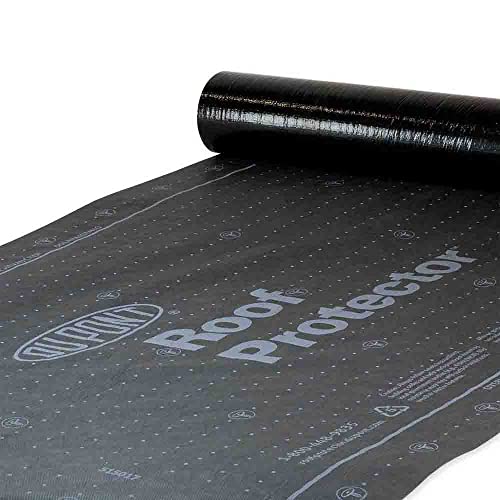
DuPont Roof Protector Underlayment offers a four-layer construction designed to provide primary protection to the roof deck and act as a secondary moisture barrier during installation. The top layer provides grip, while the lamination and scrim layers offer strength and water resistance. This underlayment is positioned as an upgrade over traditional felt, with enhanced durability and tear resistance—beneficial for curved geometries where movement and thermal expansion can stress materials.
Gueevin Self Stick Roll Roofing with Reflective Surface

Gueevin’s self-stick roll roofing features a 35.5-inch width and 32.8 feet length with a reflective aluminum surface. Made from butyl rubber, it claims solvent-free formulation with no shrinkage or toxic emissions. The product emphasizes strong adhesion, waterproofing, and elasticity to accommodate thermal expansion and contraction on curved or irregular roof profiles. It is suitable for metal and plastic roof panels, dormers, porches, and other curved surfaces where a flexible, self-adhesive layer is advantageous.
Sasylvia Self Stick Roll Roofing for Versatile Applications

Sasylvia offers a 6-inch wide, 33-foot long self-stick roll roofing with a 1.2 mm thickness, designed for dormers, porches, and various curved roof surfaces. The material is based on butyl rubber and emphasizes strong adhesion, waterproofing, and resilience against thermal movement. Its compact width makes it suitable for targeted repairs on curved edges or small sections, while still providing durable sealing for metal and plastic roofing surfaces.
DEKS Self-Adhesive Flashing for Various Roofs

DEKS Self-Adhesive Flashing is designed for versatility across different roofing materials, including tile, metal, polycarbonate, and fiberglass. The product highlights a trim-to-size capability and lead-free adhesive, making it suitable for curved transitions and detailing where flashing must seal irregular shapes and joints. It complements underlayment and reinforcement layers by providing a flexible, self-adhesive option for edge and patch work on curved roofs.
Buying Guide: Key Purchase Considerations for Curved Roofs
- Flexibility and conformability: Curved roofs demand materials that bend with the surface without cracking or tearing. Look for self-adhesive or fabric-reinforced options that tolerate movement and temperature changes.
- Primary vs. secondary moisture protection: Underlayment products (like a roof protector underlayment) provide deck protection, while reinforcement fabrics and flashing address coating integrity and leak prevention. A layered approach often yields the best results on curved geometries.
- Adhesion strength and solvent content: For self-stick products, adhesion quality and solvent-free formulations reduce odor, cure time, and potential substrate damage. Verify compatibility with your substrate (metal, concrete, wood, etc.).
- Thickness and coverage: Thicker materials can offer better puncture resistance and durability, but ensure they fit the curve and edge details. Check roll width and length to optimize waste and installation time on curved layouts.
- UV exposure and environmental resistance: Curved roofs may expose materials to sun and weather at varying angles. Reflective surfaces and UV-stable compositions can extend service life in outdoor conditions.
- Compatibility with coatings: Some reinforcement fabrics are designed to be embedded in acrylic or elastomeric coatings. Confirm coating compatibility to prevent delamination or poor adhesion on curved surfaces.
- Installation ease: When working on curved surfaces, lighter, easier-to-cut materials reduce labor time. Self-adhesive options offer simpler installation, especially on complex geometries.
- Durability under thermal cycling: Curved roofs often experience more thermal expansion and contraction. Materials with good elasticity and seal integrity help prevent gaps and leaks over time.
In selecting products for curved roofs, consider a balanced combination: a reinforced fabric to strengthen coatings, a durable underlayment to protect the deck, and flexible flashing to seal transitions. Each of the five highlighted products serves a distinct role in addressing the unique demands of curved roofing systems, from reinforcement to edge detailing.