Best Angle Finder Tools for Precision Projects
For craftsmen, builders, and DIY enthusiasts, an accurate angle finder is a Must-Have tool. This guide highlights top-rated digital angle finders and protractors that help you measure inner and outer angles, set miter saws, and transfer angles to lumber with confidence. The selections below emphasize accuracy, ease of use, durable construction, and practical features for carpentry, plumbing, and cabinetry tasks.
Summary of chosen products
| Product | Brand | Key Benefit | Special Feature |
|---|---|---|---|
| Klein Tools 935DAG Digital Electronic Level | KLEIN TOOLS | Versatile angle gauge with zero calibration | Auto-rotating high-visibility display; magnetic base |
| Klein Tools 935DAF Digital Angle Finder | KLEIN TOOLS | 3-in-1 angle finder for inside/outside angles | Precise miter saw protractor; +/- 0.2° |
| LEXIVON Aluminum Miter Saw Protractor | LEXIVON | Sturdy aluminum protractor with laser-etched scales | Internal O-ring for smooth operation |
| Saker Miter Saw Protractor | Saker | Lightweight, precise angle finder for carpentry | “O” body design for easy readings |
| TBVHOMM Digital Angle Finder Protractor | TBVHOMM | 2-in-1 ruler and protractor with large display | Includes batteries; wide measuring range |
Klein Tools 935DAG Digital Electronic Level and Angle Gauge

The Klein Tools 935DAG functions as a versatile digital angle gauge and level. It can measure angles from 0 to 90 degrees and 0 to 180 degrees, and it supports relative angle measurements with a zero calibration feature. This model doubles as a digital level, offering a straightforward way to confirm plumb or perfectly horizontal readings during cabinet installs, plumbing runs, and framing work. A high-visibility display remains legible in dim conditions, and the automatic rotation keeps readings oriented to the user, no matter how the tool is held. A strong magnetic base enables hands-free use on ferromagnetic surfaces like pipes, miter saw blades, and ducts, making it convenient for busy workshop setups.
Key features include a large, auto-rotating display for quick reading, a zero-calibration function to measure relative angles, and a magnetic base for secure alignment. For projects requiring both angle and level accuracy, this tool provides a compact, reliable option that minimizes time spent adjusting measurements. The combination of dual-range angles and magnetic mounting makes it a practical choice for electricians, plumbers, and carpenters working in tight spaces.
Klein Tools 935DAF Digital Angle Finder

The Klein Tools 935DAF is a precision 3-in-1 digital angle finder designed to handle inside and outside angles, as well as lengths and miter saw angles. Its design supports efficient calculations for exact saw blade angles and tight joints, helping ensure clean miters in cabinetry and trim work. The device also features machined ruler edges that contribute to reliable measurements with tight tolerances, making it a solid choice for professional carpenters who require repeatable results across multiple projects. The 0.2-degree precision supports careful alignment tasks in complex installations.
In practice, this model’s ability to measure both interior and exterior angles simplifies many workflow steps. The clearly marked scales and robust construction make it suitable for shop use as well as on-site adjustments. When you need to lock in precise miters before cutting, the 935DAF provides dependable readings and straightforward operation that reduces trial-and-error fits.
LEXIVON Aluminum Miter Saw Protractor
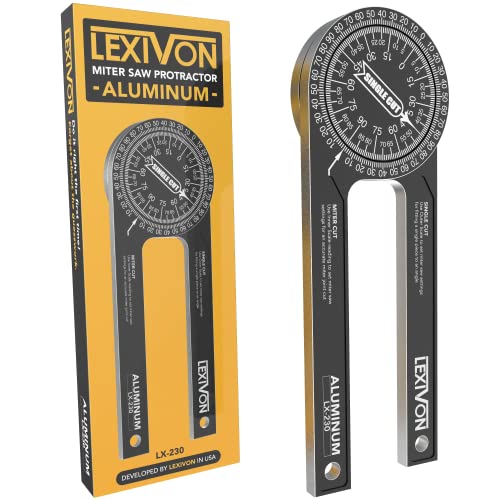
The LEXIVON LX-230 protractor is built from CNC-machined aluminum alloy for durability and precision. Its laser-engraved scales provide high-contrast, easy-to-read measurements, and the unit includes an internal Teflon O-ring mechanism that ensures smooth, precise reads on both inside and outside corners. The dual-scale setup lets users transfer their work angle directly to a miter saw, with improved accuracy for both single cuts and compound cuts. It’s a reliable option for cabinet makers, crown molding projects, and general carpentry where consistent repeatability matters.
Users benefit from the tool’s lightweight yet sturdy construction, which supports frequent transport to job sites. The smooth operation reduces grip fatigue during long measurement sessions, while the clear engravings minimize the risk of misread angles in busy work environments. The LX-230 is a solid addition to any shop’s angle-measurement kit, particularly for those prioritizing durability and clear measurement lines.
Saker Miter Saw Protractor

The Saker Miter Saw Protractor emphasizes accuracy and portability for carpentry and remodeling work. Its easy-to-read precision laser-engraved scales allow direct angle readings to the miter saw, simplifying crown molding, trim work, and a variety of carpentry tasks. The tool’s “O” body design supports smooth operation, while the aluminum alloy construction ensures resistance to corrosion and wear. At a compact size, it is easy to carry on job sites, enabling on-the-spot angle references without a bulky toolkit.
With lightweight yet durable materials, the Saker protractor is well-suited for professionals and hobbyists who demand quick measurements and dependable results in tight spaces. The combination of simple operation and precise readings makes it useful for both initial layout work and final adjustments before cutting or mounting. This model balances portability with accuracy, making it a sensible pick for a wide range of building tasks.
TBVHOMM Digital Angle Finder Protractor
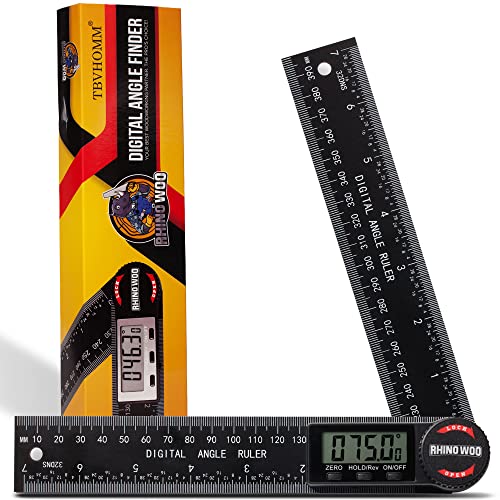
The TBVHOMM digital angle finder protractor combines a ruler and protractor into a versatile 7-inch/200mm tool. It features a large LCD display with a measuring range of 0 to 999.9 degrees and an accuracy of ±0.3 degrees, with a 0.1-degree resolution. The device ships with two batteries, ensuring immediate use after opening. This model is suitable for woodworking, cabinetry, construction, and drafting where an extended angle range is beneficial and where quick, clear readings support efficient progress on complex layouts.
Practical advantages include the two-in-one function, which reduces the number of tools needed on a job site. The large display improves readability in various lighting conditions, and the included spare battery helps prevent downtime. The TBVHOMM protractor is a pragmatic option for users who want a straightforward device that delivers dependable measurements across many common angles encountered in home improvement projects.
Buying Guide: What to consider when choosing an angle finder
- Angle range and accuracy: Look for devices offering full 0–360° capability with precise tolerances (±0.2° to ±0.3°) for fine carpentry and precise miters.
- Display readability: A high-contrast, backlit, or auto-rotating display improves visibility in dim or cluttered workspaces and ensures quick readings while you work.
- Measurement features: Some tools function as digital levels, protractors, or both. Decide whether you need straight edges, inner/outer readings, or miter-saw angle transfer capabilities.
- Build quality: Aluminum and steel constructions offer durability for rough job sites, while lightweight designs improve portability for frequent transport between locations.
- Magnets and mounting: Magnetic bases enable hands-free use on ferromagnetic surfaces, which can save time during installation tasks and alignment work.
- Power and battery life: Consider whether the device includes batteries, auto-shutoff features, and how easy it is to replace or recharge them during extended projects.
- Calibration and zeroing: Zero calibration and easy re-zeroing support relative angle measurements, which is valuable when aligning components across multiple parts.
- Compatibility and transfer: Some models offer direct angle transfer to saws or rulers, reducing guesswork when setting cuts and joints.
When comparing these tools, consider your typical project workload, the environments you work in (shop vs. field), and how often you need to switch between measuring angles and using a level. For beginners, a model with clear displays and straightforward operation can reduce learning time. For professionals, durability, precision, and reliable transfer of angles to equipment will drive value over the tool’s lifetime. Finally, assess whether you prefer compact, lightweight devices or more robust, feature-rich options that handle a wider range of tasks in one instrument.