Best Compact Circular Saw Corded for Precise DIY and Craft Projects
When selecting a compact corded circular saw, builders want balance: light enough to maneuver, yet powerful to tackle tough cuts. The following five corded models offer compact footprints, reliable motors, and bevel capabilities that suit small workshops and on-site tasks. This guide highlights each tool’s strengths, key features, and what to consider when choosing for wood, plastics, or light metals. Use the table below to compare essentials at a glance.
| Product | Brand | Bevel Range | Weight | Max Cutting Depth (90°) |
|---|---|---|---|---|
| DEWALT 7-1/4-Inch Circular Saw (DWE575) | DEWALT | 0°–53° | 8.8 lb | 2-1/4 in |
| Skil 5080-01 13-Amp 7-1/4″ Circular Saw | Skil | 0°–51° | Not specified | 2-1/4 in |
| Seesii Mini Circular Saw with Laser Guide | Seesii | 0°–45° | Not specified | 1-11/16 in |
| GALAX PRO 4Amp Circular Saw with Laser Guide | GALAX PRO | 0°–45° | Not specified | 1-11/16 in |
| G LAXIA Mini Circular Saw with Laser Guide | G LAXIA | 0°–45° | Not specified | 1-11/16 in |
Below are five corded compact saws that balance portability with cutting power. Each entry includes a direct link to the product page for quick comparison and notes on what makes it suitable for trim work, cabinetry, and small-project framing.
DEWALT 7-1/4-Inch Compact Corded Saw (DWE575)

The DEWALT DWE575 is among the lightest in its class at 8.8 pounds, aiding maneuverability for overhead or precise cut lines. Its 15-amp motor provides ample power for most hardwoods and framing tasks. With a bevel capacity of 53 degrees and stops at 45 and 22.5 degrees, this saw enables clean mitered cuts without a secondary tool. The compact design also helps reduce fatigue on longer jobs and supports accurate, repeatable cuts in tight spaces. A balanced profile and magnesium shoe contribute to durability and control on the jobsite.
Skil 5080-01 13-Amp 7-1/4″ Circular Saw

The Skil 5080-01 delivers strong power with a 13-amp motor and a bevel range up to 51 degrees, enabling versatile crosscuts and bevel cuts. It weighs less than previous generations, helping reduce fatigue during extended tasks. Its 7-1/4″ blade size provides a familiar footprint for common plywood, boards, and framing materials, while the durable construction supports frequent use on job sites. Positive bevel stops help you lock in common angles for efficient, repeatable cuts without the need for constant measurement reference.
Seesii Mini Circular Saw With Laser Guide
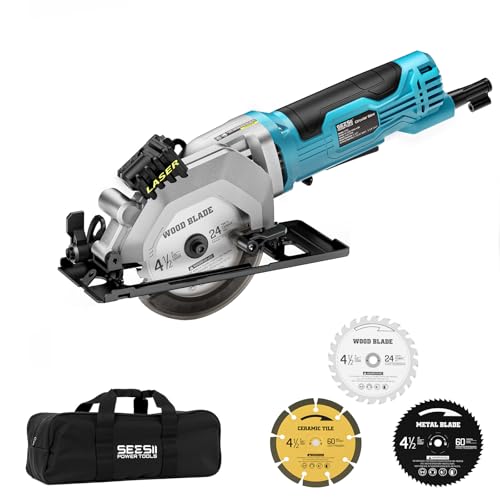
Seesii’s 4.8-amp corded mini saw delivers up to 4000 RPM for faster cuts in wood, plastics, and soft metals. A laser guide and parallel rails promote straight, precise lines, while the dust hose adapter helps keep the workspace neat. With a max depth of 1-11/16″ at 90° and 1-1/8″ at 45°, this compact model excels at trim work, remodeling, and smaller cabinetry tasks where a lighter tool is beneficial. The ergonomic handle design aids comfortable one-handed operation for extended use.
GALAX PRO 4Amp Circular Saw With Laser

GALAX PRO’s compact unit features a 4-amp motor delivering 3,500 RPM, a laser guide, and a 4-1/2″ blade for tight-cut work. The laser guide helps with accuracy for straight cuts, while the bevel up to 45 degrees broadens its usefulness for angled cuts. A 1-11/16″ cutting depth at 90° makes it suitable for small carpentry jobs, cabinetry work, and cutouts where space is constrained. The included vacuum adapter supports a cleaner work surface during projects.
G LAXIA Mini Circular Saw With Laser Guide

G LAXIA’s 4-amp mini saw is designed for portability and precision. It includes a laser guide and a rip guide to help maintain straight lines, making it suitable for furniture making, small cabinetry, and craftwork. The tool supports a 0–45° bevel and a depth of 1-11/16″ at 90°, enabling controlled cuts in a range of materials. Weighing in as a compact option, it offers easy handling for detail work or on-the-go adjustments in tight spaces.
Buying Guide: Key Purchase Considerations For Compact Corded Saws
- Power and speed: Corded models typically rely on steady current to maintain RPM. Look for a motor around 13 amps or similar power for tougher cuts, while compact builds may use 4–5 amp motors for light-duty tasks.
- Bevel range and stops: A wider bevel range (0–45° or 0–53°) increases versatility for angle cuts. Positive stops help speed setup and improve repeatability on job sites.
- Weight and balance: Lighter saws reduce fatigue during overhead or long sessions, but ensure balance and durability aren’t sacrificed. An anti-fatigue grip and magnesium or reinforced bases improve control.
- Cut depth and blade size: A 7-1/4″ blade is common for general-purpose cutting, while smaller blades (4-1/2″) excel in tight spaces but have reduced depth. Check maximum depth at 90° for your typical material thickness.
- Laser guides and guides: Laser guides and parallel guides can improve accuracy, especially for repetitive cuts. Ensure compatibility with optional accessories (dust collection, vacuums).
- Dust management: A dust hose or vacuum adapter maintains visibility and cleanliness, particularly in enclosed workspaces.
- Ergonomics and safety: Look for ergonomic handles, switch locks to prevent accidental starts, and a comfortable trigger reach for precise control.
- Manufacturing support and accessories: Availability of blades, fences, guide rails, and replacement parts can affect long-term usability and value.
- Intended use: For trim work, cabinetry, and small framing, prioritize models with compact footprints, stable cutting depth, and reliable bevel accuracy.