Best 120 Volt Stick Welder for Home Projects
Choosing a 120-volt stick welder for home use means balancing portability, ease of use, and reliable performance on common welding rods. The models below represent popular options that pair compact designs with smooth arc control, hot-start features, and practical safety aids. This guide highlights five top-rated units, their standout features, and practical tips to help you pick the right welder for DIY repairs, metalwork, and light fabrication.
| Product | Brand | Voltage | Notable Feature |
|---|---|---|---|
| YESWELDER 205Amp Stick Welder | YESWELDER | 110V/220V | Large LED display, hot start, arc force |
| ARCCAPTAIN Stick Welder (200A) | ARCCAPTAIN | 110V/220V | Synergic control, portable, LED display |
| Forney 298 Easy Weld 100ST | Forney | 120V | Versatile, 90A output, basic accessories |
| RUBIK 225 Amp Stick Welder | RUBIK | 110V/220V | Dual voltage, LCD display, VRD protection |
| HONE 140Amp Stick Welder | HONE | 110V/220V | Digital IGBT, hot start, arc force |
The following sections detail each model’s strengths, typical use cases, and what to consider when pairing a welder with your projects. All selections emphasize practical performance for common home workshop tasks, from repairing fences to building light aluminum or steel assemblies.
YESWELDER 205Amp Stick Welder Overview

The YESWELDER machine is designed for versatility with dual-voltage support and a robust 205-amp capability. Its Hot Start and Arc Force features help establish an initial arc quickly and maintain stable current for cleaner beads, especially useful when welding thicker joints or in outdoor conditions. The LED display makes it easier to monitor welding current and mode without removing your helmet. Weighing under 8.4 pounds, it remains highly portable for job-site travel and quick mid-project repositioning. This unit supports common rods such as 6010, 6011, 6013, and 7018, expanding its practical range for DIY projects, repairs, and light fabrication.
Key considerations: With dual voltage, you can choose between 110V or 220V input depending on available outlets, which is helpful for garage or outdoor use. The compact design can be a strong asset for homeowners who value mobility. For best results, select an electrode diameter appropriate for the current range and ensure proper ventilation to prevent overheating during extended sessions.
ARCCAPTAIN Stick Welder With Synergic Control

This model emphasizes ease of use with a large LED display and synergic control that automatically matches current and voltage as you select electrode diameter. The 200A output covers a wide range of common welding tasks, while the 110V/220V capability provides flexibility for household outlets or outlets on a worksite. The unit is noted for its portability, with a lightweight build and a handle-friendly design that makes it suitable for light transport and on-site maintenance. It also supports arc force and anti-stick features to help beginners strike and maintain a stable arc.
Technology and operation details: The internal MCU control and IGBT inverter deliver stable arcing and smooth welding across typical rods like 6010, 6011, 6013, and 7018. Care should be taken not to power on while the screen is active or the fan is still running, but once powered up, the interface provides quick access to essential parameters. This welder is appropriate for outdoor maintenance, hobby fabrication, and occasional metal repair projects.
Forney 298 Easy Weld 100ST
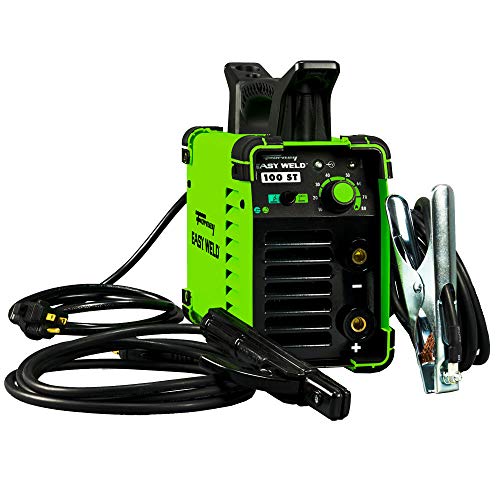
The Forney Easy Weld 298 is a compact, easy-to-use 120-volt welder suited for home repair tasks and light fabrication. With 90 amps of output, it can handle typical 1/16″ to 1/8″ welding rods for household projects. The kit commonly includes an electrode holder and a ground clamp, which helps new welders get set up quickly. This unit prioritizes simplicity and reliability, making it a practical choice for beginners who want a straightforward, job-ready machine for fence repairs, small brackets, and basic metalwork around the house.
Best-use scenarios: The Forney 298 suits beginner to intermediate users focusing on small projects, hobby metalwork, and weekend repairs. The 120V input limits some high-heat or heavy-thickness work, but its portability and straightforward operation make it a dependable starter welder. Adequate ventilation and clean surfaces will improve arc stability and bead appearance on common steels.
RUBIK 225 Amp Stick Welder With LV LCD

The RUBIK stick welder offers 110V/220V dual voltage with a 2-in-1 design that makes it a strong option for DIY enthusiasts who need flexibility across different outlets. The large LCD display helps users monitor current and voltage with clarity, while VRD protection provides additional safety on low-current operations. This model targets both beginners and more experienced hobbyists who may work on small repairs, shelves, racks, or light structural components around the home or workshop.
Important considerations: The dual-voltage capability is valuable for navigating typical home garages and outdoor setups. As with other 120V-capable welders, choice of electrode size and proper rod type will influence bead quality and penetration. This unit’s portability and integrated protections support extended, low-cost hobbyist use, but heavier, thick-walled joints may require a higher-output machine.
ARCCAPTAIN iControl TIG 205 Pro (5-in-1)

This model blends TIG and Stick capabilities in a 205A platform with iControl and app-based monitoring for enhanced workflow. It supports 120V/240V inputs, enabling a wide range of shop configurations. Its large LED display and 5-in-1 functionality—including TIG and stick modes—make it a versatile choice for projects that require both welding and precise heat control. The app connection offers status monitoring, parameter adjustments, and potential learning resources, which can be helpful for technicians building skills and documenting results.
Usage notes: For TIG-related tasks, you’ll need compatible accessories (foot pedal and torch) that may not be included. The unit is designed for outdoor maintenance, metal fabrication, and hobby projects. If you primarily need stick welding with occasional TIG capability, this model offers a broad feature set, though it might be more complex than a pure-stick welder for beginners.
Buying Guide: Key Purchase Considerations
When selecting a 120-volt stick welder, consider how you plan to use it, your experience level, and your workshop setup. The following points help compare the options above and other potential models:
- Voltage and amperage range: A wider range offers more flexibility for different rods and metal thicknesses. Dual-voltage units are useful if you have access to both 110V and 220V outlets.
- Arc stability and start features: Hot Start, Arc Force, and Anti-Stick features help beginners strike and maintain a steady arc, improving bead quality and reducing frustration.
- Display and controls: Large LED displays simplify setting parameters, while intuitive controls reduce the learning curve for new welders.
- Portability and weight: Lighter machines are easier to transport for on-site repairs, but ensure the unit has adequate build quality and cooling for longer sessions.
- Rod compatibility: Most 120V welders excel with common mild steel rods (E6010, E6011, E6013, E7018). If your projects include stainless or aluminum, verify compatibility or consider multi-process options.
- Safety features: VRD protection, thermal overload protection, and proper ventilation contribute to safer operation, particularly for beginners and DIY enthusiasts.
- Accessory inclusion: Check whether essential items (ground clamp, electrode holder, cables) are included, as missing components can add setup time and cost.
In practice, the right 120V stick welder balances your typical project load with portability. For homeowners tackling fence repairs, metal brackets, or light structural work, units with robust arc control and a clear display provide dependable results. If you anticipate higher-volume work or occasional TIG needs, a dual-function model with good app support offers expanded capabilities, but may require more investment and setup.