Best Beginner Welders for Automotive Projects in 2025
For first-time welders tackling automotive improvements, choosing a versatile, easy-to-use welder can save time and frustration. The following 5 models are beginner-friendly, support multiple welding modes, and are suitable for DIY auto repairs, frame work, and small fabrication tasks. Each section highlights core capabilities, setup tips, and what to expect when starting out with automotive projects.
Buying options at a glance
| Product | Welding Modes | Voltage | Best Use |
|---|---|---|---|
| ARCCAPTAIN 160A MIG Welder | Gas MIG, Flux Core MIG, Lift TIG, MMA | 110V / 220V | Beginner home repairs, light automotive body work |
| ARCCAPTAIN 6-in-1 Aluminum MIG Welder | Gas MIG, Flux Core MIG, Lift TIG, Stick, Spot, Spool Gun (optional) | 110V / 220V | Aluminum and mixed-metal projects, beginner-friendly |
| PANERGYRIC 160A MIG Welder | Gasless MIG, Lift TIG, Stick | 110V / 220V | Everyday automotive frame and panel repairs |
| MJUM 160A 3-in-1 Welder | Flux Core MIG, Stick, Lift TIG | 110V / 220V | Beginner-friendly with strong versatility for vehicles |
| MIGVAN 180A MIG Welder | Gasless MIG, Gas MIG, Stick, Lift TIG, Spool Gun (optional) | 110V / 220V | DIY auto repairs, thicker metals, portable and versatile |
ARCCAPTAIN 160A MIG Welder 4-in-1: Beginner Friendly
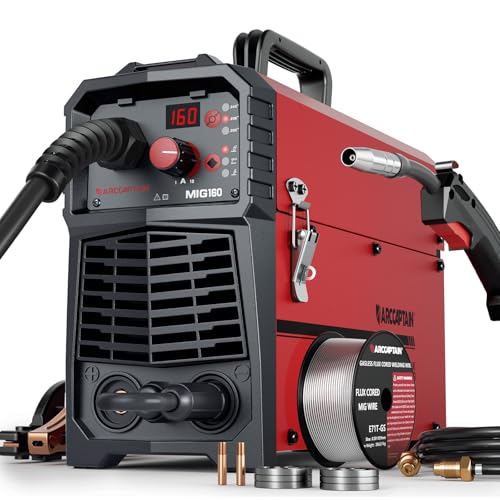
The ARCCAPTAIN 160A MIG Welder combines four essential welding modes in a compact package, making it a practical choice for automotive beginners. It supports Gas MIG and Flux Core Gasless MIG to handle carbon steel, stainless, and thicker metals, plus Lift TIG and MMA for precision welds on automotive panels, exhaust brackets, and light frame repairs. Synergic control automatically matches welding current and wire feed speed for a smoother setup, which helps new users achieve cleaner welds with minimal trial-and-error. Weighing under 12 pounds, it is portable enough for garage-to-site projects and quick roadside fixes. Ideal for home DIY, maintenance, and basic road equipment repairs.
ARCCAPTAIN 6-in-1 Aluminum MIG Welder

This 200A multi-process welder is a strong choice for beginners who want to experiment with aluminum in addition to steel. It offers Gas MIG, Flux Core MIG, Lift TIG, MMA, Spot, and the option to add a spool gun for aluminum welding. Its synergic control streamlines setup, automatically tuning current and wire feed to the chosen wire diameter. The unit supports 110V/220V power, enabling use in a standard garage or on-site jobs. Although some functions (like the WP-17V TIG torch and spool gun) require separate purchases, the platform is aligned with automotive repair needs, including aluminum body panels and chassis components.
PANERGYRIC 160A MIG Welder

The PANERGYRIC 160A MIG Welder emphasizes 3-in-1 versatility: gasless flux-core MIG, Lift TIG, and stick welding. With dual voltage (110V/220V) and a digital LED display, it is accessible to beginners who need clear feedback on parameters. Synergic control helps auto-match wire speed and current for smoother starts, while the unit remains portable enough for garage and yard projects. It’s well-suited for automotive repairs on stainless and carbon steels, making it a practical entry point into more challenging welds with confidence.
MIG Welder Portable 160A 3-in-1 by MJUM

The MJUM 3-in-1 welder combines Flux Core MIG, Stick, and Lift TIG into a compact, dual-voltage package. It supports up to 5/16″ materials and works with common flux-core wires (0.030″, 0.035″, 0.040″). A smart IGBT-based control system helps beginners by auto-adjusting current to produce cleaner welds with fewer errors. At under 13 pounds with a carrying handle, this unit is highly portable—great for on-site auto repairs, farm repairs, or weekend hobby projects that require a reliable welding capability without a heavy setup.
MIGVAN 180A MIG Welder: 5-in-1 Power

The MIGVAN M-180 is a 5-in-1 welding machine designed for serious beginners who plan to level up quickly. It covers Gasless MIG, Gas MIG, Stick, Lift TIG, and Spool Gun (spool gun optional), with dual voltage operation (110V/220V). Its smart synergic system auto-calibrates voltage and wire feed for consistent results, while manual override supports 2T/4T modes for better control on longer welds. A robust cooling system and protective casing are geared toward workshop environments as well as mobile applications, making it a flexible option for automotive projects that require reproducible welds on thicker materials.
Buying Guide: Key Purchase Considerations For Automotive Beginners
- Welding processes: For automotive work, a machine that offers MIG (gas or flux-core), TIG (for thin metals and clean welds), and stick can cover most tasks. A 3-in-1 or 4-in-1 model provides the most versatility for beginners tackling frames, exhaust supports, and body panels.
- Voltage and power: Dual-voltage (110V/220V) units are ideal for a home garage, letting you plug into standard outlets while still delivering higher power for thicker metals when needed.
- Synergic control: Machines with synergic (auto) wire-feed and current matching simplify setup, helping beginners produce consistent welds with less trial and error.
- Portability: Weight and handle design matter if you plan to move the welder between a driveway, garage, or job site. Lighter units under 15 pounds are generally easier to handle for beginners.
- Accessories and consumables: Consider whether the kit includes essential consumables (nozzles, contact tips, brushes) and whether adding a spool gun or TIG torch is a future upgrade. For aluminum work, a spool gun is often a worthwhile addition.
- Safety and learning curve: Start with thicker, easier-to-weld metals like mild steel and carbon steel. Practice on scrap pieces to master arc stability, nozzle cleaning, and correct travel speed before moving to critical automotive components.
- Maintenance and durability: Look for robust build quality, a reliable cooling system, and good protection against dust and moisture—useful for garage setups and outdoor work.
These selected models provide a range of beginner-friendly features with automotive relevance. When choosing, align the machine’s capabilities with your typical projects, budget, and whether you expect to weld aluminum or heavier chassis parts in the future.