Best Soundproofing Materials for Walls to Improve Acoustic Privacy
Choosing the right wall soundproofing materials can dramatically reduce echoes, reverberations, and outside noise. This guide highlights five effective options, spanning foam panels to mass-loaded vinyl, with practical considerations for home studios, offices, and living spaces. Each product offers different benefits—absorption, vibration damping, and fire safety—so you can balance performance with budget and installation needs.
| Product | Type | Best Use |
|---|---|---|
| Sound Proof Foam Panels (GUERRI) | Acoustic Foam Panels | Echo reduction in studios and offices |
| Trademark Soundproofing Mass Loaded Vinyl | Mass Loaded Vinyl (MLV) | Adding mass to walls for general sound blocking |
| TroyStudio Mass Loaded Vinyl Barrier | Mass Loaded Vinyl | Compact, high-density sound blocking |
| Saiqiang Acoustic Foam Panels (12 Pack) | Acoustic Foam Panels | Wall treatment for studios and offices |
| Knightsacoustic 36Packs Curved Foam Panels | Acoustic Foam Panels | Enhanced absorption with curved design |
Introduction: This article compares five relevant wall soundproofing products, focusing on performance, installation, and safety considerations. The selections cover different approaches—from absorbing sound with foam to increasing wall mass with vinyl—so you can tailor a solution to your room size, use case, and noise sources.
Sound Proof Foam Panels by GUERRI

GUERRI’s wedge-design acoustic foam panels are crafted to absorb noise and reduce echoes, flutter echoes, and reverb. The triangular wedge pattern also contributes to a decorative wall appearance. They’re designed to help optimize environments for music recording or focused work. The panels use high-density polyurethane foam with good resilience, and they are rated for flame retardancy, meeting SGS environmental and safety tests. Some installations may require time to fully regain their full size after compression.
Trademark Soundproofing Mass Loaded Vinyl

Mass Loaded Vinyl (MLV) from Trademark Soundproofing provides a dense, flexible barrier that adds mass to existing walls, floors, or ceilings. At 1 lb per square foot and a thickness around 1/8 inch, it can achieve substantial STC improvements while remaining relatively thin. It’s non-toxic and made from virgin materials, with a focus on reliability and safety for indoor environments. This option is particularly effective when retrofit space is limited or when layering with other treatments.
TroyStudio Mass Loaded Vinyl Barrier

TroyStudio’s MLV barrier is a compact, 1/8-inch-thick sheet designed to add mass and dampen vibrations. With an 8-foot length and 1-foot width, this product covers typical project footprints efficiently. It offers a solid STC in practice and is described as flexible, waterproof, and flame retardant (B1). The backing is nonwoven fabric, aiding handling and installation, and it’s marketed for indoor and outdoor use where space is at a premium.
Saiqiang Acoustic Foam Panels (12 Pack)

Saiqiang’s 12-pack features 1-inch-thick high-density polyurethane foam with a wedge profile for enhanced absorption. The materials are designed to reduce noise, echoes, and reverberations, improving clarity in studios, offices, or gaming rooms. The panels emphasize durability and consistent performance, with a flame-retardant composition to support safety in occupied spaces. They’re suitable for vertical wall mounting and align well with other acoustic treatments to maximize effectiveness.
Knightsacoustic 36Packs Curved Foam Panels
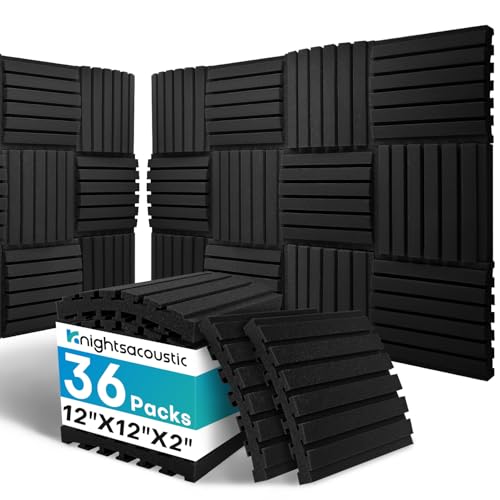
Knightsacoustic offers a 36-pack of curved 2-inch foam panels designed to improve absorption and diffusion. The curved groove design increases contact area with sound waves, which can help reduce reflections and echoes more effectively than flat panels. The product notes caution about a temporary odor when first opened, which is common with flame-retardant foams; airing out for about 24 hours is recommended. This option provides a strong balance of coverage and performance for larger rooms or studios.
Buying Guide
- Acoustic goals: Choose foam panels for absorption and diffusion to reduce echoes; use MLV when wall mass and barrier effects are required.
- Space and layout: Thicker panels (1 inch or more) offer better absorption; consider curved or uniquely shaped panels to increase surface area and diffusion in larger rooms.
- Fire safety and compliance: Prioritize products with flame retardant properties and safety certifications, especially in living spaces and studios.
- Installation: Self-adhesive options are easy to install but may require surface preparation. Consider professional mounting for large areas or delicate walls.
- Durability and maintenance: Look for high-density foams and durable backing materials to ensure long-term performance and easier cleaning.
- Mixing approaches: For optimal results, combine absorption (foam panels) with mass-loading (MLV) in key areas like adjacent walls or shared ceilings to minimize noise transmission and internal reflections.
- Ventilation and odor: Some flame-retardant foams may emit odors initially; airing out the panels before final placement can improve comfort.
When planning a wall treatment, consider testing a small area first to evaluate how the space responds to different materials. A layered approach—foam panels for absorption plus MLV for mass—often yields the best balance of sound control, space efficiency, and installation practicality.