Best Angle for Framing Nailer: Top Picks for Angled Framing Projects
Choosing the right angled framing nailer can improve accuracy and speed on wood-framing jobs, roofing, and decking. This guide highlights five top-performing models that balance weight, power, and nail compatibility for American DIYers and professionals. Each option supports angled nailing to reach tight spaces and intricate framing tasks. Read on to compare features, weights, and actuator options to find the best fit for your project needs.
| Product | Brand | Type | Nail Range | Angle |
|---|---|---|---|---|
| DEWALT 20V MAX Finish Nailer, Angled, 16GA | DEWALT | Cordless Finish Nailer | 16 GA | 16° |
| NuMax SFR2190 Pneumatic Framing Nailer | NuMax | Pneumatic Framing Nailer | 21° Plastic Collated | 21° |
| Metabo HPT Framing Nailer NR90AES1 | Metabo HPT | Framing Nailer | 2″–3-1/2″ (Nails) | 21° |
| 3PLUS HDA1564SP 15 Gauge Angled Finish Nailer | 3PLUS | Finish Nailer | 1-1/4″–2-1/2″ | 15° |
| DEWALT 20V MAX Angled 15GA Finish Nailer DCN650B | DEWALT | Finish Nailer | 15 GA | 15° |
Introduction to selections: The following five products cover a range of power sources (cordless and pneumatic) and work contexts—from lightweight, battery-powered finish nailers for trim to robust framing guns for structural work. Each listing includes angled capabilities for tight spots, varied nail sizes, and build quality to handle daily construction tasks. The items are suitable for framing, subfloor, and trim projects, helping you decide whether you need mobility or raw driving power.
DEWALT 20V MAX Finish Nailer, Angled, 16GA (DCN660B)

The DEWALT DCN660B is a cordless finish nailer powered fully by a 20V MAX battery, removing the need for a compressor, hose, or gas cartridges. Its brushless motor enhances runtime and durability, while a tool-free selector allows switching between sequential and contact actuation modes. The angled 16-gauge design supports precise nailing in tight trim and molding applications, making it suitable for interior finish work that requires reach and control. This model emphasizes portability and consistent performance without external air pressure requirements.
NuMax SFR2190 Pneumatic 21 Degree Framing Nailer

The NuMax SFR2190 is a pneumatic framing nailer designed for framing, subfloors, roof decking, pallets, and fencing. It uses 21-degree plastic-collated full-round-head nails from 2″ to 3-1/2″ long and 0.113″ to 0.131″ diameter. Its one-piece hardened steel drive blade provides durability against wear and tear in job-site conditions. This tool is well-suited for builders who prioritize a straightforward, air-powered workflow with reliable performance on larger framing projects.
Metabo HPT Framing Nailer NR90AES1

The Metabo HPT NR90AES1 is a 21-degree plastic-collated framing nailer designed for flooring, roof decking, and general framing tasks. Weighing around 7.5 lbs, it offers a balanced feel that minimizes operator fatigue during extended use. It supports a range of 2″ to 3-1/2″ nails with plastic collations, making it versatile for framing and structural work. Its design focuses on comfort and maneuverability for repetitive driving during builds and renovations.
3PLUS HDA1564SP 15 Gauge Angled Finish Nailer

The 3PLUS HDA1564SP is a 15-gauge angled finish nailer designed for flush fastening with 1-1/4″ to 2-1/2″ nails. It features tool-free depth adjustment for precise insertion and a Work Contact Element to prevent misfires. A no-mar tip helps protect surfaces during finish work. While primarily used for trim and molding, the angled design supports tight corners and intricate framing details in interior projects.
DEWALT 20V MAX Angled 15GA Finish Nailer DCN650B
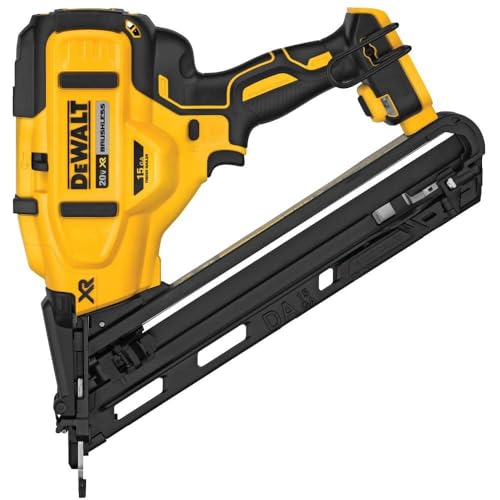
The DCN650B is a cordless 15-gauge angled finish nailer that runs on 20V MAX power, eliminating the need for a compressor, hose, or gas cartridges. Its brushless motor improves runtime and durability, while a micro nose design enhances line of sight and accuracy for precise nail placement. This model is well-suited for crown molding, baseboards, and other finish carpentry tasks where angled drive is advantageous in tight spaces.
Buying Guide: Key Considerations For Angled Framing And Finish Nailer Purchases
Purpose and scope: Distinguish framing versus finish nailers. Framing nailers (typically 21° or 22° plastic or wire collated) emphasize drive power for structural wood, while finish nailers (15° or 16°) prioritize precision and a smoother finish for trim and molding.
Power source: Pneumatic tools require air compressors and hoses, offering dependable power for heavy fastening. Cordless options provide mobility and cleaner work sites but rely on battery life and charging times. Choose based on project length, site constraints, and workflow preference.
Angle and compatibility: Angled nailers reach tight corners and awkward joists. Check the available nail sizes for each model (length and gauge) to ensure compatibility with your typical framing or finish nails.
Weight and balance: Lighter tools reduce fatigue on long sessions. Balance influences maneuverability, especially when working overhead or in tight spaces. Testers often favor sub-8 lb framing guns for extended use.
Drive mode and safety: Look for selective actuation (sequential vs contact) for better control on delicate or precise work. Features like a Work Contact Element or no-mar tips protect your material and reduce accidental misfires.
Durability and maintenance: Hardened drive blades, corrosion-resistant components, and straightforward maintenance routines extend tool life on rough job sites. Consider models with durable housings and reliable seals for air tools.
Accessories and compatibility: Consider included or optional accessories such as depth adjustment, anti-double-fire mechanisms, and belt hooks. For cordless models, verify battery compatibility with existing tools to optimize procurement costs.
Price-to-performance balance: While premium models offer advanced features, many mid-range angled nailers provide reliable performance for typical framing and finish tasks. Align the tool’s capabilities with your most common project types.