Best Blades for Table Saws and Miter Saws for Clean, Precise Cuts
Choosing the right blade can dramatically improve cut quality, finish, and overall project efficiency. The following blades are popular with hobbyists and professionals for table saws and miter saws, offering a range of tooth counts, kerf widths, and carbide quality. This guide highlights five highly regarded options, summarizes their core specs, and explains what to look for depending on your cutting needs.
Summary of selected products
| Product | Brand | Tooth Count | Kerf | Arbor | Notable Feature |
|---|---|---|---|---|---|
| WEN BL1080 | WEN | 80 | 0.10 in | 5/8 in | Ultra-fine finish |
| FOXBC 80-Tooth | FOXBC | 80 | 0.098 in | 5/8 in | High-density tungsten carbide |
| DEWALT DWA11080 | DEWALT | 80 | 0.10 in | 5/8 in | Fine finish, low vibration |
| Luckyway 60T/32T Pack | Luckyway | 32T & 60T | 0.08 in | 5/8 in | General purpose duo |
| ANGELSWORD 32/60/80T 3 Pack | ANGELSWORD | 32T/60T/80T | 0.098 in | 5/8 in | Three finishes in one pack |
WEN BL1080 80-Tooth Finish Blade

The WEN BL1080 blade is designed for ultra-fine finishes on both hard and softwoods. It features a 10-inch diameter, a 5/8-inch arbor, and a robust RPM rating up to 6000, making it suitable for general table and miter saw use. The ultrathin 1/10-inch kerf minimizes material waste and reduces cutting resistance, helping to produce cleaner edges with less vibration. Its carbide tips deliver durability for ongoing, precise work, especially on trim and finish carpentry tasks.
This blade is a strong choice when projects demand a refined surface quality and smoother crosscuts. The fine-tooth count slows tear-out while maintaining throughput, which is beneficial for cabinet assembly, shelving, and trim work where finish quality matters most. While it excels in finish cuts, it remains versatile enough for general sawing tasks in light-to-medium workloads.
WEN BL1060 60-Tooth Finish Blade
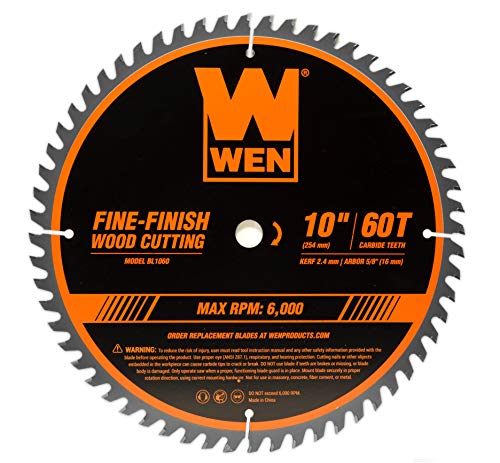
The WEN BL1060 offers a 60-tooth configuration optimized for fine finish work on both miter and table saws. With the same 10-inch diameter and 5/8-inch arbor compatibility, this blade strikes a balance between smooth cuts and reasonable material removal. The ultrathin kerf helps reduce waste and resistance, contributing to straighter, smoother edges on sheets, planks, and panel cuts. This makes it well-suited for cabinetry parts, furniture components, and decorative joinery where precision is key.
Users benefit from a predictable cut quality with minimized chip-out and improved surface readiness for finishing. The blade’s tooth arrangement promotes cleaner crosscuts and miters, which is helpful when assembling frames, facings, or decorative trim. Durability remains solid for regular woodworking tasks, though heavy-rip cuts may call for a blade with more aggressive tooth geometry.
FOXBC 80-Tooth Ultra Finish Blade

The FOXBC 10-inch, 80-tooth blade is engineered for ultra-finish wood cutting with a 0.098-inch kerf and a 5/8-inch arbor. The blade’s high-density tungsten carbide teeth provide improved wear resistance, contributing to longer life and more consistent finishes across multiple passes. Its thin kerf reduces drag, allowing for smoother operation and less vibration, which is noticeable on delicate or fine-finish projects.
Ideal use cases include precision cross-cuts, fine fretwork, cabinetry, and decorative trim where a crisp surface is essential. The blade’s ATB (Alternative-Top-Beat) tooth arrangement helps minimize chipping on end grain, while maintaining efficient cut rates for typical softwood and hardwood applications. It’s a suitable upgrade for builders seeking a more refined edge without sacrificing speed on light-to-medium projects.
DEWALT DWA11080 80-Tooth Fine Finish

DEWALT’s DWA11080 80-tooth blade is designed for a fine finish with a carbide composition optimized for clean, accurate cuts. The blade’s design includes a patented body slot that helps dampen vibration, contributing to smoother operation and less wandering during cuts. The tooth geometry is tuned to enhance cut quality, delivering precise results in trim, paneling, and cabinetry tasks.
With a focus on finish quality and durability, this blade is well suited for projects that require high surface quality on plywood, veneered substrates, and solid lumber. The low-vibration profile reduces user fatigue during longer sessions, making it a dependable choice for shop-based cabinet making and custom woodworking where repeatable finishes matter.
Luckyway 2-Pack 10-Inch Blades
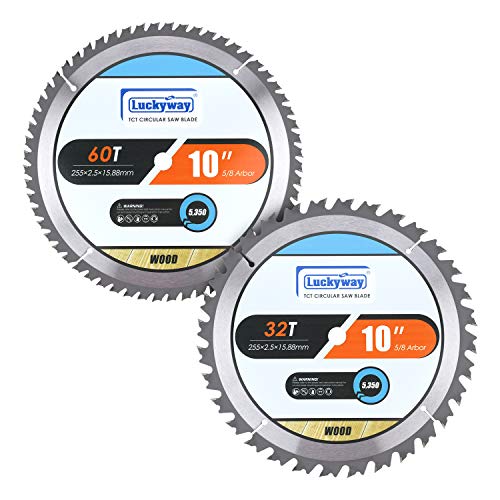
The Luckyway set provides two blades, a 32-tooth and a 60-tooth option, designed for a broad range of general-purpose wood cutting. The 32T blade is geared toward faster material removal on rough cuts, while the 60T blade favors cleaner crosscuts and finishing tasks. Both blades use a 5/8-inch arbor and a sturdy blade body designed to resist bending and deflection during cuts.
This pairing is convenient for workshop floor-to-wall transitions, paneling, shelving, and mid-grade carpentry where you need versatility without swapping blades frequently. The dual-pack approach lets users switch between rough-and-finish cuts in the same project, helping streamline workflows in small shops or DIY setups where budget constraints favor multipurpose tools.
ANGELSWORD 3-Pack: 32T/60T/80T
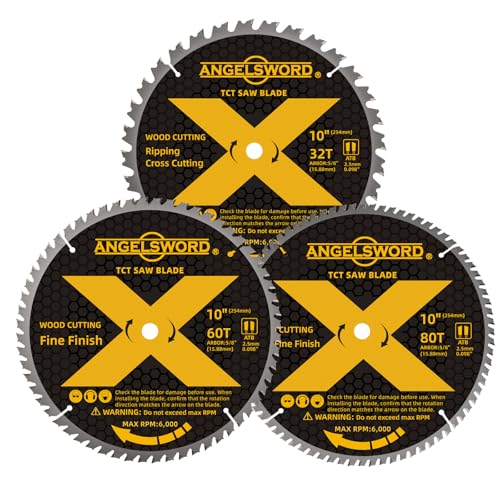
This ANGELSWORD trio covers a broad range of cutting needs with 32T for framing and faster rough cuts, 60T for general finish work, and 80T for ultra-fine finishes. The set uses a 5/8-inch arbor and a thin 0.098-inch kerf, designed to minimize waste and reduce vibration. Tungsten carbide teeth provide wear resistance and longer blade life, making the trio a flexible choice for mixed-material projects including framing, cabinetry, and decorative trim.
The three-blade combination supports a multi-stage workflow: rough-cut framing with the 32T blade, then switch to 60T for intermediate finish work, and finish with 80T for pristine edge quality. This makes it appealing for workshops that handle a variety of job types without stocking separate blades for each task.
Buying Guide: Key Considerations For Your Blade Choice
- Tooth count and finish needs — Higher tooth counts (e.g., 80T, 60T) yield finer finishes and reduced tear-out on delicate materials, while lower tooth counts (32T) cut faster and are better for rough work or framing.
- Kerf width — Thin kerf blades reduce waste and require less power, improving cut feel and efficiency, especially on portable saws. Standard kerf (0.098–0.10 in) balances strength and material savings.
- Arbor compatibility — Most 10-inch blades use a 5/8-inch arbor; ensure your saw accepts this size or use an adapter. Incompatibility can cause vibration or a poor cut.
- Vibration and stability — Some blades incorporate designs to reduce vibration and improve surface quality. Look for features like vibration-damping bodies or precise tooth geometry for smoother operation.
- Material and durability — Carbide-tipped teeth offer longer life and consistent performance across hardwoods and softwoods. Tungsten carbide teeth are common for finish blades and heavy-use environments.
- Intended use — Finish blades suit cabinetry and trim; general-purpose blades cover a broad spectrum; specific blades are better for framing or laminated panels. Consider a blade set if your shop handles diverse tasks.
- Maintenance and replacement—Inspect blades for glazing, fried teeth, or dull edges. Regular cleaning and occasional sharpening or replacement help maintain cut quality and tool accuracy.
When selecting a blade, align your choice with project types, material hardness, and desired surface quality. A finish-focused blade is indispensable for cabinetry and furniture components, while a general-purpose blade can cover many light-to-medium tasks. For mixed-duty shops, a combination pack or a compact set can provide flexibility without overwhelming the workflow.