Best Budget Circular Saw for Home Projects
Finding a reliable circular saw that delivers solid performance without breaking the bank is essential for DIYers and hobbyists. The following picks balance power, durability, and value, helping you complete a range of cuts—from framing to decking—without overspending. Each option is chosen for budget-conscious buyers who still need solid accuracy and ease of use.
style=”font-weight:bold;”>Summary Table of Chosen Products
| Product | Brand | Key Strength | Bevel Range | Power Source |
|---|---|---|---|---|
| Skil 5080-01 13-Amp 7-1/4″ Circular Saw | Skil | High torque, reduced weight | 0-51° | corded |
| DEWALT DCS391B 20V MAX Circular Saw | DEWALT | Balanced depth of cut, lightweight magnesium shoe | 0-50° | cordless |
| DEWALT DCS590B 20V MAX XR Circular Saw | DEWALT | Brushless motor, high motor power | 0-57° | cordless |
| SKIL 5280-01 15 Amp 7-1/4″ Circular Saw | Skil | Laser guide for quick, accurate starts | 0-51° | corded |
| BOSCH CS10 15 Amp Circular Saw | BOSCH | Lightweight magnesium footplate, durable design | 0-56° | corded |
Skil 5080-01 13-Amp 7-1/4″ Circular Saw

The Skil 5080-01 combines a robust 13-amp motor with a lightened design to reduce user fatigue during long projects. Its 51-degree bevel capability, aided by positive stops, enables precise bevel cuts for framing, shelving, and deck components. The saw is designed for everyday durability, with a balance of power and control suitable for beginners and more experienced users seeking an affordable option. The lightweight construction helps maneuverability on small job sites, while the 7-1/4 inch blade supports standard plywood and dimensional lumber tasks.
DEWALT DCS391B 20V MAX Circular Saw

This cordless DEWALT model uses a responsive 5150 RPM motor and a magnesium shoe to deliver durability without excessive weight. The tool is engineered for jobsite use, offering a compact form that reduces fatigue during extended cuts. Its balance and rubber overmold grip provide comfortable control, particularly when cutting overhead or along vertical surfaces. It is well-suited for tradespeople who already own other 20V MAX tools and want a portable circular saw for quick, on-site tasks.
DEWALT DCS590B 20V MAX XR Circular Saw

DEWALT’s XR line emphasizes efficiency with a brushless motor and impressive no-load speed. The DCS590B supports up to 5,500 RPM, delivering fast cuts across a variety of materials. A maximum depth of cut of 2-9/16 inches at 90 degrees offers flexibility for thicker stock, while the 2-inch depth at 45 degrees accommodates more aggressive bevel cuts. This model is ideal for seasoned DIYers who require longer runtimes between charges and higher power density from a cordless setup.
SKIL 5280-01 15 Amp 7-1/4″ Circular Saw
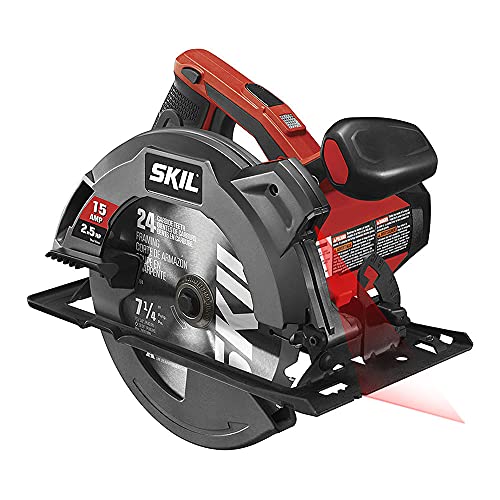
The SKIL 5280-01 adds a single-beam laser guide to help with initial cuts and layout, along with a capable 15-amp motor that drives a 7-1/4 inch blade. The saw provides a 51-degree bevel capacity with a positive stop at 45 degrees, enabling a broad range of cuts typical for framing and carpentry. A spindle lock simplifies blade changes, contributing to faster task cycles on the job site or in a workshop environment. This model is a practical pick for those who value precise starting lines and straightforward maintenance.
BOSCH CS10 15 Amp Circular Saw

The BOSCH CS10 pairs a 15-amp motor with a lightweight magnesium footplate, emphasizing durability and flatness for accurate cuts. The tool includes a convenient saw hook for storage between individual cuts, supporting efficient workflow on a busy site. With a bevel capacity up to 56 degrees and a robust build, the CS10 is suited for users who value a well-rounded, reliable corded option that remains affordable without sacrificing performance.
Buying Guide: Key Purchase Considerations
- Power vs. portability: Corded models provide consistent power for longer cuts, while cordless options offer mobility for lightweight tasks and overhead work. Consider your typical projects and workspace layout.
- Bevel range and depth: A wider bevel range (e.g., 0–50° or 0–57°) increases versatility for angled cuts. Check the maximum depth at 0° and 45° to ensure it matches your material thickness.
- Motor type and RPM: Higher no-load RPM and a brushless motor generally translate to faster cuts and longer tool life, particularly on tougher materials. Brushless options usually come with longer runtime per charge in cordless models.
- Weight and balance: A lighter saw reduces user fatigue, but ensure it remains stable during cutting. Magnesium footplates and ergonomic grips improve control on longer sessions.
- Accessories and compatibility: Look for laser guides, spindle locks for blade changes, and included blades. Laser guides can improve initial accuracy, while a spindle lock speeds up blade changes.
- Durability and maintenance: Cast or die-cast components and robust shoe construction contribute to tool longevity. Validate warranty terms and replacement parts availability for ongoing maintenance.
- Budget vs. performance: For most home projects, a 13–15 amp corded saw or a capable 20V max cordless saw offers a strong balance of power and value. Consider long-term costs such as batteries and rapid chargers for cordless models.
Across the selections, the budget-friendly options emphasize essential cutting performance, comfortable handling, and practical features like bevel adjustments and laser guides. When choosing, align the tool with the types of cuts you perform most often, your preferred power source, and how frequently you’ll work on projects that demand extended use without fatigue.