Best Chair Climbers for Stairs: Safer, Easier Mobility at Home
Finding the right chair climber for stairs can dramatically improve independence for seniors and mobility-impaired users, while giving caregivers added confidence. This guide reviews five top options, comparing load capacity, portability, and control style to help you choose a stair chair that fits daily routines and home layouts. Below, you’ll find a quick product summary, detailed sections for each pick, and a practical Buying Guide to weigh your decision.
| Product | Brand | Load Capacity | Type | Key Benefit |
|---|---|---|---|---|
| Powered Stair Climbing Wheelchair XFGW30-107 | FADHOLE | 480 lbs | Powered | High load, smooth straight-stair operation |
| Power Climbing Wheelchairs 480 lbs | BELIVOR | 480 lbs | Powered | Rugged construction with portable design |
| MS3C-300WC-X Stair Trolley | MS3C | 350 lbs | Manual/Electric assist | Digital controls; compact and foldable |
| Fitnet Powered Stair Wheelchair | Fitnet | 480 lbs | Powered | Durable, easy control for straight stairs |
| Manual Lift Stair Chair 350+ lbs | GOSHET | 350.5 lbs | Manual | Foldable, portable with sturdy aluminum frame |
FADHOLE Stair Climbing Chair XFGW30-107

This powered stair climbing chair is designed to help caregivers and seniors navigate straight staircases with controlled assistance. The aluminum alloy frame supports up to 480 pounds while keeping the unit relatively light for easy handling. An intuitive control panel allows caregivers to operate the chair with slow, deliberate movements, prioritizing safety over speed on steps. Not suitable for spiral staircases, it aims to provide dependable mobility on standard stair layouts.
BELIVOR Power Climbing Wheelchairs

Designed as a next-generation stair climbing wheelchair, this model focuses on smooth stair navigation while being a strong alternative to bulkier lifts. It features a rugged aluminum alloy build and reinforced nylon seating, delivering a 480-pound capacity without sacrificing portability. The unit emphasizes easy, button-activated operation for climbing at a measured pace and is best suited for straight stair layouts, both indoors and outdoors.
MS3C-300WC-X Stair Trolley

The MS3C-300WC-X offers a versatile stair trolley option with a weight capacity of 350 pounds. It combines adjustable, digital color-coded controls with ergonomic lifting handles to reduce caregiver strain. Rotating casters improve maneuverability in tight spaces, and the unit folds compactly for storage. A lithium-ion battery and a headrest are included, though the wheelchair itself is not part of the package, so coordination with an existing chair is required.
Fitnet Stair Climbing Wheelchair

Fitnet’s stair chair emphasizes advanced climbing technology and a high 480-pound capacity with a durable aluminum frame and reinforced nylon seating. The control panel is manned by an attendant, providing gentle, button-activated movements that emphasize safety on straight stairs. The design stresses long-term performance with corrosion-resistant materials and a balance between reliability and portability for home use.
GOSHET Manual Lift Stair Chair
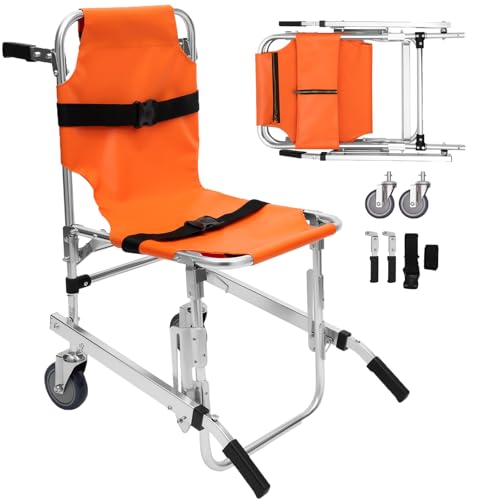
This manual lift chair emphasizes portability and rapid deployment. Built with a high-strength aluminum alloy frame and chrome-plated joints, it supports up to about 350 pounds. The foldable design reduces storage space, with a wide seat and reinforced seams for durability. Retractable front handles and safety straps aid in secure transfers, making it well-suited for home use or emergency evacuation scenarios.
Buying Guide: Key Considerations For Choosing A Chair Climber For Stairs
- Purpose and stair type: Identify whether you need a powered seat lift for straight stairs or a manual/assist option for variable layouts. Spiral stair cases may require a different design or a specialized solution.
- Load capacity and weight: Ensure the chair or trolley can safely support the user’s weight, plus any required accessories. Higher capacity often correlates with more robust frames but may impact portability.
- Control interface: Consider caregiver usability—whether button controls are intuitive, require minimal force, and offer safety features like slow start/stop and speed control.
- Portability and storage: Look at foldability, weight, and how easily the unit fits in home storage spaces or trunks for transport.
- Durability and materials: Aluminum frames and reinforced seating materials offer better durability and corrosion resistance for long-term use indoors and outdoors.
- Safety features: Prioritize anti-slip pedals, secure locking mechanisms, restraining straps, and automatic chair stabilization during climbing.
- Maintenance needs: Check battery life, charging requirements, and ease of part replacement or service availability.
- Usage scenario: Distinguish between indoor daily transfers, outdoor access, or emergency evacuation needs to select the right combination of portability and support.
- Cost of ownership: While prices aren’t displayed here, assess total cost of ownership including replacement parts, maintenance, and potential warranty coverage.
When evaluating options, align the chair climber’s capabilities with the primary stair configuration of the home, the user’s mobility level, and caregiver workflow. A well-chosen model should offer reliable assistance for straight stairs, ease of control for caregivers, and durable construction to withstand regular use.