Best Commercial Deadbolt Locks for Enhanced Security in 2025
Commercial deadbolt locks are a cornerstone of secure entry control for offices, storefronts, and industrial spaces. This guide highlights five strong options that meet serious ANSI and fire-rating standards, with features designed for durability, pick resistance, and backset versatility. Each product is evaluated on build quality, installation compatibility, and real-world performance to help facilities managers choose the right fit for interior and exterior doors. Below is a quick overview of the picks to compare at a glance.
| Product | Brand | Notable Feature |
|---|---|---|
| BRINKS Commercial Deadbolt | BRINKS | ANSI Grade 1; 3-hour UL fire rating |
| Master Lock DSCHSD32D | Master Lock | Grade 2; Bump Stop |
| HISAFE In-Use/Vacant | HISAFE | In-use/Vacant indicator; reversible |
| Schlage B560P626 | SCHLAGE | Grade 2; C Keyway |
| LYNN HARDWARE Heavy Duty | LYNN HARDWARE | Industrial Grade 2; 1” bolt |
BRINKS Commercial Single Cylinder Deadbolt

The BRINKS commercial deadbolt is built for interior or exterior security tasks where reliability matters. It fits doors ranging from 1-3/8” to 2” thick, with an adjustable latch that accommodates 2-3/8” or 2-3/4” backset. The lock uses corrosion-resistant steel and a 6-pin SC4 brass cylinder, and includes two keys for authorized access. ANSI Grade 1 certification and a 3-hour UL fire rating indicate strong protection against both forced entry and heat exposure, making it suitable for high-traffic entrances and critical spaces. The design emphasizes durability, with materials chosen to withstand daily wear in commercial settings.
Master Lock DSCHSD32D Heavy Duty Deadbolt

The Master Lock DSCHSD32D focuses on robust single-cylinder performance for commercial doors. It offers a fixed 2-3/4-inch backset and a full 1-inch solid core throw bolt for added strength against prying. The thumb turn inside supports efficient operation from the interior, while the exterior key access provides controlled entry. Door compatibility requires matching backset and thickness to ensure a proper fit. This unit is positioned as a solid Grade 2 option for spaces that require durable hardware without the premium costs associated with Grade 1 models.
HISAFE In-Use/Vacant Commercial Deadbolt

The HISAFE model emphasizes visibility and access control with an in-use/vacant indicator that clearly signals room occupancy. It is reversible for both left- and right-handed doors and features a 2-3/4” backset to fit a broad range of door thicknesses from 1-3/8” to 2”. The latch core includes a brass backset and protective features intended to reduce corrosion and ensure smoother operation. This unit is suitable for offices or restrooms where occupancy status matters, offering a practical blend of security and convenience in busy environments.
Schlage Commercial B560P626 Grade 2

The Schlage B560P626 is a Grade 2 single-cylinder deadbolt featuring a C Keyway and standard 1-3/8″ to 1-7/8″ door range. It is designed for straightforward external or internal security applications, with a lock that can be activated from outside via a key and from inside by turning the interior mechanism. ANSI certification indicates compliance with recognized security standards, while the lock’s backset compatibility supports typical commercial door configurations. This model suits facilities needing reliable, easy-to-replace hardware with broad compatibility.
LYNN HARDWARE Heavy Duty Designer Deadbolt
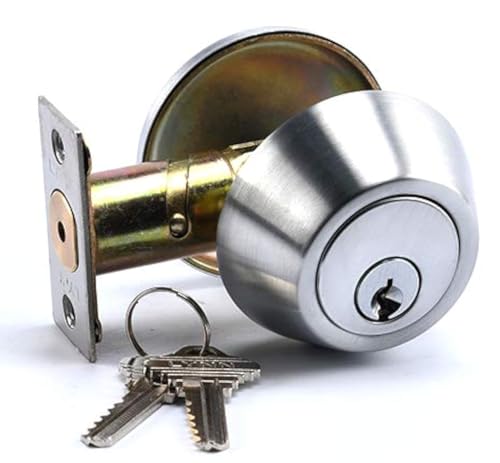
The Lynn Hardware heavy-duty model is designed for commercial use on wood or metal doors and features a single-cylinder operation with a hardened steel bolt and a 1” bolt throw. It supports backsets from 60mm to 70mm (2-3/8″ to 2-3/4″) and is rated for various door thicknesses, typically 1-3/8” to 2”. The latch plate is fixed, and the unit emphasizes anti-cutting and anti-prying performance for higher-traffic spaces. This option is appropriate for storefronts or industrial rooms that demand robust mechanical security.
Buying Guide: Key Purchase Considerations
- Security Grade and Standards: For high-traffic commercial doors, prioritize ANSI Grade 1 or Grade 2 options, depending on the risk profile. Grade 1 typically offers the strongest construction and resilience to forced entry, while Grade 2 is adequate for many business environments without the premium cost.
- Backset and Door Thickness: Ensure the lock backset (commonly 2-3/8″ or 2-3/4″) matches your door preparation. Verify door thickness compatibility (often 1-3/8″ to 2″ or up to 2-1/4″) to prevent misalignment and ensure a proper seal.
- Finish and Corrosion Resistance: Satin chrome and other durable finishes help resist corrosion in high-traffic or outdoor-adjacent applications. Consider corrosion-resistant steel components for longevity in humid or outdoor environments.
- Fire Rating: If the door serves a corridor or egress path, a 3-hour UL fire rating can be critical for life safety compliance and compartmentalization requirements.
- Keying and Access Control: Decide between single-cylinder (keyed outside, thumb-turn inside) and more advanced options when access control is needed. Some products include key and thumb-turn combinations or in-use/vacant indicators for occupancy signaling.
- Indication Features: In-use/vacant indicators support secure room management in offices and restrooms, reducing unauthorized occupancy and aiding staff workflow.
- Installation and Fit: Some models require specific door materials (wood, metal, aluminum) and may have fixed latch plates. Verify compatibility with your door construction and frame.
- Maintenance and Replacement: Choose locks with readily available spares (cylinders, keys, strike plates) and straightforward installation to minimize downtime during maintenance or rekeying.
Additional Considerations and Perspectives
When selecting a commercial deadbolt, it helps to balance security with operational workflow. A Grade 1 option can offer the strongest protection but may be overkill for lower-risk entrances like employee break rooms. Conversely, Grade 2 options provide solid security with cost efficiency for many storefronts and offices. For spaces that require clear occupancy signaling, in-use/vacant indicators help prevent unauthorized access during off-hours. Backset versatility is essential for retrofits where existing door prep can limit hardware choices. Finally, consider maintenance ease and availability of service hardware to reduce total cost of ownership over the product’s lifecycle.
Facility managers should also assess compatibility with existing door hardware, including strike plates, door closers, and door hinges, to ensure seamless integration and consistent security performance. In busy entrances, the combination of durable construction, reliable keying, and standard backset options can simplify procurement, installation, and ongoing maintenance while meeting industry standards and local building codes.