Best CoreXY 3D Printer for High-Speed, Precise Printing
The CoreXY movement system is renowned for fast, stable, and precise 3D printing. This guide highlights five top CoreXY models that blend speed, reliability, and versatility for hobbyists and professionals in the United States. Each pick emphasizes auto-leveling, high-temperature capabilities, or multi-material potential to expand your toolkit. Below you will find a quick overview of the featured printers, followed by in-depth sections that cover design, performance, and ideal use cases.
Summary of chosen products:
| Product | Brand | Build Volume | Key Strength |
|---|---|---|---|
| ELEGOO Centauri Carbon 3D Printer | ELEGOO | 256x256x256 mm | Ready-to-print right out of the box with auto calibration |
| FLASHFORGE AD5X | FLASHFORGE | 220x220x220 mm | Ultra-fast CoreXY with multi-color capability |
| FLASHFORGE AD5M | FLASHFORGE | 220x220x220 mm | Fully Auto Calibration and all-metal CoreXY |
| Sovol SV08 | Sovol | 350x350x345 mm | Open-source Voron-based CoreXY with quad-gantry auto level |
| FLASHFORGE Adventurer 5M | FLASHFORGE | 220x220x220 mm | Fully auto leveling with high-speed CoreXY |
ELEGOO Centauri Carbon CoreXY Printer
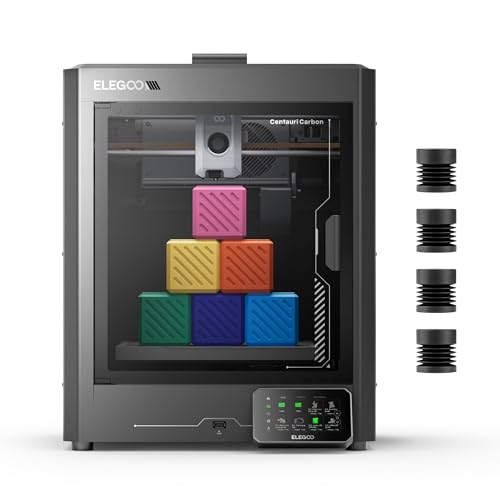
The ELEGOO Centauri Carbon is a fully assembled CoreXY printer designed for immediate use. It includes auto bed leveling and a user-friendly touchscreen, reducing setup time for beginners and busy makers. With a 256x256x256 mm build volume and a heated bed, it enables rapid prototyping of mid-sized parts using a range of materials. The 320°C nozzle and enclosed chamber support high-temperature filaments, while the built-in camera aids monitoring and calibration checks during prints.
FLASHFORGE AD5X Multi-Color CoreXY Printer

The AD5X delivers high-speed CoreXY performance with speeds up to 600 mm/s and 20,000 mm/s² acceleration. It supports multi-color printing with up to four colors simultaneously, enabling vibrant, complex models in a single print. A 1-Click Auto Leveling feature ensures consistent first layers, while the all-metal core XY platform provides rigidity for reliable, repeatable performance in rapid prototyping and batch production scenarios.
FLASHFORGE AD5X Multi-Color with IFS
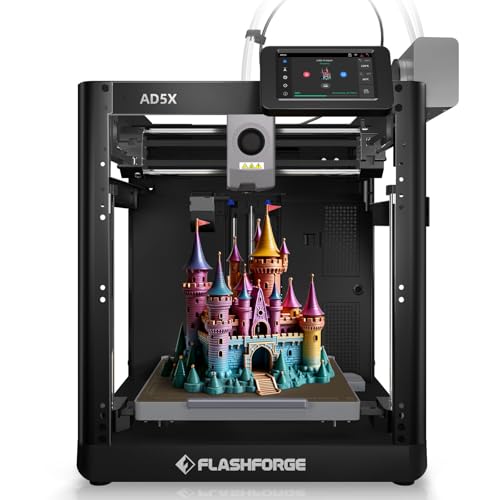
This variant extends the color versatility with Intelligent Filament System (IFS), enabling multi-color printing and advanced filament handling. Expect auto-loading/unloading and a large filament capacity with up to 4 kg auto-refill capability. With 600 mm/s travel speed and an all-metal CoreXY chassis, it supports rapid production of multi-material parts while maintaining print stability and accuracy across colors.
FLASHFORGE Adventurer 5M CoreXY Printer

The Adventurer 5M focuses on speed and ease of use, featuring a fully automatic leveling system and CoreXY motion for high-speed printing up to 600 mm/s. A 280°C direct extruder with a quick-detach nozzle supports rapid material changes, and the dual-sided PEI platform aids easy part removal. This model is suitable for users who prioritize quick setup and fast turnaround times on a range of projects.
FLASHFORGE AD5M Auto-Calibration CoreXY Printer

The AD5M offers fully automatic calibration with a robust all-metal CoreXY frame for high-speed precision. The 220x220x220 mm build volume balances compact size with ample room for mid-sized parts. A replaceable, quick-swap nozzle simplifies maintenance and rapid filament changes, making it a practical choice for users who require dependable auto-calibration and continuous operation in a busy workshop.
Buying Guide: CoreXY Printer Considerations
- Speed versus stability: CoreXY systems can achieve high speeds, but print quality depends on frame rigidity, motion smoothness, and effective cooling. Look for robust all-metal construction, precise linear rails, and responsive control firmware to minimize artifacts at high speeds.
- Auto-leveling and calibration: Auto bed leveling reduces setup time and improves first-layer reliability. Evaluate the level of automation, how it handles bed compensation, and whether it supports your preferred print surfaces.
- Extruder temperature and materials: A higher max nozzle temperature expands material compatibility (PLA, PETG, ABS, CF-reinforced filaments, etc.). Ensure the hotend design minimizes clogs and maintains consistent extrusion with your target materials.
- Build volume and footprint: Choose a size that fits your workspace while providing enough room for the largest parts you plan to print. Build volume often trades off with printer footprint; plan accordingly.
- Multi-color and multi-material support: If your projects require different colors or materials in a single print, prioritize printers with multi-color capabilities or an intelligent filament system. Suck-in filament handling and switching speed matter for productivity.
- Open-source vs closed ecosystems: Open-source slicers and firmware offer customization, community support, and compatibility with various software. Closed systems may be simpler but limit flexibility.
- Maintenance and accessibility: Look for printers with easily accessible hotends, quick-swap nozzles, and straightforward maintenance routines. Regular checks on belts, couplers, and bearings help sustain accuracy at speed.
- Monitoring and safety features: Built-in cameras, filament sensors, and enclosure designs can improve reliability, especially for remote or unattended operation. Ensure proper ventilation for higher-temperature materials.
These considerations help compare models across speed, reliability, material capabilities, and ease of use. When selecting a CoreXY printer, map your typical projects to these criteria—whether you prioritize ultra-fast prototyping, multi-color projects, or robust high-temp performance for engineering-grade parts.