Best Cork Underlayment for Tile Floors: Quiet, Durable Options for Your Home
Looking for the best cork underlayment for tile floors? This guide highlights five top cork-based underlayments that reduce noise, help with moisture control, and improve comfort underfoot. Each option is explained with who it’s best for, key benefits, and a clear trade-off so you can choose confidently for kitchens, baths, or living areas.
| Product | Best For | Key Benefit |
|---|---|---|
| Panelee 200 Sq. Ft. Cork Roll | DIY enthusiasts and large projects | Large roll size; versatile use; good sound absorption |
| QEP 72000Q Natural Cork Underlayment Roll | Ceramic tile and stone installs | Crack isolation and sound reduction |
| Eco Cork Foam Floor Underlayment | Vinyl, laminate, and cork flooring | Built-in vapor barrier; easy installation |
| CAPITOL Premium Cork Underlayment Roll | Floating or glued floors | Crack isolation; sound reduction |
| CAPITOL Premium Cork Underlayment Sheets | Smaller spaces or precise cuts | Crack isolation; versatile sheet format |
Panelee Cork Roll Underlayment — 3mm, 48″ x 600″
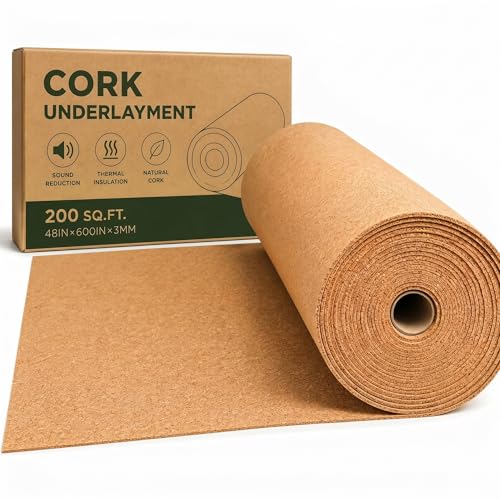
The Panelee Cork Roll provides a 3 mm thick, large 48″ by 600″ roll suitable for wide-area tile projects and DIY adjustments. It’s dense enough to absorb sound and minimize heat transfer, while remaining natural and low in volatile emissions. This roll is best for buyers planning custom cuts or multiple room applications, such as kitchens, offices, or dorm spaces. A key limitation is that very small patches require careful trimming to maintain uninterrupted underlayment coverage.
QEP Natural Cork Underlayment Roll — 4 ft x 50 ft (200 sq ft)

QEP’s roll is designed for ceramic tile, stone, marble, glued wood, and floating floor systems. It doubles as a crack isolation membrane, resisting stress crack transfer up to 1/8 inch and offering solid sound absorption. This option suits users seeking a proven, traditional cork underlayment with robust crack protection, especially under heavy tile installations. It may be less ideal for vinyl-first projects that prioritize vapor barriers built into the underlayment.
Eco Cork Foam Floor Underlayment — 100 Sq Ft

Eco Cork Foam combines cork with a built-in 6 mil vapor barrier, making it suitable for moisture-sensitive installations such as vinyl plank, laminate, and cork flooring. It emphasizes sound insulation and includes easy installation features like self-sealing tape and a smooth roll design. Choose this for projects where moisture control is a priority along with straightforward setup. A limitation is that it’s optimized for interlocking or laminate-like systems where the vapor barrier helps prevent humidity ingress.
CAPITOL Premium Cork Underlayment Roll — 6 mm, 200 sq ft

This 6 mm CAPITOL roll is a natural cork underlayment designed for tile, stone, marble, glued wood, and floating floor systems. It acts as a crack isolation membrane and reduces sound transmission both across and through floors. It is well-suited for larger tile projects or installations in multi-room areas where vibration and crack transfer are concerns. A potential drawback is the heavier roll that may require more effort during handling and cutting.
CAPITOL Premium Cork Underlayment Sheets — 6 mm, 150 sq ft

Capitol’s cork underlayment sheets provide a compact 6 mm option in a 2′ x 3′ size, ideal for precise cuts and smaller installations. The sheets maintain the same crack isolation and sound-reduction properties as their roll counterpart, making it a good choice for bathrooms, kitchens, or small remodels where uniform coverage is needed without handling large rolls. The trade-off is more seams to manage than a continuous roll in larger rooms.
Buying Guide: Key Considerations For Cork Underlayment With Tile
- Moisture Management: If your space has high humidity or potential water exposure, prioritize underlayments with built-in vapor barriers (like Eco Cork Foam) or moisture-tolerant performance.
- Crack Isolation Effectiveness: For homes with shifting subfloors or heavy tile loads, choose products marketed as crack isolation membranes to reduce stress transfer.
- Sound Reduction: If you need quieter rooms, look for denser cork formulations and products specifically noting sound absorption or sound transmission class improvements.
- Installation Type: Roll formats are efficient for large spaces; sheets and tiles offer precision for tight cuts or irregular areas. Consider your space layout when selecting between rolls and sheets.
- Compatibility: Verify compatibility with your chosen tile adhesive system and flooring type (ceramic, stone, engineered wood, vinyl, etc.).
- Thickness: Thicker underlayments (e.g., 6 mm) provide better sound and moisture buffering but add height; ensure floor height remains compatible with doors and transitions.
Frequently Asked Questions
- Q: Do cork underlayments require any special adhesive or installation method? A: Most cork underlayments are installed with standard floor adhesives or directly beneath tile with appropriate thin-set mortar, following product-specific guidance for seam treatment and bonding.
- Q: Can cork underlayment be used under all types of tile? A: Cork is versatile for ceramic, stone, and some engineered surfaces, but always check the manufacturer’s recommendations for your exact tile and subfloor.
- Q: Will cork underlayment improve floor warmth? A: Cork’s natural properties help reduce heat transfer and improve comfort in many installations, especially when paired with heated floors.
- Q: Is cork underlayment environmentally friendly? A: Cork is a renewable material sourced from cork oak trees, offering an eco-friendly option when sourced responsibly.
- Q: Are there any installation concerns with cork underlayment? A: Proper subfloor flatness, surface cleaning, and adherence to manufacturer guidelines are essential to prevent telegraphing or edge lift on tiled surfaces.
- Q: How do I choose between a roll and sheet option? A: Use rolls for large, open areas to minimize seams; use sheets for smaller spaces or where precise cuts are needed.