Best Internal Door Draft Excluders for a Cozy, Energy-Efficient Home
Door draft excluders for internal doors help seal gaps, reduce energy loss, and quiet noisy spaces. This guide highlights five top picks suited for different needs—whether you want quick installation, self-adhesive ease, or a heavy-duty under-door design. Each product below is evaluated for who it’s best for and why it stands out, along with a practical caveat to consider before buying. Use this overview to choose an effective solution for rooms, hallways, basements, and offices.
Summary table of selected products:
- Hojoy 2 Pack Under Door Draft Stopper — Best for quick, flexible installation and soundproofing on many floor types.
- BKSAI Door Draft Stopper No Adhesive — Best for tool-free, no-drill installation with adjustable sizing.
- JNEKWOZ 36″ Door Draft Stopper — Best for solid self-adhesive sealing and easy under-door use.
- GroTheory 2 Pack Door Draft Stopper — Best for versatile, self-adhesive multi-surface use and energy savings.
- MAGZO Door Draft Stopper — Best for adjustable fit and durable, washable cover.
Hojoy 2 Pack Under Door Draft Stopper

Best for quick, flexible installation across different doors and floor types. This 2″ by 39″ silicone and fabric draft stopper can bend and deform to fit gaps with a seamless seal, reducing air leakage and external noise. The product emphasizes energy savings in both winter and summer environments and offers soundproofing benefits for bedrooms and living rooms. A potential limitation is that adhesive-based options may be sensitive to door finish or texture, which can affect long-term adhesion on certain surfaces.
BKSAI Door Draft Stopper No Adhesive

Best for tool-free, no-drill installation with adjustable sizing. The foam cushion under the door is designed for a 24–29 inch width and a distance under the door of 0.2–0.9 inches, making it suitable for standard interior doors. It uses a simple slide-in cover with elastic loops to prevent slipping. Choose this if you want to avoid adhesives and prefer a customizable fit. A caution: be sure to measure door clearance accurately to avoid a loose fit or binding under the door.
JNEKWOZ 36″ Door Draft Stopper
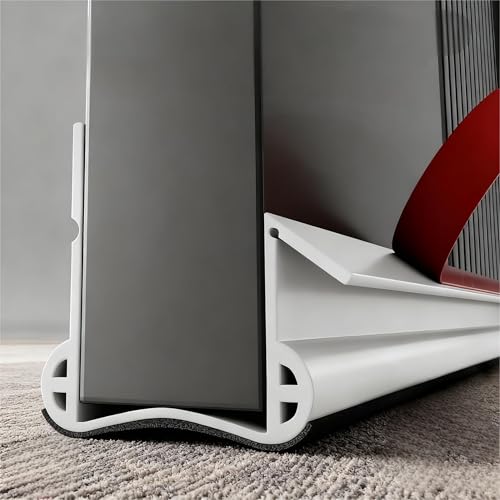
Best for effective energy savings and strong self-adhesive sealing. This 36″ long, white door draft stopper reduces cold drafts and dampens outside noise with a highly elastic sealing design and a back adhesive. It is compatible with wooden, aluminum, and PVC doors. A note: the self-adhesive may require surface prepping for best adhesion, and removal can leave minimal residue on some finishes.
BKSAI Door Draft Stopper No Adhesive (Second Listing)

Best for a repeatable, simple installation with no glue or drilling. This design mirrors the concept of a customizable cushion under the door for 0.2–0.8 inch gaps and 24–29 inch widths. The product emphasizes ease of replacement and efficient heating or cooling retention. Limitation: it requires precise sizing to ensure the cushion sits snugly without binding when the door opens and closes.
STORMGUARD Internal Letter Box Draught Excluder

Best for blocking drafts at letter slots while maintaining pass-through clearance. This white PVC excluder includes brushes and a flap, creating a barrier against drafts through mail slots. It is quick to fit with pre-drilled fixing holes. A caveat is that its focus is specific to letter boxes and it complements rather than replaces door gaps in other rooms.
GroTheory 2 Pack Door Draft Stopper

Best for versatile, multi-surface use and energy savings. The under-door sweep uses a self-adhesive design and triple-layer sealing to reduce noise and dust entry. It is suitable for exterior and interior doors, RV doors, and even some windows. Caution: placement on delicate floor finishes should be tested first to avoid potential adhesive residue or surface damage.
Buying Guide
What size and material should I choose?
- Measure door width and gap height carefully. Most options are 2″ wide and 39″ long, but some models offer 24–29″ widths for tighter doors.
- Consider floor type (hardwood, tile, carpet) to ensure the draft stopper moves smoothly and does not scuff surfaces.
Adhesive vs. no-adhesion—what works best?
- Adhesive, like self-adhesive foam or silicone strips, can provide a tight seal but may leave residue or require surface prep. They work well on clean, smooth door bottoms.
- No-adhesion designs (inserts, under-door cushions) avoid residue and are easy to move between doors but need precise sizing and alignment.
Noise reduction and energy savings
- Look for products marketed as soundproofing or insulating to ensure the seal helps with both noise and temperature control.
- Three core benefits: reduced heating/cooling loss, minimized dust, and quieter rooms.
Installation considerations
- Under-door blockers typically require light assembly or simple fitting; ensure there is no binding when doors swing.
- For multi-room use, choose a product with adjustable length or multiple pack options to cover different door sizes.
Multi-surface compatibility
- Some options are designed for wooden, PVC, or metal doors. Confirm compatibility with your door type to avoid damage or poor adhesion.
FAQ
- Q: Do these works on carpeted floors?
- A: Yes, many are designed to slide under doors over various floor types, but some may require thinner carpets for smooth operation.
- Q: Will these leave marks on floors or door finishes?
- A: Adhesive models can leave residue on some surfaces. No-adhesive models avoid this but require precise sizing.
- Q: How do I measure for the correct size?
- A: Measure door width and the gap height. Choose a product that matches or exceeds the measured gap for a snug fit.
- Q: Are these hard to install?
- A: Most options are designed for quick installation with minimal tools or none at all, depending on the model.
- Q: Can I trim these to fit odd door sizes?
- A: Some models support trimming; check product instructions for safe cutting guidelines.
- Q: Do they help with cooling in summer?
- A: Yes, sealing gaps reduces air exchange, improving efficiency for cooling and heating.