Best Electricity Usage Monitors for Real-Time Home Energy Tracking
Discover top electricity usage monitors that help households track power consumption, optimize energy use, and potentially lower bills. This guide highlights five dependable options with real-time data, grid compatibility, and safety certifications to fit typical American homes. Each selection features robust monitoring, easy installation, and useful insights for daily energy decisions.
| Product | Brand | Key Benefit |
|---|---|---|
| Emporia Vue 3 Home Energy Monitor | EMPORIA | UL-certified, real-time energy management with solar/net metering |
| Upgraded Watt Meter Plug | MECHEER | Inline plug monitor with 8 display modes and cost tracking |
| Smart Home Energy Monitor (16x60A) | Refoss | 16 branch sensors for detailed whole-home monitoring |
| Upgraded Watt Power Meter Plug | MECHEER | Multiple parameters with adjustable backlight and overload alert |
| P3 P4400 Kill A Watt | P3 | Simple, focused usage monitoring with day/week/month views |
Emporia Vue 3 Home Energy Monitor

The Emporia Vue 3 is a UL-listed home energy monitor installed in the circuit panel using clamp-on sensors. It supports single-phase, single-split phase, and 2-wire systems, with optional 3-phase and 4-wire Wye configurations using an additional 200A sensor sold separately. Real-time monitoring covers solar generation and net metering, helping households optimize usage alongside distributed energy resources. The device emphasizes safety and reliability, backed by a 1-year warranty. The Vue 3 is designed for ongoing energy management, offering insights and automation that can help prevent costly outages or equipment strain.
Key features include in-panel installation, broad phase support, and continuous energy management across day-to-day operations and solar activity. The combination of UL certification and real-time data enables homeowners to identify efficiency improvements, schedule high-load tasks for off-peak times, and maintain safer electrical environments. This monitor is suitable for users seeking a scalable, integrated solution that aligns with smart home ecosystems and energy autonomy goals.
Upgraded Watt Meter Plug

This plug-in energy monitor measures power (W), energy (kWh), voltage, current, frequency, power factor, unit price, and total cost. It features eight display modes to provide at-a-glance info while appliances run. The device includes overload protection that activates a warning when power draw exceeds a preset threshold, promoting safety for high-wattage devices. Made with quality ABS materials for durability, the unit is designed for standard US outlets, making it an accessible option for monitoring individual appliances or electronics without panel installation.
With cost-tracking and multiple display modes, users can quickly assess how much electricity their devices consume in real time and over time. The clear backlit display is visible in different lighting conditions, and the overload alert helps prevent overheating or electrical hazards. This monitor is ideal for users who want a straightforward, portable solution for monitoring single-appliance energy use and cost implications without modifying their home’s electrical panel.
Smart Home Energy Monitor (16x60A)

The Refoss Smart Home Energy Monitor offers comprehensive energy tracking with 16 branch circuit sensors, each rated up to 60A, and two main circuits up to 200A. It supports various single-phase and three-phase configurations, including TN/TT neutrals, with incorporation into standard home panels. The system provides 24/7 monitoring via a dedicated app, giving real-time power, voltage, current, and power factor data for major loads like heating, cooling, and water heating. Recent software updates add features such as energy statistics export and simplified CT management, improving usability for ongoing optimization.
Designed for heavy-duty households, this monitor aims to illuminate how different devices contribute to overall energy use. The 16-sensor setup enables granular visibility into branch circuits, promoting targeted efficiency improvements. A one-year warranty adds confidence in long-term reliability and potential energy savings through informed behavioral changes and load shifting.
Upgraded Watt Power Meter Plug
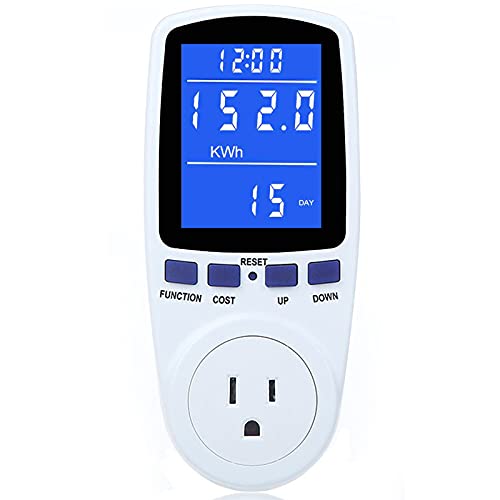
This watt meter plug tracks power (W), energy (kWh), voltage, current, frequency, power factor, cost, and maximum/minimum values, with eight display modes. An adjustable 0–3680W overload threshold lets users tailor alerts to their equipment and preferences. The display includes a backlight with multiple timing options, enabling easy reading from various angles and lighting conditions. It is built with durable PC plastic for stability and heat resistance and uses standard US sockets for compatibility with common household devices.
The device provides practical insights on daily usage and cost, helping households identify energy hogs and compare efficiency across devices. The overload warning feature adds a safety layer for high-wattage appliances or faulty equipment. This monitor is well suited for users who want a compact, plug-in solution that delivers essential energy metrics and alerting without installation complexity.
P3 P4400 Kill A Watt

The P3 P4400 Kill A Watt offers straightforward electricity usage monitoring with multiple viewing modes and time-based analytics. It enables users to track daily, weekly, monthly, and yearly usage, providing a simple, reliable snapshot of consumption. The screen is designed for easy readability, helping homeowners quickly interpret energy costs for individual devices. This monitor is ideal for those who want a low-cost, no-frills solution to quantify energy use and establish baseline consumption figures for budgeting and efficiency efforts.
As a compact, consumer-focused device, it emphasizes clarity and simplicity, making it a good entry point for beginners or for quick checks of appliance energy use. It does not require installation beyond plugging the meter into an outlet and plugging the device into the monitor, offering a quick way to compare devices and identify energy inefficiencies across a typical American home.
Buying Guide: Key Considerations for Electricity Usage Monitors
- Installation and scope: Decide between in-panel monitors (higher setup cost, broader coverage) and plug-in meters (lower cost, quick setup, device-level data).
- Measurement range and sensors: Consider the number of circuits or devices you want to monitor. Panels with multiple branch sensors provide granular insights, while a few main sensors cover general usage.
- Safety and certification: Look for UL or ETL certifications for electrical safety. This matters for long-term reliability and peace of mind in U.S. homes.
- Real-time data and historical trends: Choose products that offer real-time monitoring plus historical data (hourly, daily, monthly) to identify usage patterns and opportunities for savings.
- Solar and net metering compatibility: If you have solar, ensure the monitor can track solar production and net metering to optimize self-consumption.
- App experience and integrations: A strong companion app (iOS/Android) and compatibility with smart home ecosystems (like Home Assistant) can enhance usability and automation.
- Display readability: For plug-in meters, a clear, backlit display helps you read data easily in various lighting conditions.
- Data export and analysis: Some models support exporting energy data for offline analysis or budget planning.
- Warranty and support: A reasonable warranty period and available customer support can be valuable for troubleshooting and longevity.
- Budget vs. needs: For simple device-level monitoring, a Kill A Watt-style monitor may suffice. For whole-home visibility and solar tracking, panel-based solutions offer deeper insights.
Overall, the best choice depends on your goals: quick appliance-level insight, comprehensive whole-home monitoring, or a blend of both. For households with solar or complex HVAC systems, a multi-sensor panel monitor provides the most actionable data. For renters or those seeking a fast start, plug-in meters offer immediate value with minimal setup.