Best Fabric Projects for Projector Screens: Top 5 Materials and Materials-Driven Picks
Answering your search for durable, high-quality fabric options for projector screens, this guide highlights five practical fabrics and finished screens that optimize image clarity, color, and ambient light handling. These picks suit DIY builders, home theater set-ups, outdoor movie nights, and classroom projects. Each product is evaluated for who it’s best for, why, and a practical limitation to consider.
The table below summarizes the five selected products, focusing on type, best-use scenario, and key strength. Use it as a quick reference when deciding which fabric or screen to buy.
| Product | Best For | Key Benefit | Limitations |
|---|---|---|---|
| Yandood Projector Screen DIY Elastic Polyester Material | DIY fixed-frame setups up to 130″, 16:9 | Stretchable, easy to mount; good color and light handling | Black backing requires careful handling for rear-light scenarios |
| Yandood Projector Screen Material Ambient Light Rejecting Grey | Ambience-lit rooms, front projection | Best matte gray with 0.85 gain for color contrast | Grey may reduce brightness in very dark rooms |
| Mdbebbron 150 Inch Projection Screen 16:9 | Outdoor/indoor big-screen use | Anti-crease, portable, foldable for travel | Polyester fabric; manage folds for setup |
| XINLEMY 150-inch Projection Screen | Large home theater, outdoor/indoor | Thick, flat fabric; 160° viewing angle | Requires proper mounting; larger footprint |
| DUYIKJ 84 Inch Foldable Projection Screen | Compact, portable front/back projection | Double-sided, 160° viewing, easy setup | Smaller size; double-sided design adds weight |
Yandood Projector Screen DIY Elastic Polyester Material

This fabric is a DIY-friendly polyester textile designed for wooden fixed-frame screens up to 130 inches with a 16:9 projection format. It is stretched and fixed on all four sides to create a stable viewing surface. The light-silver gray color improves contrast and reduces ambient light impact, supporting better color reproduction in moderately lit rooms. The black backing helps prevent light bleed from the back, which reduces reflection interference. Note that it is not suitable for rear projection, as light transmission continues through the fabric to some degree.
Best for: DIY enthusiasts building a fixed-frame screen in a home theater or classroom where a front-projection setup is used. This material is ideal for projects where a user wants a custom screen size under 130 inches and values a balance between color accuracy and ambient light control.
Why selected: It combines practical DIY installation with a front-projection-friendly gain profile and a strong backing to minimize backlight bleed, making it a versatile base fabric for custom projects.
Caution: The black backing helps block light from behind but avoid rear-projection configurations entirely, as the fabric is not designed for rear projection performance.
Yandood Ambient Light Rejecting Grey Screen Fabric

This is a multi-layer EPPE polymer projection screen fabric, designed to diffuse light evenly and deliver high-contrast, saturated color. The surface has a delicate matte finish, providing wide-angle image integrity beyond 160 degrees. The gain sits around 0.85, which supports vivid images without excessive hotspotting. The grey tint helps preserve color fidelity in environments with ambient light, and the fabric maintains good resolution (125 line pairs per mm). It’s suitable for front projection, and is marketed as an alternative to PVC and canvas-based screens in eco-friendly contexts. It is not recommended for very low-brightness projectors below certain ANSI levels due to its matte nature.
Best for: Rooms with some ambient light where high color saturation and broad viewing angles are desirable. Ideal for those seeking a grey, ambient-light-friendly screen surface rather than a bright-white surface.
Why selected: The ambient-light rejecting design and wide viewing angle make it a robust choice for living rooms or classrooms that cannot achieve full blackout.
Caution: Grey screens may feel dimmer in darker rooms if the projector output is modest; ensure projector brightness aligns with room lighting for optimal results.
Mdbebbron 150 Inch Projection Screen
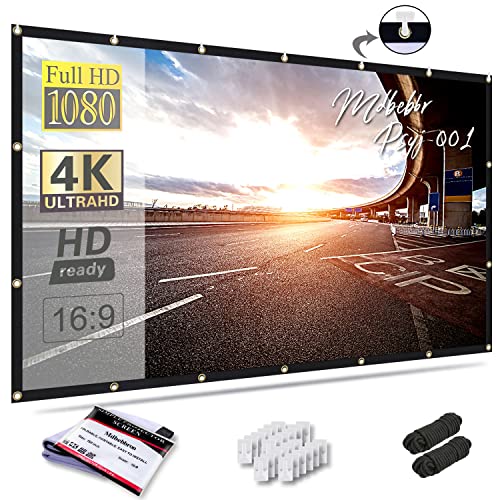
This screen uses a foldable, anti-crease polyester fabric, designed for easy storage and transport. It is suitable for a wide range of environments—home theater, office, educational settings, and outdoor events. The fabric is thickened and smooth, reducing wrinkles when folded and maintaining projection sharpness and brightness compared with many other screens. The one-piece design supports compact transport, while still providing a large 150-inch, 16:9 viewing area. This makes it a good choice for audiences who value portability without sacrificing image quality.
Best for: Situations requiring a large-screen experience that travels well, such as outdoor movie nights or mobile presentations. It’s a practical pick for users who need a balance of size, portability, and reliability.
Why selected: Its anti-crease property and foldable design are strong advantages for frequent transport, with a front-projection-friendly surface suitable for most standard projectors.
Caution: Folding and packing may require careful handling to maintain the surface smoothness prior to setup; ensure it is fully extended and tensioned before use to avoid wrinkles.
XINLEMY 150-Inch Projection Screen

The XINLEMY model offers a thick, polyester-based fabric that yields a flat picture with minimal light transmission, contributing to clear, bright images and vibrant color. It is a 150-inch, 16:9 screen with a wide 160° viewing angle, designed for both indoor and outdoor use. The installation is straightforward, with self-adhesive hooks and nylon ropes included for mounting. The large size suits family rooms, backyard movie nights, and classrooms that require a big, immersive display.
Best for: Large living rooms or outdoor spaces where a clear, bright image is essential and simple, quick setup matters. Suitable for households that place a premium on a flat projection surface and easy mounting.
Why selected: The combination of a high-contrast surface, broad viewing angle, and easy installation makes this a strong all-around fabric-screen option for big-screen experiences.
Caution: The 150-inch footprint requires adequate space and a stable mounting area to avoid sagging or edge curling during use.
DUYIKJ 84 Inch Foldable Projection Screen

This foldable screen uses 100% projector screen fabric within a polyester base, offering a sharp, bright image with strong color fidelity. It supports front and back projection and is designed for portability—lightweight and foldable with included installation tools. The 160-degree viewing angle helps accommodate larger groups. The compact 84-inch size is suitable for bedrooms, dorm rooms, or small living spaces where a full-sized fixed-frame screen is impractical.
Best for: Users needing a compact, portable screen for camping trips, small rooms, or quick-setups where both front and rear projection are desired. It’s a practical choice for travelers or casual movie nights.
Why selected: Its portability and dual-projection capability offer flexibility for varied environments, while the surface provides reliable color and brightness in a small format.
Caution: Smaller screen size may disappoint users seeking a cinema-scale experience; ensure the projector’s throw distance fits the 84-inch diagonal in the intended space.
Buying Guide: Key Purchase Considerations
- Screen size and aspect ratio: Determine the largest practical screen size for your room and the intended projection distance.
- Surface type and gain: Matte gray surfaces reduce ambient light bleed; white surfaces maximize brightness. Choose gain in line with room lighting and projector brightness.
- Front vs. rear projection: Back-projection fabrics require a specific backing. Choose fabrics explicitly designed for the intended projection method.
- Portability vs. permanence: Foldable and lightweight fabrics suit portable use; fixed-frame fabrics suit permanent installations.
- Durability and care: Dry-clean or hand-washable fabrics ease maintenance; consider crease resistance for travel and storage.
- Installation: Look for mounting options and included hardware (hooks, ropes, tapes) that match your wall or frame system.
- Color accuracy and viewing angle: Look for fabrics with wide viewing angles (around 160°) to minimize color shift at the edges.
- Environmental impact: Some newer fabrics substitute PVC with polymer-based compounds for lower environmental impact.
FAQ
- What fabric is best for ambient-light rooms? Light-rejecting or grey screen fabrics are designed to preserve color and contrast in rooms with some ambient light.
- Can I use any fabric for rear projection? No. Rear-projection fabrics require a diffusive front surface and a specific backing to prevent light from passing through to the viewer.
- Is a larger screen always better? Not necessarily. Consider room size, throw distance, and seating arrangement to avoid distortion and brightness loss.
- What maintenance do these fabrics require? Most fabrics are wipe-clean or hand-washable. Avoid harsh cleaners that may degrade the fabric’s optical properties.
- Are foldable screens good for daily use? Foldable screens are convenient for travel and occasional use but may require careful unfolding to prevent creases before setup.
- How important is the viewing angle? A wide viewing angle (around 160°) ensures consistent color and brightness for viewers seated off-center.