Best Fiber Mesh for Concrete Slab: Durable Reinforcement Options for Stronger Surfaces
Choosing the right fiber mesh for a concrete slab can improve crack resistance, extend durability, and support long-term performance. This guide reviews five top options commonly used in plastering, rendering, tiling, and cement-based repairs. Each product is evaluated for strength, ease of installation, and compatibility with alkaline environments. Use this overview to compare materials and select the mesh that best fits your project scale and substrate condition.
The following quick reference table highlights key details to help you compare at a glance:
| Product | Brand | Primary Use | Notable Feature |
|---|---|---|---|
| YIQUEDOK Fiberglass Mesh | YIQUEDOK | Plastering, rendering, walls | Alkaline resistant, easy install |
| SXKJDM Fiberglass Mesh (1x100m) | SXKJDM | Crack prevention on walls/ceilings | Non-self-adhesive, high tear resistance |
| Fibre Glast Scrim Mesh White | Fibre Glast | Concrete repairs, roofing, window screens | First Quality certified |
| Bubujia Premium Select Fiberglass Mesh | Bubujia | Plastering, rendering, tiling | Excellent stability and cohesion |
| SpiderLath Fiberglass Lath | SpiderLath | Stucco netting and reinforcement | Non-rusting, self-furring |
YIQUEDOK Fiberglass Mesh For Plastering
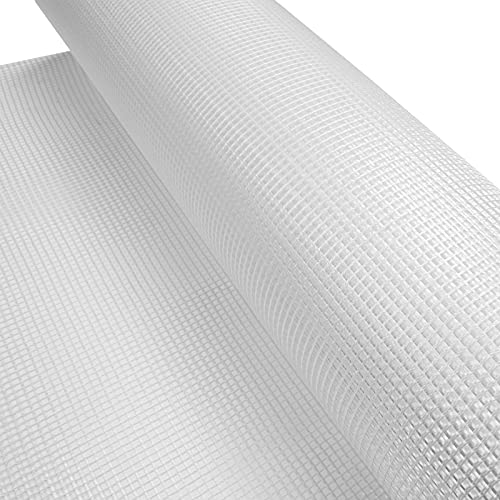
This fiberglass mesh from YIQUEDOK measures 39 inches wide and five yards long, offering robust stability and cohesion for plastered surfaces. It is designed to resist alkaline environments common in cement and gypsum applications, which helps reduce cracking over time. The non-adhesive construction allows installers to position and embed the mesh within the base coat with consistent coverage. Use it for exterior or interior walls, waterproofing interfaces, and crack-resistance layers in plaster or render systems.
Key features include easy installation, compatibility with common wall substrates, and a focus on reinforcing cement-based coatings. The mesh supports larger surface areas and can contribute to improved surface uniformity when properly embedded in wet base coats. For best results, follow standard render or plastering procedures and ensure the mesh is fully saturated within the mortar film before troweling.
SXKJDM Plastering Mesh 1x100m

The SXKJDM plastering mesh combines platinum fiberglass woven fabric with a polymer non-toxic emulsion coating. It is non-self-adhesive, so it requires embedding within the cementitious layer rather than relying on sticky backing. The mesh offers high-temperature resistance, strong tear resistance, and compatibility with cement and gypsum reactions. It can be cut to fit irregular surfaces and cracks of various sizes, making it suitable for walls and ceilings where enhanced crack control is needed in large areas. Note that edges may be slightly apart due to manufacturing tolerances, which is common with this material class.
Its non-adhesive nature emphasizes traditional embedding techniques, with emphasis on durability and resistance to alkaline cement blends. It’s particularly useful for projects where a robust reinforcement layer is desired beneath a plaster or render coat, helping to prevent reflective cracking and surface deformation over time.
SXKJDM Plastering Mesh 1x50m
This smaller SXKJDM roll shares the same base material and non-adhesive application as its 100-meter counterpart. It remains non-self-adhesive and cuttable to fit varying crack patterns and surface quirks. The mesh’s properties—insulation support, high strength, and resistance to alkaline reactions—make it a versatile choice for crack repair on interior or exterior surfaces. It is particularly useful for smaller repair zones where precise sizing and consistent reinforcement are required.
When integrating this mesh, ensure an even distribution of the adhesive or mortar behind the mesh and verify full contact across the surface to maximize crack mitigation without creating gaps behind the reinforcement layer.
Fibre Glast Scrim Mesh White

Fibre Glast Scrim Mesh is a versatile white fiberglass fabric, commonly used for concrete repairs, roofing, and window screen applications. The product is lightweight and easy to handle, with a 1-2 oz weight per square yard and a 50 inch by 36 inch sheet size. It’s described as first quality certified, emphasizing consistent quality across batches. This mesh provides reinforcement for repairs and supports coatings where additional tensile strength helps reduce crack propagation. It’s suitable for projects ranging from concrete patches to broader stucco or render refinements.
Practical use includes serving as a substrate under roof shingles or as a backing layer for joint tapes, with emphasis on reliable, uniform reinforcement. Its fabric-like feel makes it a flexible option for irregular repairs or curved surfaces that require conformability and strength without heavy weight.
Bubujia Premium Alkaline Resistant Mesh

Bubujia’s premium fiberglass mesh is designed for 39-inch width and five-yard lengths, offering extensive coverage for plastering, rendering, tiling, and gypsum-based walls. It emphasizes alkaline resistance and strong cohesion with the base coat, facilitating easy embedding in wet render and enabling reinforcement across large, flat surfaces. The mesh supports adaptations to uneven surfaces and helps strengthen the plaster layer, contributing to improved mechanical performance and durability of the finished surface.
Users should ensure proper embedding within the render and avoid gaps between mesh sections. The material is well-suited for larger repair zones in both interior and exterior applications, where consistent reinforcement is critical for long-term stability and crack control.
SpiderLath Fiberglass Lath

SpiderLath provides a fiberglass lath option for stucco and reinforced plaster systems. It is marketed as a non-rusting alternative to metal lath, with self-furring capability for improved attachment behind the base coat. The product claims six times greater strength than standard metal lath, which translates to enhanced crack resistance and surface integrity across stucco applications and wall assemblies. The self-furring design helps reduce labor time by simplifying the installation process on prepared substrates.
When using fiberglass lath, ensure compatibility with the chosen render or plaster system and follow local building codes for lath spacing and embedment depth. This option is particularly beneficial in environments prone to moisture and corrosion concerns where metal lath might corrode over time.
Buying Guide: Key Purchase Considerations
- Alkaline resistance: Cement and gypsum mixes are alkaline; select meshes explicitly rated for alkaline environments to prevent degradation and cracking.
- Adhesive vs. non-adhesive: Non-adhesive meshes require embedding within the base coat, while adhesive-backed options can simplify initial positioning. Choose based on project workflow and substrate.
- Mesh size and thickness: Larger surface areas benefit from broader or thicker meshes for improved load distribution; thinner meshes work well for small repairs or intricate surfaces.
- Substrate compatibility: Consider whether you need a reinforcement layer for concrete, plaster, stucco, or tile backing, and ensure the mesh is designed for that substrate.
- Length and width: Roll dimensions affect labor time and waste. For large slabs, longer rolls reduce joints; for detailed work, cut-to-size options are helpful.
- Certification and quality: Look for products with quality certifications or tested performance claims, especially for critical structural repairs or exterior applications.
- Installation technique: Some meshes require wet base coats and thorough embedding, while others may serve as a substrate or wash-coat reinforcement. Follow manufacturer guidelines for curing and drying times.
- Cost vs. durability: Balance upfront material costs with expected lifespan and the potential for fewer crack repairs over time.