Best Gas Log Splitter for Efficient Firewood Prep and Outdoor Work
Choosing a gas-powered log splitter can dramatically reduce the time and effort needed to prepare firewood. This guide highlights five strong options that balance power, portability, and versatility for American homeowners and professionals. Each product section includes key specs, real-world capabilities, and user-friendly features to help you compare on factors like tonnage, engine size, and mobility. Whether you need horizontal, vertical, or dual-position operation, these models cover a wide range of splitting tasks from small piles to large hardwood logs.
| Product | Tons | ||
|---|---|---|---|
| BILT HARD 18-Ton | 18 | 7 HP 209cc | Rapid auto return ram, portable full beam |
| BILT HARD 20-Ton | 20 | 7 HP 209cc | Towable with 13″ tires, fast 7s cycle |
| Landworks 20 Ton | 20 | 7 HP | Rapid auto return, Bucher gear pump |
| BILT HARD 25-Ton | 25 | 7 HP 223cc | Horizontal/Vertical, tow-ready |
| BILT HARD Full Beam 30-Ton | 30 | 7.5 HP 223cc | Dual-position, 2-stage gear pump |
BILT HARD 18-Ton Portable Gas Log Splitter

The BILT HARD 18-Ton model delivers robust splitting force with a 7 HP 209cc OHV engine, producing torque for easier chunking of tough wood. Its portable full-beam steel wedge design combines strength with mobility, aided by 10″ heavy-duty tires for transport across varied terrains. A notably fast cycle time of 7.5 seconds supports high-volume tasks, handling logs up to 20 inches long and 16 inches in diameter. This setup makes it suitable for homeowners dealing with frequent firewood preparation or small landscaping jobs.
BILT HARD 20-Ton Gas Log Splitter

The 20-Ton BILT HARD gas splitter uses a 7 HP 209cc OHV engine and a 2-stage gear pump to deliver substantial splitting power. Its towable design supports ATV/UTV towing up to 25 MPH, enabling easy relocation across job sites. With a practical 7-second cycle time, it can split logs up to 21 inches long, enabling faster completion of mid-to-large wood piles. The combination of portability and power makes it well-suited for remote or outdoor work where flexible transport matters.
Landworks Log Splitter Portable 20 Ton

Landworks offers a 20-ton portable splitter with a Rapid Auto Return ram and a Bucher gear pump for reliable, continuous splitting Power. The unit weighs about 130 pounds and uses a horizontal full-beam design with a steel wedge to balance strength with portability. It includes 10″ transport wheels for easy movement between sites. The 7HP gas engine provides a steady power curve, supporting a 7.5-second cycle reset between logs to sustain throughput on larger jobs, while accommodating logs up to 20 inches long and 16 inches in diameter.
BILT HARD 25-Ton Horizontal/Vertical Gas Splitter
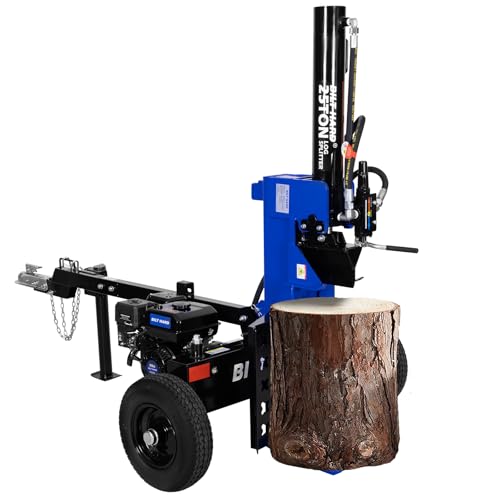
This 25-Ton splitter combines a robust 7 HP 223cc OHV engine with a dual-position operation system that enables quick switches between horizontal and vertical modes. It also features a ball hitch and DOT-rated tires for easy trailering and transport, plus safety chains for secure towing at speeds up to 45 MPH. It is designed to tackle dense, knotty logs efficiently, delivering significant throughput for larger yard tasks or professional use in a backyard shop setting.
BILT HARD Full Beam 30-Ton Gas Log Splitter

The 30-Ton Full Beam model is powered by a 7.5 HP 223cc OHV engine and uses a 2-stage gear pump to maximize splitting power. Its dual-position design supports horizontal and vertical splitting, and with 16″ DOT tires and a 2″ ball coupler, it’s built for versatile towing and stable transport across various terrains. The heavy-duty build is intended for demanding hardwood splitting tasks, enabling efficient processing of large logs with reduced manual labor.
Buying Guide
When selecting a gas log splitter, consider the following factors to align a model with your needs:
- Ton capacity: Higher tonnage means easier handling of knotty hardwood; match the log diameter and length you most often process.
- Engine and pump: 7 HP engines with 2-stage Bucher gear pumps provide strong, steady power. Check torque ratings and cycle times to estimate throughput.
- Portability: Towable models with ball hitches, 10–16 inch tires, and weight around 120–180 pounds offer better mobility for remote job sites.
- Operational position: Horizontal, vertical, or dual-position units reduce operator strain and adapt to log shapes and sizes.
- Cycle time: Shorter cycles (e.g., 7 seconds or less) improve productivity on large volumes of wood.
- Safety and controls: Look for two-hand operation, emergency shutoff, and sturdy wheels or stabilizers to prevent movement during operation.
- Maintenance and parts: Availability of spare parts (filters, seals, pumps) and dealer support affect long-term practicality and uptime.
- Stability vs. portability trade-off: Heavier units tend to be more stable but less mobile, so balance your workspace and transport needs.
In practice, for frequent outdoor work or small-to-mid-scale firewood projects, a 20-ton model with tow stability and a 7 HP engine offers a strong balance of power and mobility. For larger tasks or professional use, a 25- to 30-ton unit with dual-position capability delivers the highest efficiency, especially when handling dense hardwoods or irregular logs. Consider your typical log sizes, transport requirements, and whether you need vertical operation to decide the best fit.