Best Underground Gas Pipe Options for Safe Outdoor and Indoor Installations
Answering the practical needs of homeowners and contractors, this guide highlights the best underground gas pipe solutions. These products are best for outdoor grills, fire pits, space heaters, and other gas-fueled appliances that require buried or concealed routing. The top picks prioritize durable materials, secure fittings, cut-to-fit flexibility, and clear compatibility. Each option is chosen for reliability, ease of installation, and safety features. This overview helps buyers compare length, diameter, and BTU capacity to match their specific system requirements.
| Product | Brand | Length | Diameter | Best For |
|---|---|---|---|---|
| CSST Gas Line 37Ft 1/2″ | Vruelia | 37 ft | 1/2″ (0.625″ ID) | Outdoor grills and fire pits; precise fit to existing fittings |
| GasFlex 1″ Flexible Gas Pipe Tubing (165ft/50m) | GASFLEX | 165 ft | 1″ | Underground piping to remote yard zones |
| 1/2″ CSST Gas Line for Natural Gas & Propane | NORSGATEN | 33 ft | 1/2″ | Indoor/outdoor grills, stoves, generators with brass fittings |
| CSST Gas Line 70Ft 3/4″ | Vruelia | 70 ft | 3/4″ | Whole-home systems and larger outdoor setups |
| GasFlex 3/4″ Tubing (330ft/100m) | GASFLEX | 330 ft | 3/4″ | Extensive underground or surface runs |
CSST Gas Line 37Ft 1/2″ From Vruelia

This 37-foot CSST gas line targets outdoor applications like grills and fire pits. It offers a 1/2″ diameter with a 0.625″ inner diameter and up to 65,000 BTU, supporting typical exterior appliances. It ships with two brass NPT fittings for quick connections and includes gloves for handling. Best for: homeowners needing a precise, cut-to-fit line for a single outdoor appliance. Caution: ensure proper trenching and protective burial coverage to minimize exposure to physical damage.
GasFlex 1″ Flexible Gas Pipe Tubing (165ft/50m)

Designed for underground and indoor installations, this 1″ gas pipe from GASFLEX uses aluminum tubing with a PE jacket and is NFPA54 listed. Its long length supports routing to remote yard areas such as BBQ zones, hot tubs, or space heaters. Best for: homeowners planning extended underground or concealed runs with durable protection. Limitations: 1″ diameter may require additional fittings for tight corners or complex layouts.
1/2″ CSST Gas Line for Natural Gas & Propane

This 1/2″ CSST option uses a seamless 304 stainless steel core with a PVC jacket and brass fittings included. It’s suitable for both indoor and outdoor uses, including grills, heaters, stoves, and generators, and offers easier assembly with included components. Best for: installations needing a robust, leak-resistant metal path with reliable brass adapters. Caution: verify compatibility with existing gas valves and ensure proper sealing components during assembly.
CSST Gas Line 70Ft 3/4″ From Vruelia
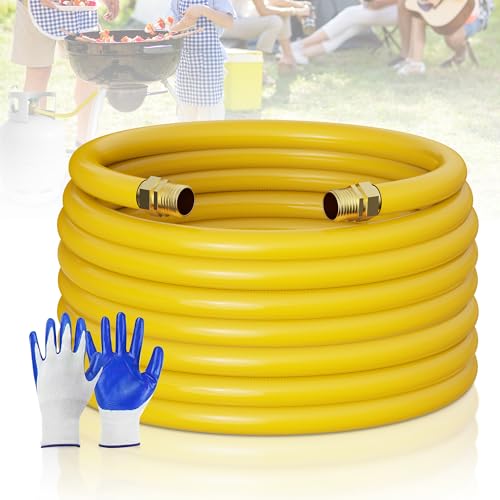
With 3/4″ diameter and up to 150,000 BTU capacity, this line is designed for larger, whole-home installations or substantial outdoor setups. It includes two brass NPT connectors and emphasizes precise sizing to prevent leaks. Best for: users needing longer runs and higher BTU capacity. Choose this if your system requires more power while maintaining secure brass fittings. Limitation: longer runs may require careful burial planning and supports along the route.
GasFlex 3/4″ Tubing (330ft/100m)

This 3/4″ GasFlex roll is intended for both indoor and underground installations and offers extensive length for large projects. It uses a durable aluminum core with a PE jacket, suitable for long, straightforward runs in yards or basements. Best for: projects needing substantial lengths without frequent fittings. Caution: ensure correct burial depth and protective sleeving to avoid physical damage over time.
38ft 1/2″ CSST Gas Line Kit

This 38-foot kit from JURPLIX provides plug-and-play compatibility with ASTM B280 brass connectors and a 1/2″ diameter. It is reinforced for outdoor and underground use with a 304 stainless core and UV-resistant yellow PE jacket. Best for: installations requiring quick, reliable cutting-to-length with minimal tools. Caution: the kit’s shorter length may necessitate additional fittings for extended runs.
Buying Guide
What to consider when selecting underground gas piping:
- Length and routing: Choose lengths that minimize joints and optimize slope for safe venting and pressure stability.
- Diameter and BTU: Match the line diameter to the expected BTU load of your appliances. Higher BTU requires larger diameter lines to maintain flow.
- Material and safety: CSST and stainless steel lines with brass fittings offer strong durability and leak resistance. Ensure proper burial protection and jacketing for outdoor use.
- Fittings and connections: Look for included brass fittings and ease of assembly. Avoid plastic-only systems for critical connections.
- Installation environment: Underground, surface-mounted, or attic/crawl-space runs each have distinct requirements. Confirm NFPA54 or local codes compliance.
- Maintenance and repairs: Flexible lines allow cutting and redrawing routes but require careful reattachment of fittings to prevent leaks.
Common Scenarios
- Outdoor grill or fire pit near the home: A 37 ft to 70 ft CSST run with 1/2″ or 3/4″ diameter is often sufficient.
- Whole-home or long-range yard installation: Longer 3/4″ runs or 1″ lines support higher BTU requirements and broader coverage.
- DIY cut-to-fit projects: Look for kits that advertise easy cut-to-length and include necessary fittings, seals, and adapters.
FAQ
- Q: Can these lines be buried directly underground?
A: Yes, many are rated for underground use, but always follow burial depth guidelines and use protective sleeving where needed. - Q: Do these kits include all necessary fittings?
A: Most include brass fittings and required components, but verify that you have the correct adapters for your appliances. - Q: What is CSST and why choose it?
A: CSST provides flexible, corrosion-resistant gas piping with good resistance to leaks when properly bonded and installed. - Q: How do I determine BTU needs?
A: Calculate the total BTU rating of all gas appliances on the line and choose pipe capacity that exceeds the combined load. - Q: Are there safety considerations for outdoor lines near electrical sources?
A: Yes, ensure bonding, proper routing away from electrical hazards, and adherence to local gas codes and NFPA54 standards.