Best Homebrew Grain Mill for Efficient Brewing
Finding a reliable grain mill can dramatically improve your homebrewing efficiency by giving you precise control over grind size and mash efficiency. The following selection focuses on durable, adjustable, and high-capacity mills designed for malt, barley, and malted grains. Each option supports either manual cranking or low-speed drill use, with sturdy bases and hardened rollers to protect husks while maximizing sugar extraction. Compare features, capacities, and setup options to choose a model that fits your batch size and workflow.
Summary of Featured Products
| Product | Brand | Capacity | Drive | Roller Type | Note |
|---|---|---|---|---|---|
| Brewland Grain Mill | Brewland | 7.7 lb hopper | Manual or electric drill | 2 rollers | Adjustable gap via 8mm hex shaft |
| FERRODAY Malted Grain Mill | Ferroday | 7.7 lb hopper | Manual or drill | 2 rollers | Adjustable gap 0.025–0.1 in |
| Mrbrew Malt Mill | MRbrew | Std metal base, 9″ wide | Manual or drill | 2 rollers | Durable base for bucket mounting |
| Grain Mill Brewing (RTUSUML) | RTUSUML | 11 lb capacity | Manual or drill | 2 rollers | Adjustable gap 0–2.5 mm |
| Grain Mill Grinder SFOWLOGE | SFOWLOGE | 11 lb capacity | Manual or drill | 2 rollers | Adjustable 0–2.5 mm |
Brewland Grain Mill For Homebrewing
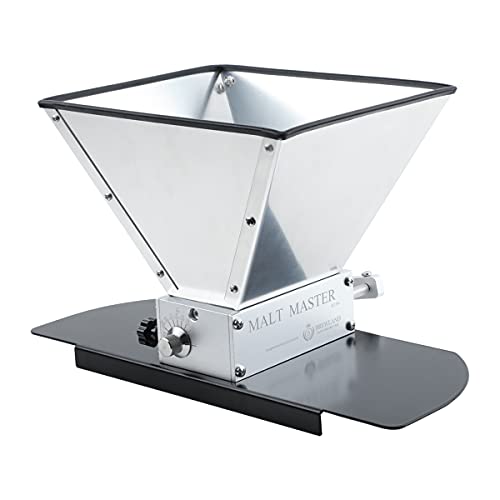
Brewland’s grain mill is built for brewing grains, malt, and barley with an 8-position calibration knob that adjusts roller spacing from 0.025 to 0.1 inch. This enables precise sugar extraction while protecting husks. It supports both manual cranking and attachment to a low-speed drill, thanks to an 8 mm hex socket on the drive shaft. A 7.7-pound hopper minimizes the need for frequent refills during medium to large batches. Note that it’s not designed for corn, coffee beans, soybeans, or sugarcane, and it won’t mill grains into powder.
FERRODAY Malted Grain Mill With 2 Rollers

FERRODAY offers a heavy-duty two-roller design with a large 7.7 lb hopper for high-volume mashing. Its knurled rollers and adjustable gap (0.025–0.1 inch) pull grains through while preserving hull integrity for efficient sparging. The drill mode supports up to seven pounds per minute in ideal conditions. While it excels with malted barley and malted wheat, it is not suitable for corn or soybeans, and it’s optimized for grain crushing rather than flour production.
MRbrew Malt Mill With Adjustable Rollers

MRbrew delivers a metal-bodied malt mill with two adjustable rollers and a robust 9-inch-wide base designed to sit securely on a bucket. The dual-roller system allows precise adjustment from 0.025 to 0.1 inches, enabling consistent grind size for better maltose extraction. The unit supports attachment to a low-speed electric drill to reduce manual effort during longer mashes and large-batch brews. It emphasizes durability and stable operation in a homebrew environment.
Grain Mill Brewing 11 Lb Hopper (RTUSUML)
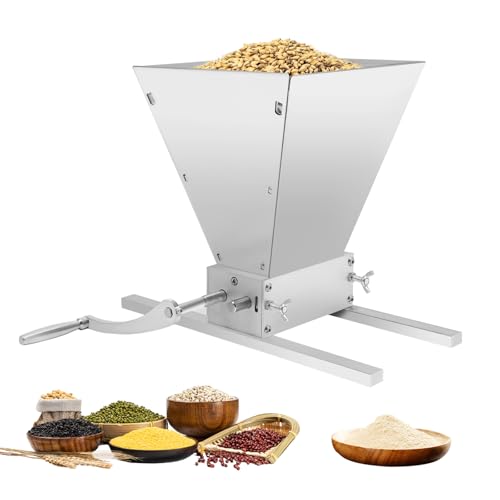
RTUSUML’s model combines a 11-pound capacity hopper with carbon steel rollers and a stainless-steel housing. The mill uses two adjustable rollers to deliver a smooth, consistent grind while preserving hull integrity. The adjustable gap range accommodates different grain densities, and the large hopper boosts productivity for sizable batches. The steel base reinforces stability during operation, whether used manually or with a drill.
Grain Mill Grinder SFOWLOGE

SFOWLOGE offers an adjustable two-roller system with a large 1.06-gallon hopper. The gap between rollers ranges from 0 to 2.5 mm, allowing precise customization for different grain densities to minimize husk damage. The combination of carbon steel rollers and a sturdy housing makes it suitable for repeated use in homebrew setups. The included aluminum mounting aids simplify placement near a bucket for convenient feeding of milled grain.
WELLBOM Grain Mill With Two Rollers

WELLBOM’s manual malt mill features two adjustable steel rollers and a large aluminum hopper with a robust metal base. The gap can be set from 0.025 to 0.1 inches, enabling consistent milling across various grain densities while minimizing husk damage. The open hopper design provides easy monitoring and feeding, and the sturdy base secures the mill to standard buckets for stable operation during long mashes or high-volume brews.
NIENIEE Stainless Steel Grain Mill

NIENIEE combines carbon steel rollers with a stainless steel hopper and housing to deliver a durable, wear-resistant grinding experience. Its precise 0–2.5 mm gap adjustment supports diverse grain densities while reducing chaff damage. The 1.06-gallon hopper capacity enhances throughput for medium to large batches, and the design emphasizes resilience and ease of cleaning for repeated homebrewing sessions.
DNYSYSJ 2-Roller Electric Grain Mill
This 110V electric grain mill offers two stainless steel rollers and a robust aluminum hopper with a capacity suitable for large batches. A belt-driven 60W motor at 75 RPM yields a substantial crush rate without overheating, while the corrosion-resistant stainless steel rollers resist wear over time. The unit is designed for fast, efficient milling and straightforward integration into a homebrew workflow with a standard US plug.
Buying Guide: Key Considerations For Choosing A Homebrew Grain Mill
- Grinding capacity and batch size: Choose a hopper size and roller system that match your typical brew scale. Larger hoppers reduce refills in bigger batches but require more space.
- Roller adjustability: Look for mills with adjustable gap settings to fine-tune grind size. A wide range (e.g., 0.025–0.1 inches or 0–2.5 mm) supports both delicate and robust malts.
- Manual vs. drill drive: Manual mills are simple and quiet, while drill-powered models boost throughput for frequent or large-batch mashing. Ensure compatibility with a low-speed drill if you plan to use this option.
- Hull integrity: Retaining hulls improves sugar extraction and reduces stray particulates. Knurled or well-designed rollers help feed grains evenly while preserving husks.
- Durability and stability: A sturdy base and high-quality materials (stainless steel or carbon steel with a solid frame) reduce vibrations and improve consistency during grinding.
- Ease of cleaning: Machines with smooth surfaces and detachable parts simplify cleaning between brews to prevent cross-contamination of flavors.
- Maintenance and replacements: Consider the availability of replacement parts, such as rollers and bearings, to extend the mill’s lifespan.
- Compatibility with buckets and mash terns: A wide base and standard bucket interfaces simplify setup, especially for larger homebrew operations.