Best Basement Lighting: Top LED Garage Lights for Basements
Finding the right lighting for a basement can transform the space from dim and utilitarian to bright and inviting. This guide highlights five reliable LED garage lights designed to illuminate basements, workshops, and storage areas with wide, even coverage. Each option offers adjustable panels, energy efficiency, and durable construction to withstand basement environments. Read on to compare features, installation, and performance across top-rated choices.
Summary of Selected Products
| Product | Brand | Light Output | Key Feature |
|---|---|---|---|
| Aoretic LED Garage Lights Bulb 2 Pack | Aoretic | 18000 LM total | 6+1 deformable panels for 360° coverage |
| Mefflypee LED Garage Lights 2 Pack | Mefflypee | 12000 LM | Five adjustable panels, 360° illumination |
| ABODONG LED Garage Light 2 Pack | ABODONG | ~15000 LM (approx.) | 6+1 deformable panels, 360° omnidirectional lighting |
| Adiding LED Garage Light 2 Pack | Adiding | ~20000 LM | E26/E27 base, 6+1 deformable panels |
| hykolity 4 Pack LED Shop Light | hykolity | 4400 LM per fixture | Linkable up to multiple units, 5000K |
Aoretic LED Garage Lights Bulb 2 Pack

These 180W garage lights deliver up to 18000 lumens with a 6500K daylight color temperature and a CRI above 80. The 6+1 deformable panels enable 360° coverage with adjustable angles up to 90 degrees, minimizing shadows and dead zones in attic, basement, and workshop spaces. Constructed with an aluminum heatsink, they emphasize heat dissipation for a long service life, claimed to exceed 50,000 hours. They’re designed to replace multiple traditional bulbs while achieving significant energy savings—benefits typical of modern LED shop lighting.
Mefflypee LED Garage Lights 2 Pack
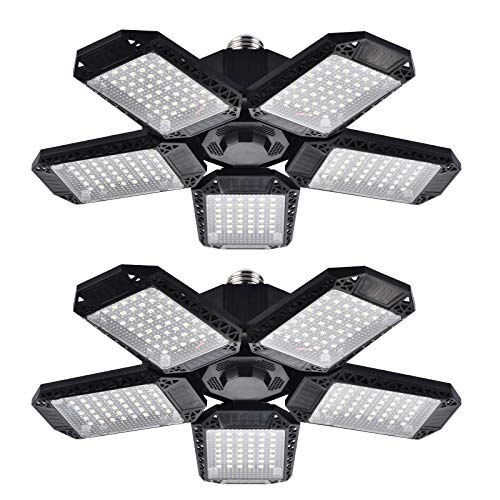
Mefflypee’s two-pack uses five adjustable panels that rotate up to 90 degrees, offering up to 360° coverage. The fixture emphasizes heat dissipation through a hollow design to extend lifespan while delivering an impressive 12000 lumens. With no flicker and strong energy savings, these lights are suited for basements, barns, and storage areas where broad, consistent illumination is needed. The design makes installation straightforward for DIY projects and quick upgrades from standard bulbs.
ABODONG LED Garage Light 2 Pack

ABODONG’s dual-pack features six deformable panels plus a central lamp to deliver 360° omnidirectional lighting. A 6500K daylight white color temperature with a CRI above 80 ensures bright, true-to-life color rendering ideal for workshop tasks. The design supports flexible mounting or hanging, and the adjustable panels reduce dark corners in basements, attics, or utility rooms. The fixture’s construction emphasizes robust heat management for longevity in cool basement environments.
Adiding LED Garage Light 2 Pack

Adiding offers a high-output option with up to 20,000 lumens split across 6+1 deformable panels, designed for basement, workshop, attic, and utility areas. The E26/E27 screw-in base provides plug-and-play ease—no rewiring required—making it a practical upgrade from conventional bulbs. The daylight 6500K temperature and CRI above 80 aid in reducing eye strain during detailed tasks and provide clear, even illumination across large spaces.
hykolity 4 Pack LED Shop Light Linkable

The hykolity four-pack provides 4400 lumens per fixture at 5000K, with ETL certification for safety and reliability. These lights are designed to be linked together, enabling scalable coverage across larger basement spaces. Their 50,000-hour lifespan reduces maintenance frequency, and the plug-in design simplifies installation. While slightly cooler in color temperature, the arrangement offers practical, high-output lighting for workshops, garages, and storage rooms with minimal energy use.
Meiqils LED Garage Light with Adjustable Panels
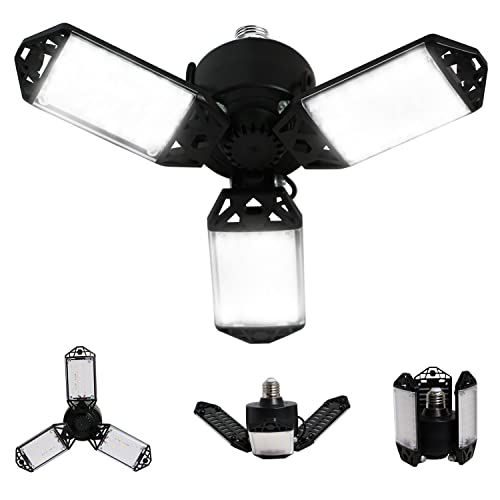
Meiqils offers an 80W configuration with 3 adjustable panels that can rotate up to 90 degrees, delivering 8000 lumens at 6500K daylight. The three-panel design provides comprehensive coverage for basement corners, and the fixture emphasizes long lifespan (up to 60,000 hours) with material safety certifications. The flexible layout helps distribute light evenly across irregular basement layouts, reducing shadows around stairwells or storage nooks.
Buying Guide: How to Choose the Right Basement Light
Key considerations ensure you pick a basement light that delivers consistent brightness, energy efficiency, and reliable performance over time.
- Light output and coverage: For large basements, look for high lumen totals (10,000+ per fixture) and multiple panels that adjust to cover corners and dead spots. A 360° coverage design minimizes shadows around support columns or storage shelves.
- Color temperature and CRI: 6500K daylight color helps with task visibility and color accuracy. A CRI of 80 or higher ensures better color rendering for workshops and hobby spaces.
- Adjustability: Deformable or rotating panels (0–90 degrees, with full 360° coverage) maximize distribution. Consider whether you prefer a center light plus side panels for uniformity.
- Installation and compatibility: E26/E27 screw-in bases simplify upgrading without rewiring. Linkable fixtures reduce wiring work for multiple fixtures in one space.
- Durability and heat management: Aluminum heatsinks and hollow panel designs improve heat dissipation, extending lifespan in cooler basement environments.
- Energy efficiency and lifespan: LED fixtures commonly save substantial energy and offer tens of thousands of hours of operation, reducing replacement cycles.
- Mounting options: Ensure your ceiling type supports hanging, flush mounting, or surface mounting as needed. Some fixtures include mounting hardware or cords for quick setup.
In evaluating options, balance brightness with coverage and installation ease. For mixed-use basements that include a workshop, a combination of high-output panels and a central light with adjustability typically yields the most even illumination. Durability and heat management are essential for spaces with variable temperatures or moisture exposure, so choosing fixtures with robust housings and proper certifications is prudent. Finally, consider how many fixtures you will need to achieve full coverage without significant gaps.