Best Louvers for Doors: Top Door Vent Grilles for Airflow
Answer: If you’re seeking effective door ventilation, choose a two‑sided louvered vent designed for interior doors. These inserts promote air exchange between rooms while preserving privacy and aesthetics. The top picks below are best for interior doors in homes, apartments, offices, or bathrooms. They vary by opening size, material, and installation method, so you can pick the best fit for your door thickness and style.
| Product | Brand | Opening Size | Material | Best For |
|---|---|---|---|---|
| INTERNAL VENTS Door Vent for Interior Doors | INTERNAL VENTS | 16 7/8″ x 3″ | Plastic | Small doors, lightweight installations |
| ABOUT VENT 18” x 4” | ABOUT VENT | 17.7″ x 3.6″ | Plastic | Standard interior doors, durable two‑sided airflow |
| Noheiwur Door Louver Vent Two Sided | Noheiwur | 20″ x 12″ | Aluminum alloy | Regular doors needing robust, long‑lasting vents |
| Steinberg14 1 Set Two‑Sided | Steinberg14 | 17.7″ x 3.6″ | Plastic | Budget‑friendly, easy install for interior doors |
| Repa Market 18″ x 5″ White Plastic | Repa Market | 18.11″ x 5.35″ | Plastic | Quiet, two‑sided air transfer for larger openings |
INTERNAL VENTS Door Vent for Interior Doors

The two‑sided door air vent grille fits a 16 7/8″ x 3″ opening with outer dimensions of 17 3/4″ x 3 5/8″. Made of plastic, its minimalist design blends with most interiors. Best for lightweight interior doors or closet doors where discreet venting is desired. This option emphasizes free air circulation between rooms without heavy hardware or complex installation.
Who it’s best for: small doors, renters, or spaces needing quick, simple venting without modifying door thickness. Why selected: compact, economical, and easy to install with a clean, unobtrusive look. Caution: ensure the door’s thickness and opening match the listed dimensions to avoid fit issues.
ABOUT VENT 18” x 4” Door Vent Cover
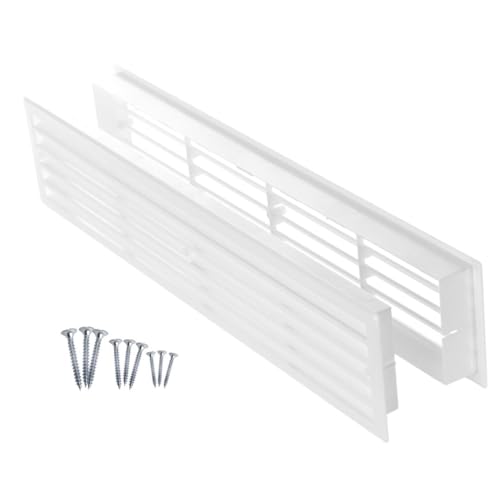
This louvered vent cover is designed for doors and furniture, with outer dimensions near 17.7″ x 3.6″ and inner air passage of 0.161 ft². It features a two‑sided design for balanced airflow and a durable plastic build. Best for interior doors where a thicker, more robust vent is preferred, such as bathrooms or living spaces with higher humidity.
Who it’s best for: homeowners seeking a long‑lasting plastic grille with two‑sided airflow. Why selected: dual‑sided design promotes even air exchange; versatile for cabinets or slim doors. Caution: check installation thickness to ensure the 1.06″ minimum fits your door or cabinet face reliably.
Noheiwur Door Louver Vent Two Sided

Two‑sided aluminum door vent grille with 45° oblique louvers is designed to maximize airflow while resisting rust and corrosion. Outer dimensions are 21.65″ x 13.78″ (front end) for a 20″ x 12″ opening, implying a robust installation suitable for doors and walls in higher traffic areas. Best for: doors requiring durable, metal construction and a more decorative edge. Caution: metal vents are heavier; ensure mounting hardware supports the weight and door structure.
Steinberg14 Two‑Sided Door Vent Cover

This white plastic vent measures 17.7″ x 3.6″ with a two‑sided design and screws for installation. It’s intended for interior doors and cabinets where moisture resistance is a priority. Best for: budget projects, quick installs, or rental homes needing simple door vents. Caution: plastic vents can show wear over time in very humid spaces; consider alternatives if you expect heavy use or moisture exposure.
Repa Market 18″ x 5″ White Plastic Vent

Outer frame 18.11″ x 5.35″ and neck openings of 17.24″ x 4.72″ or 17.04″ x 4.52″ support larger two‑sided installations for doors up to about 1.96″ thick. Made from white plastic, it emphasizes durability, easy maintenance, and a clean look. Best for: larger interior doors or spaces requiring stronger airflow. Caution: installation may require precise neck sizing and possible glue or screw mounting depending on door thickness and mounting method.
Buying Guide: Key Purchase Considerations
What size opening do you need?
- Measure the door opening precisely. Choose a vent with a front outer dimension that fits the cutout and a neck opening that matches the door depth.
- Two‑sided vents are typically better for balanced airflow between rooms.
What material suits your space?
- Plastic vents are lightweight, affordable, and corrosion‑resistant for humid spaces.
- Aluminum vents offer durability and a premium look but are heavier and may require sturdier mounting.
How important is aesthetics and noise?
- Look for smooth finishes and minimal profiles for a clean appearance.
- Consider louver angle and material; metal vents can be quieter and sturdier in high‑traffic areas.
Installation considerations
- Check door thickness compatibility and whether screws or adhesives are included or required.
- Ensure there is no interference with door operation or hardware such as hinges and handles.
Best use cases and limits
- Best for interior doors with frequent airflow needs, such as between living spaces, bathrooms, and closets.
- Avoid if you require high‑strength security doors or doors with unusual thickness where neck sizes don’t match.
FAQ
- What is a door louver vent? — A door louver vent is a grille installed in or on a door to promote passive airflow between rooms.
- Do I need professional installation? — Most options are designed for DIY installation with basic tools; verify depth and mounting hardware requirements.
- Which material lasts longer? — Aluminum vents are generally more durable, especially in humid spaces, but plastic vents can be sufficient for lighter use.
- Can these vents prevent door slamming? — Yes, by balancing air pressure, but they are not a substitute for door stops in high‑traffic areas.
- Will vents affect privacy? — Louver designs balance airflow with visibility; choose slat angles appropriate for your privacy needs.
- Are these suitable for cabinets or wardrobes? — Many options are designed for doors and can be installed on furniture pieces with the appropriate thickness.