Best Miter Saw Blade: Precision Options for Clean, Accurate Cuts
Introduction
Choosing the right miter saw blade enhances precision, finish quality, and user confidence. This guide presents five top picks that balance durability, cut quality, and versatility for common woodworking tasks. Each blade targets clean crosscuts, reduced vibration, and long life, making them suitable for hobbyists and professionals alike. The selections span 12-inch and 10-inch options to accommodate a range of saws and material types.
| Product | Diameter | Teeth | |
|---|---|---|---|
| DEWALT DW3128P5 / DW3123 | 12″ | 80T / 32T | Crosscutting versatility |
| DEWALT DWA112CMB | 12″ | 40T / 60T | Fine finish and accuracy |
| Freud LU91R012 | 12″ | 72T | Hi-density TiCo carbide blend |
| WEN BL1280 | 12″ | 80T | Ultra-thin kerf for efficient cuts |
| WEN BL1060 | 10″ | 60T | Fine finish option for smaller saws |
DEWALT DW3128P5/DW3123 12-Inch Crosscut Saw Blade Pack
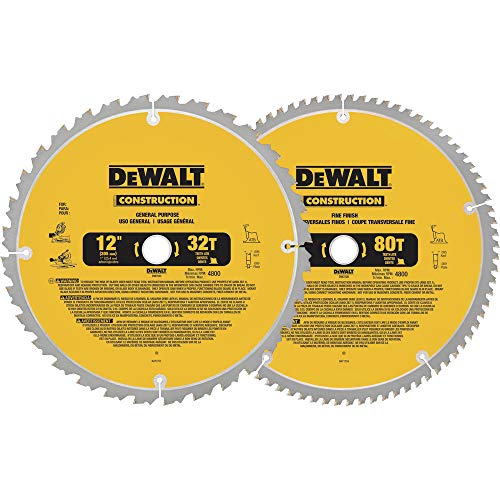
The DEWALT DW3128P5 80-tooth and 32-tooth carbide blades provide crosscutting versatility with clean, accurate results. The 80-tooth blade excels at fine finish work, while the 32-tooth blade handles faster crosscuts where a smoother finish is less critical. The blades are designed to minimize vibration and deliver precise, repeatable cuts, making them suitable for hardwoods and softwoods alike.
Key Features
- 80-tooth crosscut blade for smooth finishes
- 32-tooth blade for fast, accurate crosscuts
- Tungsten carbide construction for long-life edge retention
- Two-pack convenience reduces downtime
DEWALT DWA112CMB 12-Inch Fine Finish Combo Pack

This fine-finish combo pack includes 40-tooth and 60-tooth blades optimized for precise, clean cuts with reduced tear-out. The patented body slot design minimizes vibration, while the optimized tooth geometry enhances accuracy and control. The result is smoother edges on hardwoods, plywood, and solid stock, with fewer touch-up steps required after cutting.
Key Features
- 40T and 60T blades for different finish needs
- Patented body slot design reduces vibration
- Optimized geometry for increased accuracy
- Carbide-tipped blades for long life
Freud LU91R012 12-Inch 72-Tooth Miter Saw Blade

The Freud LU91R012 uses a premium TiCo carbide blend and a thin kerf design to maximize performance. Its 72-tooth configuration is optimized for crosscuts and fine finish work, delivering consistent, clean edges through tough woods. A negative hook angle helps control feed and reduces blade bite for smoother operation near the fence.
Key Features
- Premium TiCo carbide blend for durability
- 72-tooth crosscut precision
- Negative hook angle for controlled cuts
- Thin kerf minimizes material removal and power draw
WEN BL1280 12-Inch 80-Tooth Fine-Finish Blade
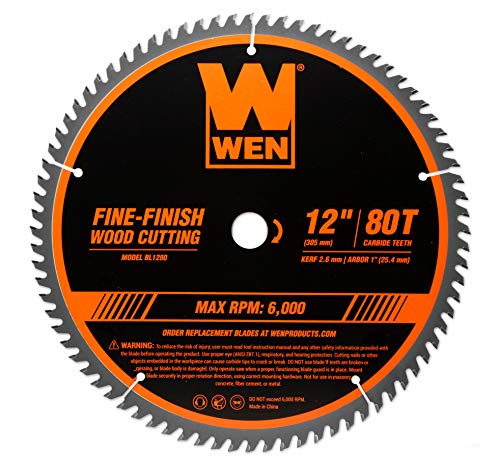
WEN’s BL1280 offers an 80-tooth configuration for fine finish work on miter saws. Its 12-inch diameter, 1-inch arbor, and 6,000 RPM rating support a broad range of woods while delivering near-glass edge quality. The ultra-thin kerf reduces horsepower needs and minimizes waste, helping achieve precise crosscuts with reduced vibration.
Key Features
- 12-inch blade with 80 teeth for fine finishes
- Ultra-thin kerf design for efficient cutting
- 1-inch arbor compatibility
- High RPM tolerance for versatile use
WEN BL1060 10-Inch 60-Tooth Fine-Finish Blade
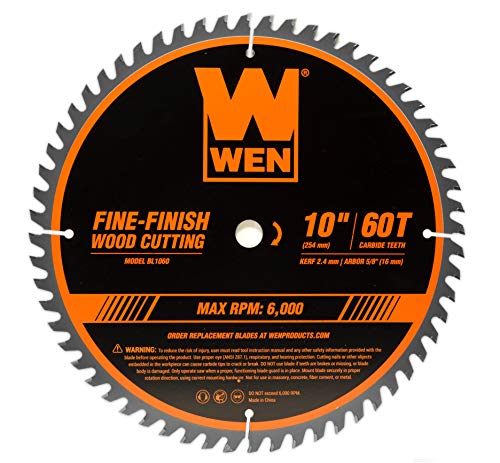
The WEN BL1060 is a 10-inch fine-finish blade designed for compact saws. Its 60 teeth provide a balance between fast feed rates and smooth edges. The ultra-thin kerf reduces material loss and power usage, making it a practical choice for delicate joinery, picture frames, and trim work on smaller projects.
Key Features
- 10-inch blade with 60 teeth for precise finishes
- Thin kerf minimizes waste and power draw
- Ideal for smaller miter saws and trim tasks
- Strong carbide tips for extended life
Buying Guide: Key Considerations For Miter Saw Blades
When selecting a miter saw blade, several factors influence performance and results. Consider the following viewpoints to match blade type to job requirements:
- Blade diameter and arbor size: Ensure compatibility with your miter saw’s diameter (commonly 10″ or 12″) and arbor (often 1″ or 5/8″).
- Tooth count and tooth geometry: Higher tooth counts (60–80T) yield smoother finishes on crosscuts, while lower counts (40–60T) cut faster with acceptable edges for softwoods or framing tasks. ATB (alternate top bevel) is common for crosscuts;
TC (TiCo) or carbide blends improve wear resistance and edge retention. - Kerf thickness: Thin-kerf blades remove less material and require less horsepower, but are generally more delicate; standard-kerf blades are sturdier for heavy cutting.
- Material compatibility: Some blades are optimized for hardwoods, softwoods, plywood, or laminates. Choose a blade with a tooth geometry suited to your material mix.
- Finish quality vs. speed: If finish quality is critical (e.g., furniture), prioritize blades with fine tooth counts and premium carbide blends. For rough framing, prioritize durability and cut speed.
- Vibration and ride: Blades with well-engineered body slots and balanced design reduce vibration, improving accuracy and operator comfort.
- Blade life and cost: Carbide-tipped blades last longer but cost more upfront. For frequent use, a balance between longevity and price matters.
In practical terms, professionals often keep both a fine-finishing blade (high tooth count) for precision work and a general-purpose blade (lower tooth count) for rapid crosscuts on framing tasks. For best results, ensure your saw’s RPM rating aligns with blade specifications to avoid overheating or blade wobble.