Best Motorized Projector Screen Options for Easy, Quiet Setup
If you’re shopping for a motorized projector screen, you want a model that combines smooth operation, durable fabric, and clear image performance. This guide highlights five top options that fit typical home theater, classroom, and office setups. Each product section explains who it’s best for, why it stands out, and any practical caveats. A quick buying guide and FAQ follow to help you compare features at a glance.
| Product | Screen Size | Best For | Key Benefit |
|---|---|---|---|
| YODOLLA 150″ | 150″ (diagonal) | Large home theaters and professional spaces | Extremely large viewing area with robust motor |
| DINAH 120″ | 120″ | Immersive movie rooms | 4K/3D HD ready with easy remote control |
| ZUEDA 100″ | 100″ | Compact spaces, versatile mounting | 160° viewing, wrinkle-free screen |
| Kayle 120″ | 120″ | Home theater and classrooms | 1.2 gain, wide viewing angle |
| VIVOHOME 84″ | 84″ | Smaller rooms and offices | Long-range remote and quiet motor |
YODOLLA 150″ Motorized Screen with 16:9 4K Ready

The YODOLLA 150″ screen uses a 16:9 format with a substantial viewing area, suitable for elite home theaters, large classrooms, and corporate presentations. The motorized assembly supports wall or ceiling mounting and includes a remote for easy control. It is designed for 4K HD content and offers a high-gain, wrinkle-free surface that reduces image distortion.
Best for: Large spaces requiring a cinematic scale, such as private villas, university auditoriums, or exhibition halls. The key advantage is the expansive image, which supports impactful presentations and immersive movies. Caution: The product notes emphasize careful measurement and installation—it’s a sizable screen that needs proper mounting alignment.
DINAH 120 Inch Electric Projector Screen

The DINAH 120″ screen provides an immersive 120-inch display ideal for movie rooms and professional settings. It includes remote control operation for effortless lowering and retracting, and is designed to support 4K 3D HD projection for sharp, vivid images. Its auto drop feature is convenient for frequent use in theaters or classrooms.
Best for: Enthusiasts seeking a large, reliable screen with convenient remote control for frequent use. Better for: spaces where quick setup and a dramatic viewing size matter. Limitation: As a larger model, ensure adequate wall or ceiling mounting space and ceiling height for full extension.
ZUEDA 100 Inch Motorized Screen
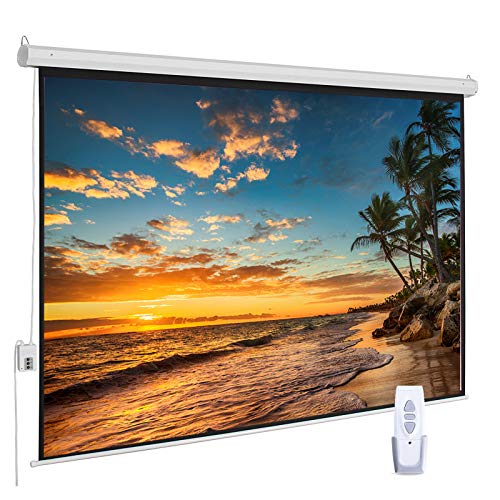
ZUEDA offers a 100″ diagonal with a 16:9 aspect ratio and a premium PVC matte white screen. It ships with a prewired power cord and a remote, enabling straightforward drops and rises. The 160° viewing angle and 1.1 gain provide broad image coverage with consistent color reproduction.
Best for: Home theaters and office spaces that require easy installation and a large, high-clarity image. Choose this if you want a wrinkle-free surface with a wide viewing angle. Caution: Confirm your mounting surface supports the overall size and weight of the unit.
Kayle 120″ Motorized Screen with Remote

The Kayle 120″ screen features a 16:9 format with a 1.2 gain surface and a 180° viewing angle. Its three-layer, black-backed fabric enhances contrast and reduces light penetration for vivid images. The remote includes RF capability, and a wall switch provides flexible control options.
Best for: Mixed-use spaces like living rooms, classrooms, and home theaters that require broad viewing angles and good color fidelity. Limitation: The fabric’s properties favor environments with controlled lighting; consider room light levels when planning placement.
VIVOHOME 84″ Motorized Screen

The VIVOHOME 84″ model offers a compact option with a 16:9 aspect ratio and an 84-inch diagonal. It supports 3D, 1080p, and 4K content with a matte white screen that provides a wide 160° viewing angle. The remote has a long-range capability, and the motor operates quietly—under 40 dB for a quieter theater experience.
Best for: Small to medium rooms, offices, and classrooms where space is at a premium. Better for: users who want a quiet, easily controlled screen with solid 4K readiness. Caution: The overall screen area is smaller, so check whether the room size matches your preferred viewing distance.
Buying Guide
What to consider when choosing a motorized projector screen
- Screen size and aspect ratio: Match the diagonal size and 16:9 or 4:3 format to your projector and room dimensions.
- Mounting options: Ensure wall or ceiling mounting compatibility and check ceiling height plus room depth for full extension.
- Gain and viewing angle: Higher gain increases brightness; a wide viewing angle helps if multiple seating rows are used.
- Motor and noise: Look for a quiet motor under 40 dB for minimal distraction during viewing.
- Remote control and controls: RF remotes are convenient; wall switches offer quick control for classrooms or offices.
- Durability and fabric: A matte white, black-backed screen helps color accuracy and light blocking; consider cleaning and maintenance.
- Usage environment: For bright rooms, prioritize higher gain and better ambient-light rejection; for dark rooms, standard gains work well.
Frequently Asked Questions
- What is the main benefit of a motorized projector screen?
It offers effortless deployment and retracting, often with remote or wall control, saving space and improving viewing experiences. - Do larger screens require more ceiling height?
Yes, ensure there is enough clearance for full drop and retraction without obstruction. - Is a higher gain screen better for bright rooms?
Higher gain can improve brightness in well-lit spaces, though it may reduce viewing angles slightly. - Can these screens handle 4K content?
Most listed options specify 4K readiness, but always confirm with the projector’s native resolution and room lighting. - Are remote controls necessary?
Remote controls add convenience for room setups and multi-use environments; RF remotes provide flexibility across larger spaces. - What maintenance is required for motorized screens?
Regular cleaning with soap and water is suggested for the screen surface; avoid harsh solvents that may damage the fabric.