Best Paint Depth Gauges for Used Car Buyers
Choosing the right paint depth gauge helps buyers assess a vehicle’s refinish history and overall condition. This guide highlights reliable options that deliver quick, accurate measurements for automotive inspection. Each model below offers ferrous and non-ferrous substrate detection, suitable for checking paint thickness across car panels and related metal surfaces.
| Product | Brand | Key Strength |
|---|---|---|
| RDINSCOS Car Coating Thickness Meter | RDINSCOS | Dual-sensor auto-detection for steel and aluminum |
| KAIWEETS Paint Thickness Gauge | KAIWEETS | Fast readings with 2-direction rotatable display |
| CM-205FN Paint Thickness Gauge | VVV-Group | Professional auto-detection and high precision |
| Tooomplus Paint Thickness Gauge | Tooomplus | Ultra-range to 3000 μm with auto-detect |
| AstroAI Paint Thickness Gauge | AstroAI | Automatic substrate recognition and limit alarm |
RDINSCOS Car Coating Thickness Meter
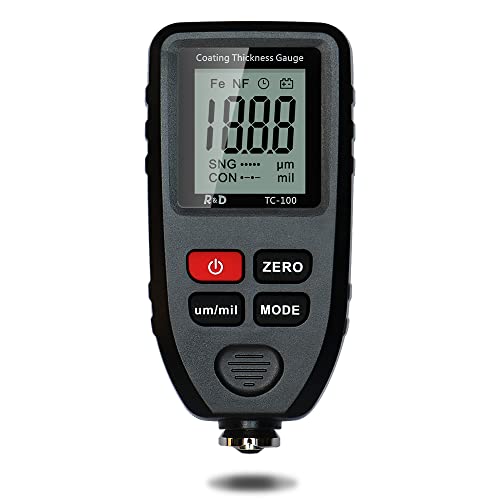
The RDINSCOS coating thickness gauge automatically detects ferrous and non-ferrous substrates, enabling measurements on steel and aluminum without guesswork. It is versatile for various applications, including checking used-car paint thickness, powder coatings, anodized aluminum, bathroom fittings, bike frames, and cabinets. For used-car buyers, this tool helps identify mismatches across panels that may indicate hidden repairs or repaints, contributing to smarter purchase decisions. The device supports quick checks across different surfaces and is especially useful when evaluating a vehicle’s overall finish and integrity.
KAIWEETS Paint Thickness Gauge

The KAIWEETS gauge delivers fast, reliable measurements with automatic substrate recognition and a pre-calibrated baseline on standard substrates. It features a large, backlit rotatable display for easy readability from multiple angles, showing measurement units in micrometers or mils, substrate type, battery status, and data storage. With 30 data storage sets and alarm limits, it streamlines record-keeping for quick comparisons across multiple panels. This model is ideal for quick inspections during used-car shopping or post-purchase assessments to confirm uniform paint thickness.
CM-205FN Paint Thickness Gauge

The CM-205FN offers professional-grade thickness measurements for cars, helping detect repaints, body filler, and previous repairs. It supports a measurement range up to 1500 μm (59.1 mil) with 0.1 μm/0.01 mil resolution and ±3% accuracy, automatically recognizing ferrous and non-ferrous substrates. This makes it a reliable option for detailers and buyers needing precise readings to verify consistent paint across panels and identify potential hidden defects in a used vehicle.
CM-224Auto 2025 Goating Thickness Gauge

This model automatically detects metal bases including zinc, iron, and aluminum, offering a convenient check for vehicles with galvanized bodies. It supports coatings up to 1500 μm (59.1 mil) with 0.1 μm/0.01 mil resolution and ±3% accuracy. The device functions as a fast, simple assistant for evaluating car body integrity, making it suitable for used-car inspections and detailing workflows where quick confirmation of uniform coating thickness is valuable.
Abizarch Multifunctional Paint Thickness Gauge

The Abizarch gauge uses FE/NFE substrate detection with dual-mode magnetic induction and eddy current methods. It records multiple data points—average, maximum, minimum, and difference—across up to 50 data sets, improving accuracy for car-buy inspections. This model is designed for precise panel-by-panel checks, helping determine even paint distribution, uniformity, and potential repairs during the car-shopping process. Automatic power-off conserves battery life for field use.
AstroAI Paint Thickness Gauge
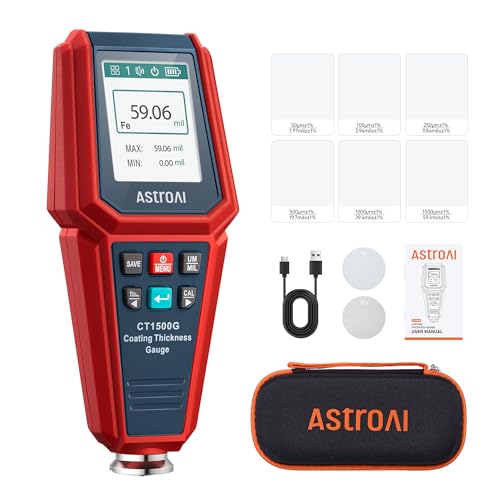
The AstroAI gauge emphasizes automatic substrate detection with wide coating compatibility, measuring ferrous and non-ferrous metals and detecting both thick and thin coatings. It is positioned as a practical tool for used-car buyers who want to identify variations in panel thickness that might indicate repairs. A built-in limit alarm helps flag readings outside expected ranges, supporting quick decision-making during vehicle evaluation.
Buying Guide: Key Purchase Considerations
- Substrate detection: Look for models with automatic recognition of ferrous and non-ferrous substrates to ensure measurements are accurate on steel, aluminum, and other metals common in cars.
- Measurement range and resolution: Choose a device that covers at least 0–1500 μm with fine resolution (0.1 μm or 0.01 mil) for precise readings and to detect subtle paint variations across panels.
- Calibration: Prefer devices with factory calibration and options for zero-point or multi-point calibration to maintain accuracy across substrates.
- Display and accessibility: A large, backlit, rotatable display improves readability in various lighting and angles, especially when inspecting many panels in a single vehicle check.
- Data storage and alarms: Devices that store multiple readings and offer limit alarms simplify trend analysis and quick comparisons during inspections or when evaluating multiple cars.
- Portability and ease of use: Compact gauges with quick measurements save time during pre-purchase inspections and professional detailing.
- Compatibility: Be mindful of plastic, carbon fiber, or other non-metal substrates; many models are designed for metal surfaces and may not measure non-metal coatings accurately.
- Use case depth: For used-car buyers, prioritize models with clear pass/fail cues and guidance for identifying inconsistent paint thickness across panels.
The listed models provide a range of capabilities—from fast dual-substrate detection to high-precision, professional-grade readings. Users can select based on the required level of detail, the typical substrate encountered in their vehicles, and whether they need data storage for multiple inspection sessions. All options aim to support objective assessment and better-informed purchasing decisions by highlighting potential repainting or repairs hidden beneath the surface.