Best Perforated Pipe for French Drain: A Practical Guide to Choose the Right System
Perforated drainage pipes are central to effective French drains, directing groundwater away from foundations, gardens, and wet basements. The right pipe combines durability, filtration, and flexibility to handle variable soil conditions. This guide highlights five perforated options chosen for typical American landscapes, focusing on length, expandability, and filtration features. Each product is evaluated for ease of installation, soil compatibility, and long-term performance. By comparing these solutions, homeowners and contractors can select a perforated pipe that reduces flooding, protects foundations, and keeps outdoor spaces usable after heavy rain.
Summary table of selected products:
| Product | Brand | Key Feature | Length / Size | Perforation Type |
|---|---|---|---|---|
| Flex-Drain 51510 | Flex-Drain | Expandable, durable with filter sock | 4-Inch by 25-Feet | Perforated with filter sock |
| Flex-Drain 51910 | Flex-Drain | Expandable, large-scale drainage | 4-Inch by 12-Feet | Perforated |
| Perforated Drainage Pipe French Drain (2 Inch) | Generic | Non-woven filter fabric, corrosion resistance | 2 Inch, 3.3 ft | Perforated |
| 2inch French Drain Pipe Perforated (Long 3m) | RENLXFI | Polyester filter with steel wire core | 3m (approx. 9.8 ft) | Perforated |
| Flex-Drain 51110 | Flex-Drain | Solid drainage option (for comparison) | 4-Inch by 25-Feet | Solid (not perforated) |
Flex-Drain 51510 Flexible/Expandable Landscaping Drain Pipe

The Flex-Drain 51510 is a perforated, expandable pipe designed for French drains and landscape filtration. Its expandable design allows installation flexibility in uneven soil and long trench runs. The perforated core is paired with a filter sock, which helps prevent sediment from entering the pipe while maintaining water flow. Durability is highlighted by a robust construction, though some users note that the product’s value is strongest when paired with compatible gravel beds and proper trench grading. This option suits medium to long drainage runs in residential landscapes.
Flex-Drain 51910 Flexible Drain Pipe
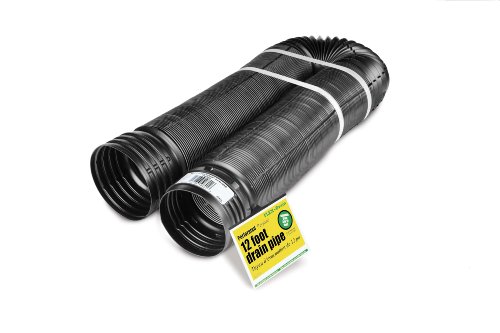
The 51910 variant expands from a compact length to a full 12 feet, enabling streamlined installations in longer trench runs. It’s a 4-inch, perforated pipe intended for groundwater drainage and French drains, particularly where soil is coarse enough to permit effective percolation. Its expandable design reduces the number of joints required, minimizing potential leak points on longer projects. Perforation quality and sock filtration help trap sediment while allowing steady water movement, making it a practical choice for yard drainage projects with variable soil conditions.
Perforated Drainage Pipe French Drain (2 Inch)

This 2-inch perforated drainage pipe combines a non-woven filter layer with a polyester fiber exterior and a steel wire core for strength. It’s designed to balance water permeability with sediment filtration, making it suitable for more compact spaces or emphasis on precise routing. The pipe’s flexibility allows easier navigation around obstacles, and its compatibility with direct connections or PVC pipe extensions enables scalable drainage solutions for smaller yards or planter borders where space is limited.
2inch French Drain Pipe Perforated (Long 3m)

Available in a roughly 3-meter length, this option emphasizes filtration and structural integrity. The polyester outer layer works with a built-in steel wire to resist compression as the pipe lies beneath soil and gravel. It’s designed for all-weather performance, providing reliable infiltration and drainage even in areas with fluctuating rainfall. Its 2-inch diameter makes it suitable for narrow trenches or perimeters where a larger pipe would be impractical.
Flex-Drain 51110 Flexible/Expandable Solid Drainage Pipe

The 51110 option is a solid drainage pipe and serves different drainage roles than perforated pipes. While not suitable for a French drain’s water filtration pathway, solid pipes are relevant in sections where a cleaned, unobstructed channel is desired, such as conveying collected water to a sump pump or a discharge area. In a comprehensive drainage plan, combining perforated segments with solid sections can optimize water management, reduce clogging, and improve long-term system efficiency.
Buying Guide: Key Purchase Considerations
- Pipe diameter: Larger diameters (2-4 inches) allow higher water flow, but require wider trenches. For typical residential French drains, 2-4 inch pipes are common depending on drainage load and soil permeability.
- Perforation and filtration: Perforation patterns influence filtration and sediment capture. A filter sock or non-woven fabric layer helps prevent sediment entry while maintaining flow. Consider socks if soil is clay-heavy or sandy with high sediment content.
- Expandability and length: Expandable designs reduce joints along long runs, lowering leakage risk. For longer trenches, choose models offering stretching or modular connections to minimize weak points.
- Material durability: Steel-reinforced cores or polyester-fiber outer layers improve durability under foot traffic, soil movements, and freeze-thaw cycles. Ensure compatibility with local climate and soil conditions.
- Installation compatibility: Assess how easily the pipe connects to PVC or other standard drainage components. Clear connection options help simplify trench work and reduce the need for additional adapters.
- Soil and landscape context: In coarse soils with fast percolation, perforation density and filtration may be less critical than trench grading and backfill quality. In fine soils, filtration becomes more important to prevent silt buildup.
- Maintenance considerations: Look for features that simplify maintenance, such as accessible cleanouts or pipes that resist clogging with sediment. A well-designed French drain benefits from periodic inspection and backfill stabilization.
- Warranty and origin: Consider brands with clear warranty statements and documented performance in similar climates. Materials sourced for durability typically offer better long-term value even if upfront costs are higher.