Best Pipe Thread Sealants for Water Systems
Choosing the right pipe thread sealant is essential for leak-free connections in water systems. The following five products are selected for their balance of performance, flexibility, and compatibility with potable water. This guide highlights what to consider when selecting a sealant for metal and plastic pipes, including setting time, flexibility, metal content, and suitability for high vibration or thermal movement.
| Product | Brand | Size | Key Feature |
|---|---|---|---|
| RectorSeal Tru-Blu 31631 | Rectorseal | 1/4 Pint | Fast-dry, PTFE enriched; high vibration suitability |
| RectorSeal No. 5 25790 | Rectorseal | 1.75 oz | Soft setting; non-metal; easy breakout |
| Hercules 15620 Real-Tuff | Hercules | 8 oz | PTFE, multi-purpose; fills gaps well |
| RectorSeal T Plus 2 23631 | Rectorseal | 1/4 Pint | Non-hardening; PTFE enriched; potable water |
| RectorSeal No. 5 25631 | Rectorseal | 4 oz | Soft setting; lead free; easy breakout |
RectorSeal Tru-Blu 31631 Pipe Thread Sealant

Tru-Blu is a fast-dry, PTFE-enriched sealant designed for areas with high vibration and thermal expansion. It lubricates and protects threads while delivering a flexible set that helps maintain a reliable seal over time. It is lead-free and suitable for potable water applications where metal-free performance is preferred.
RectorSeal No. 5 25790 Pipe Thread Sealant

No. 5 is a non-hardening, slow-drying thread sealant that seals and lubricates while protecting threads. It permits easy breakout, contains no metals, and is designed for potable water applications. Its soft-set nature makes it a forgiving option for threaded connections that may require future disassembly.
Hercules 15620 Real-Tuff PTFE Pipe Sealant
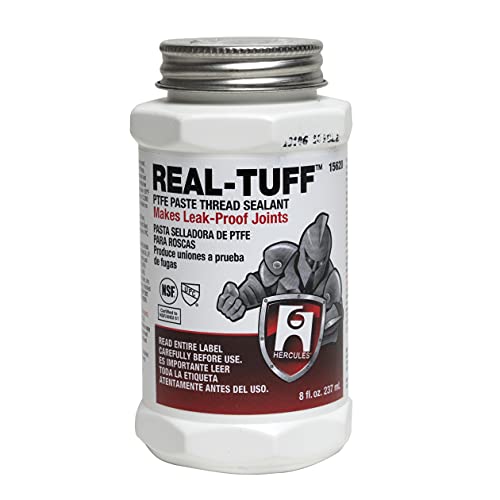
Real-Tuff provides a durable PTFE-based seal on a wide range of metals and plastics. It is a multi-purpose, heavy-duty sealant that fills gaps and imperfections, offering strong protection for threaded joints in challenging environments, including those with exposure to varying temperatures or vibration.
RectorSeal T Plus 2 23631 Pipe Thread Sealant

T Plus 2 is PTFE-enriched and designed to stay flexible, making it suitable for both plastic and metal pipe connections, including iron and stainless steel. It is a non-hardening sealant that lubricates and protects threads and is approved for potable water applications, offering versatility for varied plumbing projects.
RectorSeal Tru-Blu 31780 Pipe Thread Sealant

31780 Tru-Blu offers fast-drying, flexible sealing with PTFE enrichment, designed for environments with high vibration. It is suitable for potable water systems and supports reliable sealing on a variety of pipe materials, including demonstrations of its low-odor, non-separating properties.
LA-CO Slic-Tite Premium Thread Sealant

Slic-Tite is a premium paste-style sealant with PTFE suitable for metal, PVC, CPVC, and ABS threads. It covers water, air, steam, gases, and fuels, and is easy to clean from hands and clothing, making it a practical option for diverse plumbing tasks.
Buying Guide: Key Purchase Considerations
- Material compatibility: Verify whether the sealant is suitable for metal pipes, plastic pipes, or both. PTFE-enriched formulas often perform well across materials.
- Drying and setting time: Fast-drying formulas speed up assembly, while soft-setting or non-hardening blends offer easier future disassembly.
- Metal content: Metal-free options reduce corrosion risk near sensitive components; metal-containing products may offer different sealing characteristics.
- Potable water suitability: Ensure the product is rated for potable water and complies with relevant standards for drinking water systems.
- Flexibility under vibration: For systems with high vibration or thermal cycling, look for flexible-set sealants that maintain a seal over time.
- Application ease: Consider nozzle type, container size, and whether the sealant adheres readily to threaded connections without excessive mess.
- Disassembly considerations: If future disassembly is anticipated, select soft-setting or non-hardening formulas to minimize thread damage.
- Metal-free vs. metal-containing: Some applications prefer metal-free compounds to avoid galvanic reactions; others may tolerate or require certain metal contents.
- Environmental and safety factors: Evaluate odor, VOC content, and handling guidelines to ensure safe use in typical residential or commercial settings.