Best Plexiglass Panels for Greenhouse: Polycarbonate Roof Solutions for Year‑Round Growth
Need durable, clear, and lightweight panels to protect a greenhouse while maximizing light for plants? The best options are twin‑wall polycarbonate panels that are UV resistant, weatherproof, and easy to cut to fit. This guide highlights five top picks and explains who each is best for. Ideal buyers include hobby gardeners upgrading a home greenhouse, farmers seeking winter warmth, and DIY enthusiasts building custom structures. Below is a quick comparison table of the featured products.
| Product | Best For | Key Benefit | Limitations |
|---|---|---|---|
| DGSL 6 Pcs Polycarbonate Greenhouse Panels | All‑weather gardens | 80% light transmission; wide temperature range | May require precise cutting for nonstandard frames |
| FAHKNS 14 Pack 4′ x 2′ Panels (0.16″) | Vast greenhouse projects | High light transmission; strong, shatterproof | Bulk panels may be heavier to handle |
| Hotop 6 Pcs 0.24″ Panels | Solid, budget replacements | Double layer, UV protected; clear and bright | Slightly thicker panels require cutting accuracy |
| XISOCO 3 PCS 0.24″ Panels | Custom or small‑to‑mid projects | Long warranty; UV protection; easy handling | Fewer panels may require additional pieces for large structures |
| VOYAR 6 Pcs 0.16″ Panels | Lightweight, quick upgrades | High transparency with UV coating; impact resistant | Thinner profile; less insulation than thicker options |
DGSL 6 Pcs Polycarbonate Greenhouse Panels

Best for all‑weather gardens needing reliable, light‑diffusing roof panels. The twin‑wall polycarbonate provides continued warmth in winter and coolness in summer, promoting steady plant growth. The panels are designed to resist high temperatures and weather extremes, with strong impact resistance that helps prevent fragmentation during storms. Choose this if you want a durable, shatterproof option that preserves light for photosynthesis. Caution: verify fit with your existing frame, as panel sizes may require precise cutting.
FAHKNS 14 Pack 4′ x 2′ Panels (0.16″)
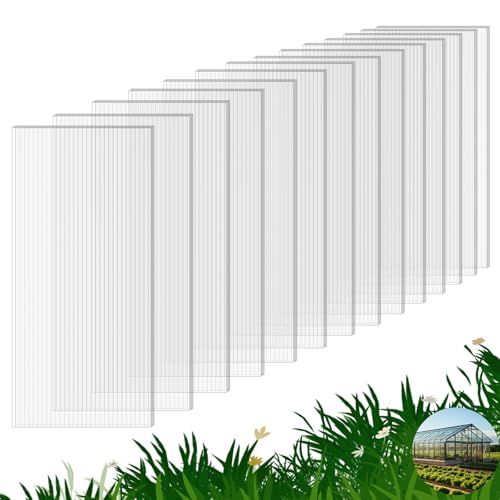
Best for larger greenhouse builds requiring many panels with excellent light transmission. These UV‑resistant sheets transmit about 80% of light, supporting robust photosynthesis while shielding plants from UV damage. They offer strong impact resistance and thermal insulation across a wide temperature range. Choose this if you’re assembling a sizable structure and want consistent brightness. Limitation: handling and installation can be heavier with many sheets in a single order.
Hotop 6 Pcs 0.24″ Panels

Best for solid replacements that require extra thickness for insulation. The double‑layer design remains clear and bright, with a broad operating range from -44°C to 120°C. Choose this if you need enhanced insulation and more durability against weather, while maintaining good light transmission. Caution: the panels can be harder to cut due to thickness; professional cutting is recommended for precise fits.
XISOCO 3 PCS 0.24″ Panels

Best for projects needing UV protection with a long‑term warranty. These panels provide 99.5% UV protection in a lightweight, shatter‑resistant design. The polycarbonate’s multiwall construction offers good light transmittance and insulation. Ideal for DIY greenhouses or upgrades where a balance of brightness and durability matters. Limitation: fewer panels may require additional pieces to cover larger areas.
VOYAR 6 Pcs 0.16″ Panels

Best for quick upgrades where light transmission is prioritized. The panels offer high transparency with a UV coating that blocks most UV rays while delivering about 89% light transmission. This makes them suitable for greenhouses where maximizing light is crucial. Caution: as a thinner option (0.16″), they provide less insulation than thicker panels, so consider climate needs when choosing.
Buying Guide: Key Considerations For Selecting Greenhouse Panels
- Light transmission: Look for panels that provide high, even light to support photosynthesis. Twin‑wall designs typically balance brightness with diffusion.
- Insulation and climate: Thicker panels (0.24″) offer better insulation; thinner panels are lighter and easier to handle but may insulate less.
- UV protection: UV‑resistant layers help prevent yellowing and extend panel life while protecting plants from excessive UV exposure.
- Durability: Panels should be shatterproof with robust impact resistance to withstand hail, wind, and debris.
- Size and fit: Confirm panel dimensions match your greenhouse frame; cutting accuracy may be required for custom shapes.
- Temperature tolerance: Panels should perform across your local climate’s extremes, from cold winters to hot summers.
- Maintenance: Check for anti‑fog or anti‑dew properties if your greenhouse experiences condensation.
Frequently Asked Questions
- What are twin‑wall polycarbonate panels?
They are two layers of polycarbonate with a gap between them, offering light diffusion, impact resistance, and improved insulation compared to single‑sheet materials.
- Are polycarbonate panels better than glass for greenhouses?
Yes for many uses: they’re lighter, shatter‑resistant, and provide good light transmission, though glass can edge out in optical clarity and long‑term scratch resistance in some setups.
- How do I cut polycarbonate panels safely?
Use a professional cutter or a fine‑tooth saw, support panels to prevent cracking, and wear safety gear to protect from shards.
- Can these panels be used for roofs and walls?
Yes. Twin‑wall polycarbonate is versatile for both roof and wall applications, offering weather resistance and insulation benefits.
- How long do polycarbonate panels typically last?
With UV protection and proper maintenance, they can last many years, retaining transparency and structural integrity in typical residential setups.
- Do thicker panels significantly improve insulation?
Yes, thicker panels generally provide better insulation, but may be heavier and harder to install in existing frames.