Best Pool Steps for Above-Ground Pools With Decks
Finding the right pool steps that pair with an above-ground pool and a deck can improve safety, convenience, and enjoyment. This guide highlights five top options designed for flat-bottom pools, sturdy handrails, slip-resistant treads, and easy installation. Each selection balances durability, weight capacity, and compatibility with deck mounting. Read on to compare key features and see which steps best fit your setup and maintenance goals.
| Product | Brand | Key Benefit | Weight Capacity | Deck/Pool Fit |
|---|---|---|---|---|
| Step-1X Above Ground Entry System | Confer Plastics | Sturdy dual handrails, slip-resistant steps | 400 lbs | Flat-bottom, fits decks up to 60 in |
| 4-Step Double Handrails Ladder | VEVOR | Long-lasting, non-slip steps, easy installation | 400 lbs | For 48–54 in depths, any decking surface |
| Roll Guard A-Frame Safety Ladder | Leisure Accents (Confer) | Lockable barrier, extra-wide steps | 300 lbs | Fits 48–56 in pools with up to 14 in toprails |
| Poolzilla Premium Deck Ladder | Poolzilla | Deck-mounted, double handrails, solid stability | Noted up to 50–54 in depth support | Flat-bottom pools, 48–54 in depth |
| XtremepowerUS 4-Step Ladder | XtremepowerUS | Snap-together installation, wide steps | 250 lbs | Flat-bottom pools |
Confer Plastics Step-1X: Sturdy Above Ground Entry System

Confer Plastics Step-1X is designed for flat-bottom above-ground pools and decks up to 60 inches high. It features dual handrails, large flat steps, and slip-resistant surfaces to enhance safety during entry and exit. The unit requires approximately 40 pounds of sand for stability and can support up to 400 pounds. Easy snap-together assembly with included mounting brackets helps secure the stairs to the pool or deck.
Key considerations: installation method compatibility with your deck, ballast requirements, and ensuring the 60-inch fit aligns with your pool height. The unit emphasizes economical strength without external weights, making it a practical option for many above-ground setups.
VEVOR 4-Step Double Handrails Ladder

The VEVOR ladder features four steps with double handrails and non-slip textured surfaces for enhanced security. It supports up to 400 pounds and is suitable for depths between 48 and 54 inches, making it a versatile option for decks attached to above-ground pools. Installation is straightforward, with a snap-on design and hollow side panels to reduce buoyancy. For added stability, weight or sand can be placed in the pipes during install.
Consider whether your decking surface requires additional anchoring or if water-filled stabilization is preferable for long-term use.
Confer 7200 Roll Guard A-Frame Safety Ladder

The Roll Guard A-frame ladder is designed for above-ground pools with heights of 48 to 56 inches and supports up to 300 pounds. It features large 5-by-18 inch Comfortread steps, an oversized platform, and curved rails for stability. A lockable roll-guard barrier helps prevent unsupervised entry, enhancing safety for families with children. It fits pool toprails up to 14 inches wide, making it a compatible choice for many standard pools.
Key considerations include the barrier mechanism, toprail compatibility, and ensuring your deck mounting aligns with the ladder’s access zone.
VEVOR 4-Step Double Handrails Ladder (Grey)

This VEVOR ladder offers a four-step design with dual handrails and non-slip textured steps for reliable footing. It supports up to 400 pounds and is suitable for 48–54 inch depths, with a snap-on installation. Hollow side panels promote water flow and reduce buoyancy, and it is recommended to fill the pipes with water or sand during installation for lasting stability across various decking surfaces.
When evaluating, consider the need for ballast weight and the optimal placement to avoid interference with deck features or pool equipment.
Confer Plastics Curve CCX-AG Drop-In Step
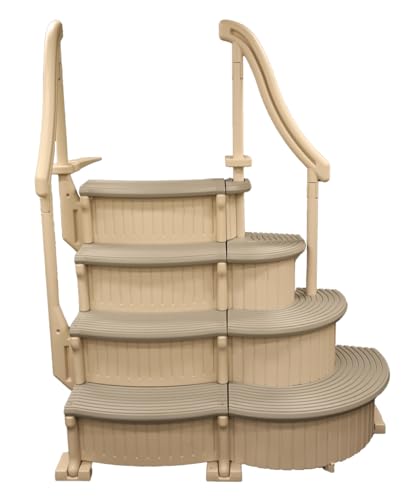
The Curve CCX-AG offers a curved pool step system with two side handrails and four large steps, supporting up to 400 pounds. The two-tone design complements most above-ground pools, and the base step can be expanded into a full curve system by adding treads oriented inward or outward. This modular approach allows customization to fit your deck layout and pool edge, delivering stable access for all users.
Key considerations include expansion options, curve direction preference, and compatibility with your pool’s toprail and deck height.
Confer Plastics Curve CCX-AG Base Step

The Curve CCX-AG Base Step serves as the foundational unit for a curved pool step system. It features the same stability and 400-pound capacity as the full Curve system, with a two-handedrail design and ample tread space. Like its curve-ready companion, it supports flexible assembly to match your deck and pool configuration, letting you build up to a complete curve staircase over time.
Consider how the base step integrates with your existing deck angles, any required fastening hardware, and how the curve will interact with water levels and deck boards.
Buying Guide: Key Purchase Considerations
Purpose and compatibility: Match the steps to your pool depth (commonly 48–54 inches for above-ground pools) and ensure the toprail width and deck height align with the unit’s design. Weight capacity should exceed household needs to accommodate adults and children.
Mounting and stability: Decide between deck-mounted or pool-mounted systems. Look for snap-together assembly, ballast options (sand or water), and features like lockable barriers or added side rails for additional safety.
Safety features: Slip-resistant treads, wide steps, and handrails reduce the risk of slips and falls. A-frame barriers and internal rails can prevent unintended access behind the ladder.
Install flexibility: Curved or modular curve systems offer expansion potential. Base steps should allow future growth if you plan to adjust your deck layout or pool position.
Durability and materials: Weather-resistant plastics or reinforced polymers withstand sun exposure and chlorine. Material choice affects long-term performance and maintenance needs.
Maintenance and care: Consider parts availability, ease of cleaning, and whether replacement steps or hardware are readily accessible from the manufacturer or retailers.