Best Primer for Basement Drywall: Low Odor, Fast-Drying Options
Choosing the right primer for basement drywall involves balancing adhesion, sealing capability, low odor, and fast drying. The following selections are tailored for basement environments, providing solid adhesion on new or repaired drywall and helping to create a uniform finish for topcoats. Below is a quick summary of five notable primers and sealers to consider.
| Product | Brand | Key Benefit |
|---|---|---|
| EVOLVE Drywall Primer | EVOLVE | Fast-drying, low odor, low VOC |
| DRAWTITE Drywall Primer & Sealer | DRAWTITE | Water-based sealer, moisture resistant |
| KILZ Drywall Primer & Sealer | KILZ | Advanced fast-drying formula for uniform finish |
| Rust-Oleum Drywall Primer | Rust-Oleum | Seals tape joints, quick-drying, low odor |
| Additional note | Various brands | Consider for washability and sealer strength |
EVOLVE Drywall Primer: Fast-Dry, Low Odor
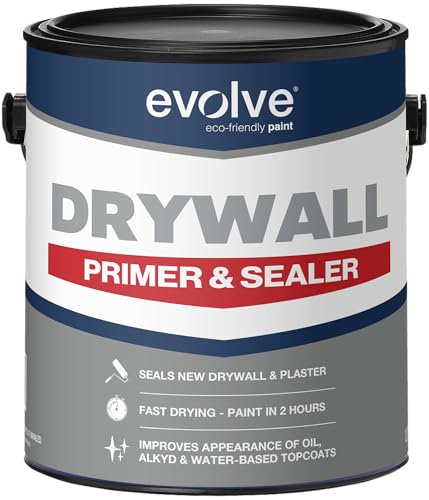
EVOLVE Drywall Primer offers low odor and low VOCs, making it suitable for enclosed basement spaces. The fast-drying formulation supports quicker project completion, reducing downtime between coats. Its adhesion performance on multiple indoor surfaces helps prepare drywall for subsequent topcoats, while maintaining a user-friendly odor profile. This primer emphasizes a balance between environmental considerations and practical basement workflows.
DRAWTITE Drywall Primer & Sealer

DRAWTITE is a water-based sealer and primer designed for sealing damaged or porous drywall before repairs. It exhibits moisture resistance once dry, helping prevent rewetting and bubbling, which is valuable in basement environments where humidity can be a concern. It’s particularly effective for chalky or porous surfaces, establishing a stable base for patching compounds and paint applications.
KILZ Drywall Primer & Sealer

KILZ Drywall Primer & Sealer is designed for interior use on uncoated drywall. Its advanced polyvinyl acetate formula penetrates porous surfaces to prevent excessive paint absorption, supporting a uniform topcoat. It is optimized for low-sheen paint finishes and is recommended for spaces where a smooth, even appearance is desired across the drywall substrate.
Rust-Oleum Drywall Primer

Rust-Oleum Drywall Primer is positioned as a basic primer for new drywall, sealing tape joints and preparing the surface for paint without raising the nap. It dries quickly with low odor, and sands easily for a smooth base for finishing coats. This option focuses on quick pre-paint readiness and ease of use for standard basement drywall projects.
Buying Guide
- Moisture considerations: In basements, moisture resistance is valuable. Look for primers labeled as moisture resistant or designed for damp environments to minimize issues after painting.
- Adhesion on porous surfaces: Porous drywall requires primers with deep penetration to prevent paint from soaking in unevenly. Primers with advanced PVA formulas or sealer properties are beneficial.
- Odor and VOCs: Low odor and low VOC formulations improve indoor air quality, especially in enclosed basement spaces with limited ventilation.
- Drying time and recoat window: Fast-drying primers reduce project duration, allowing quicker applications of topcoats. Check recoat times to plan multi-coat workflows.
- Surface compatibility: Some primers are best for new drywall, others for repaired or chalky surfaces. Match the product to your drywall condition and repair needs.
- Topcoat compatibility: Ensure the primer is compatible with your intended topcoat sheen (flat, eggshell, etc.) to achieve desired finish consistency.
- Ease of application: Consider brush, roller, or sprayer suitability based on room size, access, and personal preference.
- Long-term durability: For basements, choosing a primer with robust sealing and adhesion helps prevent peeling or staining after moisture exposure.
When selecting a primer for basement drywall, prioritize moisture resistance, adhesion on porous surfaces, and low-odor formulations to ensure a safer, simpler painting process. The options presented provide a range of adhesion strengths, sealing capabilities, and drying profiles to fit different basement renovation needs.