Best Propane Generators for Homes: Reliable Backups for Power Outages
Power outages can threaten safety and comfort, especially in regions with storms, heatwaves, or winter ice and snow. Propane generators offer a versatile, long-term fuel source and fast startup for home backup power. Below, you’ll find five dependable options selected for American homes, covering dual-fuel versatility, transfer-switch readiness, and safety features. This guide explains how to choose the right model and what each unit can deliver in real-life scenarios.
| Product | Fuel Type | Key Benefit |
|---|---|---|
| Westinghouse 12500 Watt Dual Fuel | Gas / Propane | Strong overall power; transfer switch ready; long runtime |
| DuroMax XP13000EH | Gas / Propane | High wattage with proven dual-fuel performance |
| WEN DF1100T | Gas / Propane | Affordable dual-fuel with versatility |
| WEN TF1450X | Gas / Propane / Natural Gas | Tri-fuel and robust wattage for heavy loads |
| Generac GP9500 | Gas / Propane / Natural Gas | Reliable brand with electric start and safety features |
Note: All models listed are designed for home backup and emergency use. They vary in running wattage, fuel flexibility, and transfer switch readiness. When selecting, consider your home’s essential circuits, expected runtime, and local permitting requirements for standby power equipment.
Westinghouse 12500 Watt Dual Fuel Generator

The Westinghouse 12500 Watt Dual Fuel Home Backup Portable Generator combines gasoline and propane capability with a remote electric start and transfer switch readiness. Its 457cc Westinghouse engine provides a balance of power and durability, and the unit supports a 6.6 gallon fuel tank with a fuel gauge for monitoring runtime. On propane, it delivers substantial running and peak watts to meet household needs during outages. The generator includes safety features such as rubber-covered outlets and an automatic low oil shutdown with a digital hour meter. VFT display keeps real-time voltage, frequency, and lifetime hours visible for informed operation.
Features at a glance include multiple receptacles: a 120V household outlet, a transfer switch-ready 120V/30A outlet, and a 50A RV-ready outlet. With a remote start key fob, you can power up quickly, which is especially valuable during emergencies. The unit is designed for transfer switch compatibility and safe outdoor use with weather-resistant outlets, making it a practical all-around option for homes with essential circuits that need reliable backup power.
DuroMax XP13000EH 13,000-Watt Dual Fuel

The DuroMax XP13000EH is a high-capacity dual fuel portable generator designed for whole-home backup. It provides up to 13,000 watts of surge power on gasoline and a strong propane performance as a secondary option. DuroMax emphasizes a robust engine designed to handle heavy loads and long runtimes, making it a practical solution for extended outages. The dual-fuel design offers flexibility when gasoline supplies are unreliable or expensive. This unit is commonly used in emergencies where several circuits or critical appliances must remain online, including air conditioning, sump pumps, and refrigerators.
Key considerations are its electrical startup and transfer switch readiness. The XP13000EH typically includes features that support easier operation in storm-prone regions, along with durable construction intended for consistent, long-term use. For homeowners, this generator balances raw power with the convenience of an electric start, reducing manual effort during stressful outage scenarios.
WEN DF1100T 11,000-Watt Dual Fuel
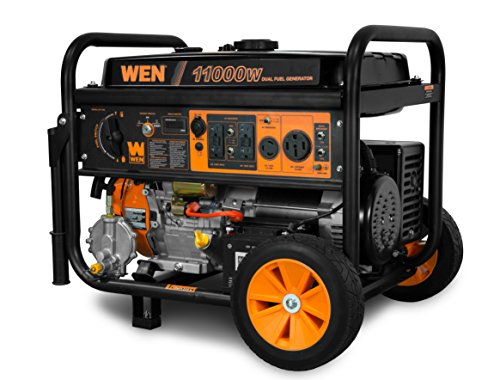
The WEN DF1100T provides 11,000 surge watts on gasoline and up to 9,500 surge watts on propane, with running watts scaled accordingly. This dual-fuel model is designed for practical home backup, offering a 120V/240V output suitable for transfer switches and larger circuits. An electric start simplifies operation, and the unit includes a wheel kit for mobility around the yard or job site. WEN’s approach emphasizes value without sacrificing essential features, making it a sensible choice for budget-conscious homeowners seeking flexibility between gasoline and propane fuels.
With its straightforward fuel switching and solid safety features, the DF1100T is well-suited for medium-load loads and essential household circuits, providing predictable power during outages and enabling more predictable management of backup power resources in residential settings.
WEN TF1450X 14,500-Watt Tri-Fuel

The WEN TF1450X stands out as a tri-fuel generator, supporting gasoline, propane, and natural gas. This flexibility is valuable when fuel supply is uncertain or costly, as the unit can operate on whichever option is most available. It runs at 120V and 240V, enabling essential circuits to be powered through transfer switches or whole-house configurations. The built-in WEN Watchdog CO Shutdown Sensor adds a safety layer by detecting dangerous carbon monoxide levels and automatically shutting down the unit if needed, which is particularly important for home environments with limited ventilation during outages.
Under load, the TF1450X provides substantial wattage across fuels, making it suitable for larger homes or properties with heavy power needs. The inclusion of a wheel kit and CO monitoring enhances portability and safety, offering a balanced option for households seeking robust, multi-fuel capability with built-in protection features.
Generac GP9500 Tri-Fuel Portable Generator

Generac GP9500 is a trusted name in home backup power, offering tri-fuel capability (gas, propane, natural gas) with electric start for quick ignition during outages. Its rugged design is paired with safety features and a durable enclosure to withstand outdoor conditions. The unit is marketed toward both home backup and jobsite use, with the potential to power essential circuits and appliances during emergencies. While Generac emphasizes reliability and user-friendly operation, the GP9500’s performance varies by fuel type and load, making it important to size your transfer switch and panel accordingly to avoid overloads.
Potential buyers should consider the balance between maximum surge power and continuous running watts, the availability of fuel types in their area, and how the unit’s footprint and noise levels fit their property and neighborhood guidelines. Generac’s ecosystem and support network can be a deciding factor for homeowners seeking long-term serviceability and availability of replacement parts.
Buying Guide: Key Purchase Considerations And Comparisons
- Fuel flexibility: Dual-fuel and tri-fuel generators offer the option to switch between gasoline, propane, and natural gas. Tri-fuel units provide maximum versatility in areas with limited or costly fuel supplies, but may come with higher upfront costs and more complex maintenance.
- Power needs: Assess your essential circuits (refrigerator, furnace, well pump, sump pump, lighting, heating/cooling loads) and estimate running and surge watts. Higher-wattage models are better for larger homes but require larger fuel tanks or more fuel on hand and may have higher noise levels.
- Transfer switch compatibility: Look for models labeled transfer switch ready, and verify compatibility with your home’s panel. An automatic transfer switch can ensure seamless power transfer during outages without manual interventions.
- Start method and ease of use: Electric start with a remote key fob is convenient during storms but requires a charged battery. Manual recoil starts are reliable but can be harder to operate in cold or wet conditions.
- Runtime and fuel capacity: Longer runtimes are essential for multi-day outages, especially in hot climates or during winter storms when appliances run longer. Larger fuel tanks and efficient engines help extend runtime.
- Safety features: CO sensors, oil shutdown, rubber outlet covers, and sturdy enclosures protect users and equipment. Consider models with built-in CO detectors or automatic shutoff when carbon monoxide is detected.
- Portability and storage: Wheeled designs simplify maneuvering. Consider the storage space and weather exposure when placing a generator in a yard or garage.
- Noise considerations: Generators produce notable noise; check decibel ratings if you live in a densely populated area or have noise restrictions.
- Maintenance and support: Strong warranty terms, readily available parts, and a reputable brand influence long-term performance and serviceability.
These considerations help compare models across power, fuel flexibility, and safety, ensuring you select a generator that aligns with household needs, climate, and local regulations. Always follow local instructions for installation, permits, and safe operation of home backup power equipment.