Best Basement Washer Pumps: Upflush and Macerator Solutions
If you need a reliable pump to handle basement laundry or other fixture drainage where gravity drainage isn’t feasible, these upflush and macerator pumps are designed to move wastewater efficiently. They’re best for homes with basements, laundry rooms, or wet bars where traditional plumbing isn’t practical. This guide highlights five strong options, focusing on suitability by scenario, ease of installation, and noise or energy considerations. Whether you’re renovating a basement bathroom, adding a laundry area, or upgrading an off‑grid setup, these pumps offer practical, low-maintenance drainage solutions.
| Product | Best For | Key Benefit |
|---|---|---|
| CrestWave 900W Macerator Pump | Basement bathrooms, kitchens, off‑grid setups | High flow and precise auto-start with quiet operation |
| Ensurix 1200W Macerator Pump | Multiple fixtures (toilet, sink, shower) in tight spaces | Smart PCB control with anti-backflow and multiple inlets |
| VEVOR Utility Sink Pump | Utility sinks, basements, wet bars | 36 ft lift and 2200 GPH for robust drainage |
| MixBubole Upgraded 1 HP Utility Sink Pump | Renovation projects without major sewer work | Three inlets and one outlet; quiet motor with PCB delay |
| Zoeller 105-001 Automatic Drain Pump System | Under-sink basements and compact installations | Solid‑handling ½” impeller; compact footprint |
CrestWave 900W Macerator Pump

The CrestWave unit uses a 900W copper motor rated for 14000 RPM, delivering up to 2200 GPH with a 29.5 ft vertical lift and 295 ft horizontal reach. It’s designed for quiet operation (about 45 dB) and features auto-start with a delay to reduce cycling. Best for basements and off‑grid bathrooms where noise and energy efficiency are important. It includes a four‑inlet system for connecting toilet, shower, sink, and laundry. Caution: the high RPM and multiple inlets may require careful wiring and layout planning in tight spaces.
Who it’s best for: homeowners needing strong performance with quiet operation in a multi-fixture basement setup. Why selected: high flow and flexible connections simplify complex drain layouts. Limitation: more complex installation due to four inlets and precise electrical requirements.
Ensurix 1200W Macerator Pump
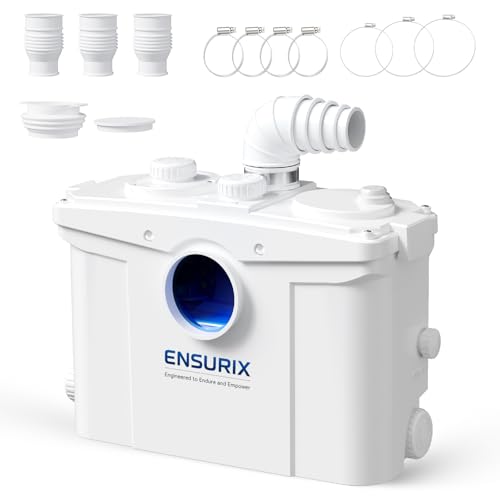
The Ensurix model features a 1.6 HP motor and can lift 28 ft vertically and 280 ft horizontally, delivering up to 2800 GPH. It supports a complete upflush system with multiple inlets for basement toilet, sink, shower, and even a washing machine. Built-in PCB smart control starts automatically based on flow and includes anti-backflow protection. Best for multi-fixture basements where space is constrained. Caution: higher power and multiple inlets require careful placement to prevent loud cycling in small rooms.
Who it’s best for: households needing a robust, all‑in‑one sewage ejector with smart control. Why selected: strong lift and flow with versatile inlet options. Limitation: larger footprint and higher energy use than smaller pumps.
VEVOR Utility Sink Pump, 1 HP

The VEVOR unit offers 2200 GPH with a 36 ft max head and a cast aluminum motor. It’s designed for reliability in basement kitchens, laundry areas, and utility sinks, with a vortex impeller to help reduce clogs. Best for ongoing, everyday basement drainage where a sturdy, ETL-tested pump is preferred. Caution: aluminum motor housing may require careful handling in humid environments to prevent corrosion over time.
Who it’s best for: homeowners wanting a straightforward, durable pump for a single-basin basement setup. Why selected: strong capacity and clog resistance. Limitation: not as compact as some under-sink models, and material choice may affect long-term durability in damp spaces.
FavorCOOL Macerator Pump With 3 Inlets

The FavorCOOL unit is a 250W all-copper motor pump with 3 inlets and a lift of 22.9 ft. It emphasizes quiet operation (low noise) and heat resistance, with oil-filled motor protection. Best for small basement projects where a low-power, quiet option is sufficient. Caution: limited lift may not suit deeper or more distant fixtures; ensure your layout fits under·basin clearance.
Who it’s best for: budget-conscious basements with moderate drainage needs. Why selected: compact, quiet, and oil-filled for durability. Limitation: lower lift and flow compared to higher‑power models.
Buying Guide: Key Considerations For Basement Drainage Pumps
What size lift do you need? Measure the vertical distance from the lowest drain to the discharge point. Higher lifts require more powerful pumps with larger motors.
How many fixtures will connect? If multiple fixtures (toilet, sink, washer, shower) share a system, choose a pump with multiple inlets and anti‑backflow features to prevent cross‑contamination.
Noise and energy use matter in basements. Look for models with auto-start, delay protection, and copper motors for durability and quiet operation.
What about installation space? Compact dimensions help in tight basements or under-sink areas; check inlet/outlet orientations to ensure a clean fit.
Material and build quality influence longevity. Cast aluminum or copper motors resist heat and corrosion better in damp environments; oil-filled motors offer extra protection.
Maintenance and safety: ensure the unit has proper ventilation, a built‑in check valve to prevent backflow, and compatible float switches for automatic operation.
Frequently Asked Questions
- What is a macerator pump and when do I need one?
A macerator pump grinds solids and pumps wastewater to a drain when gravity drainage isn’t feasible, common in basements or tight renovations.
- How much vertical lift do I typically need for a basement install?
Most basement applications require 20–36 feet of vertical lift, depending on the drain location and fixture height.
- Can these pumps run continuously?
Many are designed for regular use but benefit from a delay feature to reduce wear and noise. Check the product’s PCB controls and specifications.
- Are multiple inlets safe for backflow concerns?
Yes, many models include anti-backflow valves or check valves to prevent sewage from returning to fixtures.
- Which pump is best for a single basement sink?
For a single sink, a compact unit with sufficient lift and 1 inlet may be ideal, such as a smaller 900–1100 W model with a single discharge line.
- Is a higher watt motor always better?
Higher wattage generally means more power and flow, but it also increases energy use and may be unnecessary for small basements—match power to load and layout.