Best Red Bulbs for Sleep: Calm Nighttime Ambience and Melatonin Support
Red light bulbs designed for sleep help minimize blue light exposure and support melatonin production, signaling your body to wind down. This guide focuses on five sleep-friendly options, suitable for adults, children, and households aiming for calmer evenings. Each product is evaluated for who it’s best for, plus practical caveats to inform your choice.
Summary table of chosen products
| Product | Wavelength / Brightness | Best For | Key Benefit | Limitation |
|---|---|---|---|---|
| Angyues 630nm Red Sleep Bulb (4-Pack) | 630 nm | Babies’ rooms and family bedrooms | Smooth dimming, blue-light blocking | Requires dimmer compatibility |
| Neporal Red Light Bulbs Sleep 9W | 625 nm | Bedroom night lighting and reading before bed | Higher brightness for visibility | Not labeled as dimmable in listing |
| Edoyosa Red Light Bulbs Sleep 670nm | 670 nm | Adults seeking melatonin-friendly rest | Natural sleep cycle support | Limited data on compatibility |
| Eastiya 625nm Red Sleep Light Bulbs (2 Pack) | 625 nm | Nurseries and bedrooms | Calming red glow for wind-down | Standard base; verify dimming if needed |
| Wivety Red Light Bulbs for Sleep, 4-Pack | 625 nm | Family rooms and nurseries | Remote-controlled dimming, low glare | Remote control required for dimming |
Angyues 630nm Red Sleep Bulb Dimmable
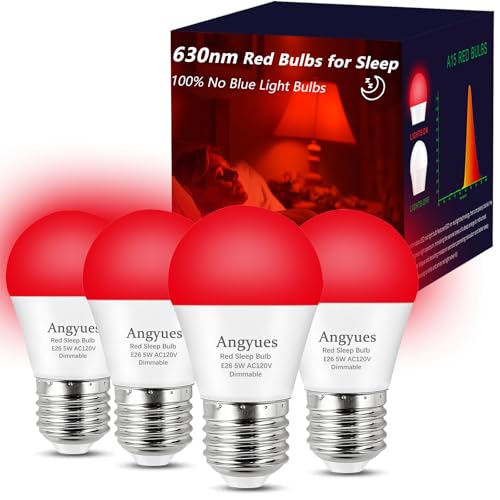
630 nm red light bulbs promote melatonin production by blocking blue light. The Angyues model offers a 0–100% smooth dimming range and is designed to be flicker-free, reducing eye strain in dim environments. Best for households seeking a simple, consistent night-time ambiance that closely mimics sunset hues.
Best for: families needing a reliable, dimmable night light that supports relaxed wake-down routines. Caution: ensure your dimmer is compatible to avoid flicker at low brightness levels.
Neporal Red Light Bulbs for Sleep 9W

Neporal’s 9W red night light uses 625 nm light with strong, low-glare illumination. It’s designed to be blue-light-free, signaling the brain to unwind quickly for a tranquil evening routine. It’s suitable for bedside lamps and nursery spaces that require gentler lighting with decent brightness.
Best for: readers and caregivers who want more brightness without blue light disruption. Limitation: listed as a high-brightness option may require careful placement to avoid harsh visuals in the final hours before bed.
Eastiya Red Sleep Light Bulbs: 625nm
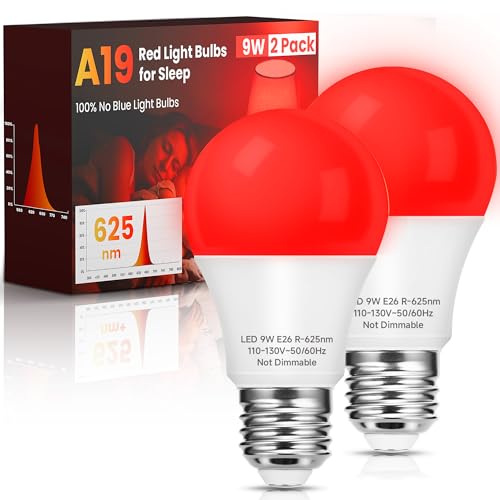
Eastiya’s 625 nm red bulbs are designed to block blue light and deliver a warm, orange-red glow. This helps establish a pre-sleep sanctuary in bedrooms or nurseries, with an emphasis on comfortable, non-disruptive lighting for low-light reading and winding-down routines.
Best for: nurseries or bedrooms needing a steady, calming red tone. Limitation: may not be explicitly marketed as dimmable, depending on the specific base model.
Wivety Red Light Bulbs for Sleep (4 Pack)

The Wivety set uses 625 nm red light with 100% blue light blocking, plus remote control for flicker-free dimming across brightness levels. This makes it a strong all-around option for households needing consistent red lighting that can adapt to night-time activities without disturbing sleep cycles.
Best for: families wanting flexible, remote-controlled brightness in multiple rooms. Limitation: dimming is handled via remote control only; no in-inline dimmer switch compatibility.
Buying Guide: Key Purchase Considerations
- Wavelength and blue-light blocking: Look for bulbs specified as 625–670 nm with clear statements that blue or green light is blocked to support melatonin production.
- Dimming and control: Decide between in-wall dimmers, smart dimmers, or remote controls. Flicker-free performance at all brightness levels is important for eye comfort.
- Brightness: Choose brightness that matches your space. Lower brightness favors winding down; higher brightness can assist late-night tasks without becoming harsh.
- Usage scenarios: Consider bedrooms, nurseries, and living spaces. Some bulbs are optimized for baby rooms; others suit adults’ pre-sleep routines.
- Energy and compatibility: Check base type (E26) and whether the bulb is dimmable. Verify dimmer compatibility to avoid flicker or hum.
- Multiple-pack value: If you need uniform lighting across rooms, multi-pack options can offer consistent color and brightness.
Frequently Asked Questions
- Do red sleep bulbs really help with melatonin production? Yes, red wavelengths minimize blue light exposure, which signals the body to produce melatonin and wind down for sleep.
- Can I use red bulbs for nighttime reading? Some 625–670 nm bulbs provide enough brightness for reading while still being sleep-friendly; choose higher brightness if needed.
- Are all red bulbs suitable for use with dimmers? Not all are; verify dimmer compatibility or opt for remote-controlled/dimmable options.
- Is blue light completely eliminated? The best sleep bulbs minimize blue and green wavelengths; some products advertise 100% blue-light blocking, but check product specs for exact claims.
- Will red light keep me awake? Red light is generally soothing and less likely to disrupt sleep, but individual sensitivity can vary.
- How many bulbs should I buy for a room? This depends on room size and desired ambient level; multi-pack options help maintain uniform color and brightness.