Best Reverse Osmosis Water Filters for Sinks
Choosing a reliable under-sink reverse osmosis (RO) system requires weighing filtration depth, mineral balancing, maintenance, and ease of installation. This article highlights five top RO systems that are well-suited for American kitchens, emphasizing trusted certifications, tankless options, remineralization, and user-friendly design. Each section provides a concise overview, key features, and installation considerations to help you compare at a glance.
style=”font-weight:bold;”>Product Summary
| Product | Brand | Stage Count | Special Feature |
|---|---|---|---|
| iSpring RCC7AK | iSpring | 6 | Alkaline remineralization AK stage |
| Waterdrop G3P600 | Waterdrop | 8 | Tankless with smart faucet |
| Express Water RO5DX | EXPRESS WATER | 5 | Complete kit with faucet and tank |
| Waterdrop WD-T3-M | Waterdrop | 9 | Remineralization, LED display |
| iSpring RCC7 | iSpring | 5 | Top-mounted faucet design |
Notes: All five options are designed for under-sink installation in typical American kitchens. Certifications and features vary; confirm compatibility with your plumbing and electrical setup before purchase.
iSpring RCC7AK: 6-Stage Alkaline RO System

The iSpring RCC7AK combines a 6-stage RO filtration with a mineral AK stage that remineralizes water to a balanced pH. The system includes a patent-pending top-mounted faucet design for above-sink installation, simplifying setup without under-sink wrenching. A transparent first-stage housing lets users monitor contaminant buildup and schedule filter changes. This unit is NSF/ANSI certified and is known for reliable performance and relatively straightforward maintenance.
Waterdrop G3P600: Tankless 8-Stage RO System

The Waterdrop G3P600 features an 8-stage filtration process with a tankless design to save under-sink space. It carries NSF/ANSI 58 for TDS reduction, 372 for lead-free materials, and 42 for taste and odor reduction. The system includes a smart display faucet that shows TDS and filter life. A compact, modern option that reduces bulk under the sink while delivering a streamlined, high-clarity filtration experience.
Express Water RO5DX: 5-Stage Under-Sink System

The Express Water RO5DX offers a complete 5-stage filtration process with a usably broad reduction range, including lead, chlorine, fluoride, and PFAs/PFOs. It ships with a dedicated faucet and storage tank, making installation and setup straightforward. The system emphasizes overall water purification performance and user-friendly serviceability, appealing to homeowners who want a reliable, do-it-yourself solution that’s easy to maintain.
Waterdrop WD-T3-M: 9-Stage Remineralizing RO
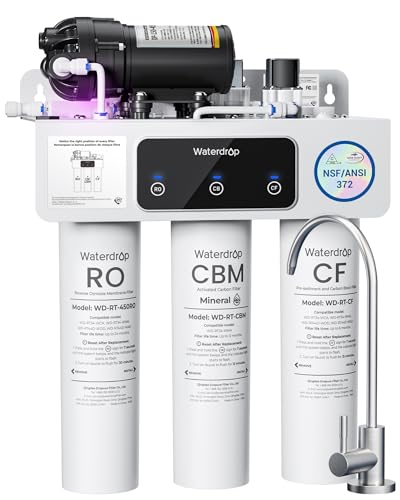
The WD-T3-M uses a 9-stage filtration sequence with a 0.0001 μm RO membrane and remineralization to balance minerals. It includes a LED display, auto-flush, and an electrical connection requirement. The system emphasizes mineral-infused water and a tankless footprint, helping to minimize under-sink clutter while maintaining sophisticated filtration performance.
iSpring RCC7: 5-Stage Under-Sink RO

The iSpring RCC7 delivers a standard 5-stage filtration process, removing up to 99% of thousands of contaminants and offering notable reductions in chlorine, fluoride, and lead. It’s NSF/ANSI 58 certified and designed for minimal maintenance with a transparent first-stage housing for quick checks. The top-mounted faucet design makes installation easier for many kitchen layouts, and the system tends to fit compact under-sink spaces.
Buying Guide: Key Purchase Considerations
- Filtration stages and contaminant targets: More stages and certified reductions can improve taste, odor, and safety—consider PFAS, lead, chlorine, fluoride, and heavy metals based on local water reports.
- Remineralization and pH balancing: If you want water with minerals and a balanced taste, models with remineralization (AK or mineral stages) offer healthier mineral content and a more natural feel.
- Tank vs. tankless: Tankless RO units save space but may require electrical connections and more frequent maintenance checks; traditional tank systems can be simpler and more forgiving in older homes.
- Faucet and installation design: Top-mounted or standard under-sink faucets affect ease of installation and compatibility with existing counters and plumbing.
- Monitoring features: Smart displays or clear filter-life indicators help plan replacements and avoid unexpected outages.
- Maintenance and filter replacement: Look for readily available replacement filters and vendor support. Some systems bundle multiple filters; others separate each stage.
- Certifications: NSF/ANSI 58 is common for RO systems; additional certifications (42, 372) indicate performance and material safety. Check that corrosion-resistant housings and safe plastics are used.
- Space and aesthetics: Tankless designs offer space savings; consider cabinet dimensions and water line routing when selecting a model.
- Cost of ownership: While initial cost matters, consider filter life, replacement frequency, and energy use for long-term value.
These considerations help balance performance, maintenance, and budget. For areas with particularly hard water or notable contaminants, a higher-stage system with remineralization may provide the most value over time.