Best Roofing Tool Belt for Efficient, on-Job Organization
Finding the right roofing tool belt helps keep essential tools within easy reach, reducing climbs and trips to a toolbox. This guide highlights five top roofing tool belts, focusing on durability, load distribution, and convenient access for workers on steep roofs or long days. Each option is designed to withstand harsh job-site conditions while keeping tools secure and accessible.
style=”font-weight:bold;”>Summary of Selected Products
| Product | Brand | Key Features | Typical Use |
|---|---|---|---|
| JACKSON PALMER Professional Tool Belt | Jackson Palmer | Five large pockets, four small pockets, two hammer loops; heavy-duty polyester; double-stitched seams; rivets | General roofing, construction, DIY projects |
| Weaver Tool Gear Super Roofer Tool Belt | Weaver Leather | Heavy-duty 1680-denier ballistic poly; weather-resistant; multiple specialized pockets | Roofing and construction essentials on-site |
| Bucket Boss 50200 Two Bag Tool Belt | Bucket Boss | Reinforced pouch bottoms; Infinity belt; large-capacity pouches | All-day roofing with extra storage |
| MELOTOUGH Tool Belt with Suspenders | MELOTOUGH | 1680D fabric; suspenders; removable organizers; hammer/phone holders; adjustable | Framers, electricians, roofers needing modular setup |
| MELOTOUGH Camo Tool Belt with Suspenders | MELOTOUGH | 5-piece framer system; camouflage design; durable webbing; removable pouches | Contractors requiring versatility and concealment |
Jackson Palmer Pro Tool Belt For Roofing

Designed for multiple trade professionals, the JACKSON PALMER belt is well-suited for roofing tasks where a mix of larger and smaller pockets keeps tools organized. The belt uses heavy-duty polyester with double-stitched seams and metal rivets to resist tearing under exposure to sun and grit. It provides five larger pockets, four smaller pockets, and two hammer loops. The layout supports quick access to pliers, nails, screws, and measuring tools while standing or kneeling on a roof. This belt balances weight distribution and can handle a typical roofing tool set without becoming bulky.
AWP Tool Belt Rig For Utility Work

The AWP Tool Belt Rig emphasizes organized storage with 18 pockets and reinforced seams for durability in tough job-site conditions. Its design supports a broad range of tools, keeping items within easy reach during roofing tasks, framing, and other utility work. The rugged 600 denier polyester fabric resists wear, and built-in carry handles aid transport between site locations. This model suits workers who need a robust, roomy belt that maintains access to frequently used hand tools and fasteners.
MELOTOUGH Pro Tool Belt With Suspenders

MELOTOUGH’s belt system highlights adaptability with a fully adjustable pro belt and removable tool organizers. The 1680D ballistic fabric and heavy-duty rivets provide long-term resilience in harsh roofing environments. A suspenders system distributes weight across shoulders and hips, reducing fatigue during long days on steep pitches. With pockets sized for hammers, phones, and various small tools, this belt supports a modular approach—you can remove or add pouches as needed for a project’s scope.
MELOTOUGH Camo Tool Belt With Suspenders
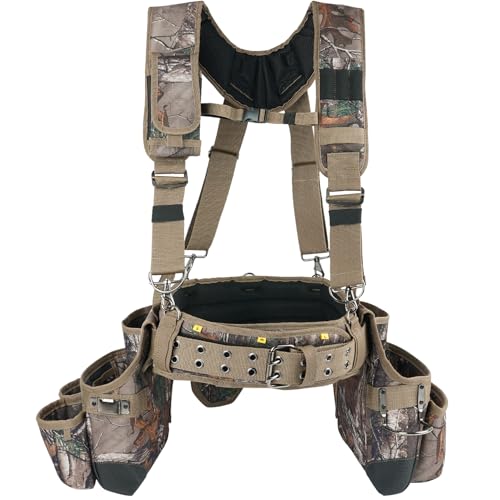
The MELOTOUGH Camo Tool Belt pairs a five-piece framer system with camouflage styling for a tactical look and practical design. It features a fully adjustable belt, padded suspenders, and two removable organizers for easy tool separation on-site. Made from 1680D ballistic fabric with reinforced stitching and heavy-duty hardware, this belt is designed to scale up or down with the amount of tools carried on a roofing job, making it suitable for varied workloads and personnel sizes.
Buying Guide: Key Considerations For Roofing Tool Belts
- Durability and material: Look for 1680D or higher denier fabrics, reinforced seams, and rivets to resist wear from shingles, nails, and grit.
- Weight distribution: Suspenders or dual-strap options help disperse weight to reduce back and shoulder strain during long shifts on a roof.
- Storage capacity: Pockets should accommodate essentials (hammer, utility knife, tape measure, screwdrivers, nails) while keeping frequently used items within quick reach.
- Adjustability: A belt with adjustable waist size and removable pouches offers a customizable setup for different workers and project scopes.
- Weather resistance: For outdoor roofing, choose belts with weather-resistant materials and coatings to withstand sun exposure and light rain.
- Ease of maintenance: Pouches that are easy to clean and resist snagging on materials help maintain belt longevity on active projects.
- Compatibility with PPE: Ensure the belt allows space for knee pads, tool holsters, and safety accessories needed on roofing jobs.
- Storage organization: Tiered pockets and specific tool loops improve efficiency by reducing tool-swaps and reach time.
- Replacement parts: Consider brands offering compatible replacement pouches or add-ons to extend the belt’s usable life.
- Value vs. cost: While premium belts cost more upfront, durability and productivity gains on roofing jobs can justify the investment over time.