Best Router Bits for Hardwood: Precision Bits for Clean, Durable Joints
Choosing the right router bits for hardwoods involves balancing cutting quality, durability, and joint accuracy. Hardwood demands sharp carbide edges, stable shanks, and designs that reduce tear-out on dense wood. The following selections cover tongue-and-groove pairs, rail-and-stile joints, flush-trim work, slab flattening, and general edge profiling—each optimized for hardwood applications. This guide highlights five highly compatible options, with practical notes on material compatibility, ease of use, and maintenance to help woodworkers achieve smooth finishes and precise joinery on tough hardwood stock.
| Product | Brand | Use Case | Key Benefit |
|---|---|---|---|
| Junreox 2PCS Tongue and Groove Set | Junreox | T/G joints for cabinet doors and shaker doors | Adjustable 3-teeth design; sturdy 1/4″ shank; anti-kickback |
| BOSCH RBS030MBS 30-Piece Set | BOSCH | Versatile set for finishing and profile work | Wide bit assortment; durable carbide; soft/hard wood capable |
| Freud Premier Adjustable Rail & Stile | Freud | Rails and stiles for doors and windows | Precise, adjustable groove; works with varied stock |
| Freud 1/2″ Top Bearing Flush Trim | Freud | Template and pattern routing, edge trimming | Top-bearing design; high-density carbide for long life |
| SpeTool Slab Flattening Bit | SpeTool | Slab flattening and spoilboard surfacing | Carbide inserts; ATS coating; durable 1-1/4″ cutting |
Junreox Tongue and Groove Bit Set

The Junreox Tongue and Groove Set features a robust 1/4″ shank and adjustable 3-teeth T-shape profile, designed for precise 1/4″ x 1/2″ tongues on boards up to 3/4″ thick. Its hardened steel body and premium alloy construction resist bending while delivering burr-free cuts with reduced heat thanks to a corrosion-resistant coating. The included spacers and nut help fine-tune spacing for tight-fitting joints, making it well-suited to shaker doors, cabinet doors, and similar panel joinery in hardwoods such as oak, maple, and hardwood plywood. This versatility supports edging, veining, and grooving across a range of hardwood species.
BOSCH 30-Piece Router Bit Set

This versatile BOSCH set covers a wide range of finishing and profile needs, with carbide-tipped bits designed for both soft and hardwoods and wood composites. The variety allows users to select appropriate profiles for edge finishing, joinery, bevels, and shaping. The durable construction supports repeated use in hardwood stock, and the assortment makes it convenient to match bit geometry to specific joint types. For hardwood projects, a good mix of straight, core box, rounding, and rabbeting bits helps create clean, precise results with minimal tear-out.
Freud Premier Adjustable Rail & Stile Bit

Freud’s rail-and-stile bit is designed for doors and related joinery where precise rail and stile alignment is critical. It works across board thicknesses from 5/8″ to 1-1/4″, delivering clean, repeatable cuts in hardwoods and softwoods alike. The adjustable design uses precision shims to vary the groove depth from 7/32″ to 3/8″, enabling compatibility with both thick raised panels and thinner plywood veneers. High-quality TiCo carbide ensures sharp cuts and long life under demanding router work in hardwood stock.
Freud Top Bearing Flush Trim Bit
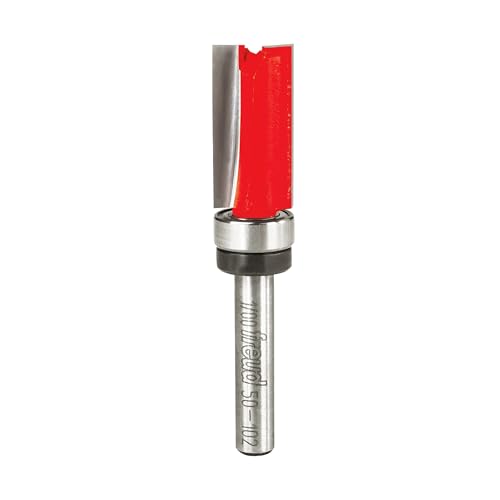
The Freud flush-trim bit uses a top-bearing design for pattern routing and template work, delivering consistent edge trimming on hardwood workpieces. The TiCo Hi-Density carbide combines longevity with sharpness, maintaining clean, accurate profiles across solid wood and veneers. This configuration is ideal for trimming plywood edges to match patterns, pattern routing for inlay work, or shaping decorative profiles on cabinet doors and window frames where hardwood stability demands precise cut quality.
SpeTool Slab Flattening Bit

The SpeTool 2+2 flute slab flattening bit is designed for heavy-duty flattening tasks on hardwood slabs. With a 1-1/4″ cutting diameter and replaceable carbide inserts, it offers long life in CNC or hand-held routers. The ATS coating reduces heat and wear, extending bit life under repeated passes. It’s especially useful for surfacing rough-sawn hardwood slabs where consistent height and flatness are essential for subsequent jointing and finishing.
Buying Guide: Key Purchase Considerations
When choosing router bits for hardwood, consider these factors to maximize performance and durability:
- Material and cutter geometry: Carbide-tipped bits stay sharp longer in dense hardwoods. For tongue-and-groove joints, look for reinforced cutters and even tooth patterns to minimize tear-out.
- Shank size and compatibility: A 1/4″ shank is common for lighter-duty work, while 1/2″ shanks offer more rigidity and reduce vibration in heavy cuts. Ensure your router can accept the chosen shank.
- Dust and heat management: Bits with corrosion-resistant coatings or advanced carbide formulations dissipate heat and resist heat-related dulling during long runs.
- Durability vs. cost: Sets with interchangeable inserts (e.g., slab flattening bits) save money over time by extending bit life through insert replacement rather than entire bits.
- Stock type and thickness: For cabinet doors and paneling, select tongue-and-groove or rail-and-stile bits that match your typical board thickness and grain orientation.
- Maintenance: Keep bits sharp with occasional honing and clean after use to prevent resin buildup, especially with hardwoods containing natural oils or tannins.
Comparative Insights
For precise joints in hardwood, tongue-and-groove sets from Junreox or Yonico offer targeted performance with adjustable features that aid fit. High-precision rail-and-stile bits from Freud deliver repeatable results for door components, while flush-trim options from Freud, along with robust subset sets like BOSCH, provide broad applicability across projects. Slab-flattening bits from SpeTool and SICWOOD offer specialized benefits when preparing slabs or spoiling boards prior to assembly, a common step in hardwood furniture making. Always align bit selection with your router’s capacity and your typical stock thickness to optimize results.