Best Rubber Coating for Concrete: Durable Waterproof Solutions
Choosing the right rubber coating for concrete helps protect basements, foundations, and other concrete surfaces from water intrusion while allowing for movement and temperature changes. Below are five proven products that mix durability, elasticity, and easy application. Each option is suitable for indoor and outdoor use, making them versatile for a range of projects from basement repair to foundation sealing.
| Product | Surface Use | Elongation / Flexibility | Volume |
|---|---|---|---|
| Liquid Rubber Basement and Foundation Repair Sealant – 1 Gallon | Concrete, Masonry, Wood, Metal | 900% elongation | 1 Gallon |
| Liquid Rubber Block & Wall Liquid Rubber Waterproofer – 1 Gallon | Basements, Foundations, Concrete | High elasticity (type varies per product) | 1 Gallon |
| Ames Maximum Stretch – 4.6 Gallon | Roofing, Concrete, EPDM, Wood | 650% elongation | 4.6 Gallon |
| Liquid Rubber Waterproof Sealant – 5 Gallon | Roofing, Foundations, Concrete | Up to 950% elongation | 5 Gallon |
| Liquid Rubber Color Waterproof Sealant – 5 Gallon | Metal, Concrete, Foundations | High elasticity and waterproofing | 5 Gallon |
Note: All products listed are designed to form durable, flexible membranes that protect concrete surfaces from water infiltration while staying resilient against movement, temperature shifts, and UV exposure.
Liquid Rubber Basement and Foundation Repair Sealant – 1 Gallon

This professional-grade sealant creates a permanent waterproof membrane for basement waterproofing, foundation leak repair, and other vertical applications. It offers up to 900% elongation, enabling strong, flexible adhesion to concrete, masonry, wood, and metal. The membrane style coating outperforms basic concrete paints and typical sealants, helping seal active leaks and moisture. It is compatible with self-leveling concrete and serves as a versatile solution for DIY projects that require a long-lasting waterproof barrier.
Liquid Rubber Basement and Foundation Repair Sealant – 5 Gallon

This larger 5-gallon version provides the same exceptional waterproofing membrane, designed to seal against active leaks and moisture in basements and foundations. The 900% elongation enables movement-and-temperature resilience, reducing future cracking and water damage. Like the 1-gallon option, it offers broad adhesion across concrete, masonry, wood, metal, and foundation surfaces, making it suitable for both DIY renovations and more extensive professional projects.
Ames Maximum Stretch – White, 4.6 Gallon

Ames Maximum-Stretch is a white elastomeric coating that provides 650% elongation to resist cracking and peeling. It has high reflectivity (approximately 88% of light) to reduce surface temperatures, which can lower cooling costs. It adheres to metal roofing, tar, and rolled surfaces, and is suitable for low-slope roofing as well as concrete and masonry projects. Use as a roof sealant, waterproofing layer, or a foundation coating to maintain flexibility over time.
Ames Block & Wall Liquid Rubber Waterproofer – 1 Gallon
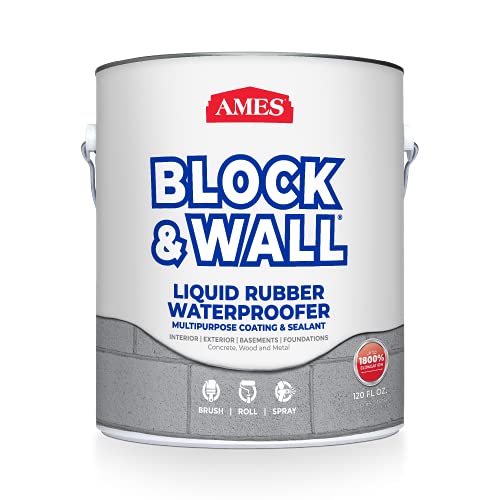
This multi-purpose white coating is designed for concrete sealers and basement foundations. While offering practical waterproofing, it also functions as a barrier against moisture ingress on walls and blocks. The formula is tailored for concrete and foundation surfaces, emphasizing adhesion and a flexible seal to accommodate substrate movement. It is manufactured in the USA and is suitable for DIY enthusiasts and professionals seeking a straightforward waterproofing solution.
Liquid Rubber Waterproof Sealant – 5 Gallon

This 5-gallon provide robust, industrial-strength waterproofing with flexible, rubberized membranes. It delivers over 950% elongation, maintaining adhesion through building movement and temperature shifts. It’s suitable for flat and low-slope roofs, foundations, concrete surfaces, gutters, and more. The coating adapts to varied substrates and can be brushed, rolled, or sprayed on, offering adaptable application for multiple project sizes and configurations.
Liquid Rubber Color Waterproof Sealant – White, 5 Gallon

This colorable waterproof sealant provides a durable, flexible membrane for metal roofs, flat roofs, foundations, and concrete surfaces. The white color option helps reflect sunlight to reduce heat gain, while the elastomeric formula resists cracking and UV exposure. It is suitable for DIY paint-and-seal projects as a standalone coating or as a base layer prior to additional finishes on concrete or metal surfaces.
Buying Guide
Key considerations when selecting a rubber coating for concrete include substrate compatibility, required longevity, and climate exposure. The following perspectives help ensure an informed choice:
- Surface compatibility: Look for products that bond well to concrete, masonry, wood, and metal. Some coatings also work well on vertical surfaces, while others are optimized for roofs or horizontal membranes.
- Elasticity and movement: Higher elongation values (e.g., 650%–950%) provide better resistance to foundational movement, temperature fluctuations, and seasonal shifts without cracking.
- Application method: Coatings can be brushed, rolled, or sprayed. Consider your project size, equipment availability, and whether you require a fast-drying, UV-resistant formulation.
- Coverage and curing time: Check coverage per gallon and total membrane thickness achievable per coat. Note curing times to avoid moisture exposure during installation.
- Color and reflectivity: White or light colors increase reflectivity and help reduce heat absorption on roofs and sunny surfaces, potentially lowering cooling costs.
- Indoor vs. outdoor use: Some products are optimized for basements and foundations, others for flat roofs or exterior walls. Ensure the product is rated for the intended environment.
- Safety and VOCs: Review odor, drying times, and any safety precautions for DIY applications, particularly for indoor spaces or poorly ventilated areas.
- Durability and UV resistance: UV stability matters for outdoor exposure to prevent surface degradation and color fading over time.
In summary, the best rubber coating for concrete depends on project scope, substrate type, and environmental conditions. For basement and foundation applications, prioritize high elongation, strong adhesion, and a durable waterproof membrane. For roofing or exterior walls, consider UV resistance and reflectivity. Always follow manufacturer guidance for surface preparation, priming (if required), and multiple coats to achieve optimal performance.