Best Rubber Flooring for Basement Gym: Durable, Safe Mats for Home Workouts
Looking for durable, comfortable flooring for a basement gym? This guide highlights top rubber-top and EVA-based interlocking mats that balance durability, noise reduction, and ease of installation. The best picks are suited for home gyms with heavy equipment, weightlifting zones, and cardio areas alike. See which mats align with your space, budget, and training style.
| Product | Size / Coverage | Best For |
|---|---|---|
| SUPERJARE 0.4″ Thick 24 Pcs | 96 sq ft | Medium to large home gym spaces with standard weights |
| ProsourceFit Exercise Puzzle Mat ½-inch (144 sq ft) | 144 sq ft | Budget-friendly, versatile floor protection for entire room |
| SUPERJARE 0.56″ Thick 12 Pcs | 48 sq ft | Smaller zones needing extra cushioning and grip |
| PRAISUN 0.56″ Rubber Top | 48 sq ft | Heavy equipment protection with non-slip top |
| AIRHOP 0.56″ Thick (48 sq ft) | 48 sq ft | Easy setup with interlocking tiles and shock absorption |
SUPERJARE 0.4″ Thick 24 Pcs Rubber Top Mats

Best for: mid to larger basement spaces needing steady load-bearing support. The dual-layer design combines a high-density EVA foam base with a rubber top for improved durability and grip. Choosing this mat helps reduce movement of heavy equipment and dampens impact noise.
Why selected: The setup offers strong resistance to wear and tear, with a rubber top that minimizes slippage during weight movements. The mat is designed to withstand heavy equipment without tearing, making it a solid option for home gyms with benches or rack setups.
Caution: Some buyers report mild rubber odor with initial use; however, the top layer is marketed as a low-odor alternative. Ensure proper ventilation during first uses.
ProsourceFit Exercise Puzzle Mat ½-inch
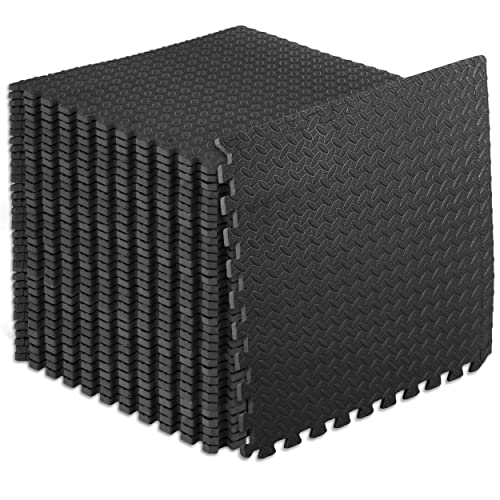
Best for: multi-use spaces where you need a large, soft, easy-to-clean surface that also serves kids areas or play zones. This mat is a practical choice for garages or finished basements used for workouts and play.
Why selected: High-density EVA foam provides comfortable cushioning and supports quiet workouts. It’s a versatile alternative to rubber mats and is easy to assemble on flat, hard surfaces. The color and texture may vary by batch, which is typical for foam-based mats.
Caution: Not a direct rubber surface; may compress more under heavy weights over time compared to rubber-top mats.
SUPERJARE 0.56″ Thick 12 Pcs Mats

Best for: smaller workout zones needing extra thickness and grip. The 0.56″ thickness offers enhanced impact absorption for heavier lifts while maintaining solid footing.
Why selected: The dual-layer design mirrors the 0.4″ version with improved cushioning. It provides less noise and vibration and keeps equipment secure during dynamic moves. Choose this if you want more floor protection in a tight space.
Caution: Coverage is limited to 48 sq ft, which may require extra edging or cutting for larger rooms.
PRAISUN 0.56″ Rubber Top Gym Flooring

Best for: home gym spaces where you need robust protection for floors from heavy weights. The rubber top surface provides high traction and reduces slipping during intense routines.
Why selected: Enhanced dual-layer construction ensures durability and tear resistance under heavy equipment. The textured rubber top aids grip and stability, while the cushioned base absorbs impact and reduces noise.
Caution: The top surface may feel slightly tacky when new; allowing ventilation can help dissipate any initial odor.
AIRHOP 0.56″ Thick Interlocking Mats

Best for: quick-install basement gyms needing a sturdy, interlocking system with strong shock absorption. Ideal for renters or builders who want a modular approach.
Why selected: 2-in-1 rubber-top EVA foam layers deliver non-slip performance and reliable floor protection. Tiles interlock for a secure fit, reducing shifts during high-intensity moves.
Caution: Interlocking connections can require a precise layout; plan room dimensions beforehand to minimize cutting.
Buying Guide: Key Considerations For Basement Gym Flooring
- Durability vs. comfort: Rubber-top layers excel at weight-bearing protection and grip, while EVA foam options offer cushion and quieter operation. Choose based on weight loads and noise tolerance.
- Coverage needs: For larger rooms, consider puzzle mats with higher square footage to reduce seams. Smaller spaces may benefit from thicker individual tiles for better protection.
- Grip and odor: Rubber tops usually provide better traction and less odor than pure foam. If odor is a concern, seek mats marketed as low-odor or odor-free.
- Installation: Interlocking systems simplify setup and removal. Plan for room shape and edge finishing to avoid gaps.
- Maintenance: Foam-based mats are generally easier to clean; rubber tops resist moisture but may require routine wiping to remove dust and chalk buildup.
- Noise and vibration: Thicker mats deliver better impact absorption, reducing noise transmission to upstairs spaces. Consider combinations of mats for zones with heavy lifting (squat racks, benches).
Frequently Asked Questions
- Q: Are rubber-top mats safe for heavy lifting in a basement? A: Yes, if the mats have a high-density base and a stable top surface designed to handle weight. Look for dual-layer designs and sufficient thickness.
- Q: Do foam tiles wear out quickly under free weights? A: Foam tiles can wear with heavy, repeated impact; rubber-top mats tend to offer longer wear life for heavy equipment zones.
- Q: Can I use these mats over concrete floors? A: Yes, most interlocking mats are designed for concrete, wood, or other hard surfaces. Ensure a flat, clean base before installation.
- Q: How many tiles should I buy for my basement gym? A: Size and layout determine this. Start with a rough area rug approach (length × width) and add extra tiles for edges and future zones.
- Q: Do these mats reduce noise from workouts? A: Yes, thicker dual-layer mats provide better shock absorption, which lowers noise and vibration transfer to other rooms.
- Q: Are there any odor considerations when installing new mats? A: Some rubber or foam products may have a slight initial odor; ensure proper ventilation during and after installation.