Best Sander for Concrete Floor: Top Picks for Smooth, Durable Results
Choosing the right concrete floor sander involves balancing power, dust control, head geometry, and maneuverability. This guide highlights five robust options suitable for residential and light commercial use, helping you achieve a smooth, even finish on concrete floors, epoxy coatings, terrazzo, and more.
Summary of Selected Products
| Product | Brand | Key Feature | Power (W) | Dust Capacity |
|---|---|---|---|---|
| WYDDDARY Concrete Floor Grinder | WYDDDARY | 6 grinding heads, large width, dust suction | 4,500 | 30 L |
| 7-Inch Concrete Floor Grinder, 2200W | Generic | High speed, 90° grinding, versatile | 2,200 | Varies by model |
| 4-Head Concrete Grinder Set, 3800W | YUCHENGTECH | 4-head system, dual dust outflow | 3,800 | Dust extraction shroud included |
| GLAUCUS 4” Three-Axis Grinder | GLAUCUS | Four-Inch, flexible control, included disc | 2,450 | Dust clearance hood |
| 3-Head Concrete Grinder Set, 4″ | YUCHENGTECH | Triple-axis design, 3 discs, efficient | 2,800 | Dust extraction shroud |
The table above provides a snapshot of what each model offers in terms of power, dust management, and head configuration to help you compare at a glance before diving into detailed sections.
WYDDDARY Concrete Floor Grinder Polishing Buffer

The WYDDDARY ground polishing buffer is designed for epoxy and terrazzo floors and features a sizable grinding width of 410mm with six grinding heads. It operates on 220V and includes a 30-liter dust bucket to support cleaner jobsites. A pure copper motor is highlighted for durability, with a focus on improved energy conversion efficiency and robust build quality. The machine emphasizes dust-free operation with dual vacuum tubes, supporting higher dust removal efficiency and extended equipment life. Weighing around 159 kg, this model is a substantial option for larger floor prep tasks.
Key features to consider include the six-head configuration for broad coverage, the high-capacity dust system, and the robust copper motor. However, note that the machine may not be suitable for floors with active glue residues, and proper dust management practices should be followed to maintain workplace safety and equipment longevity.
Best use cases: preparing concrete surfaces for sealants or coatings, removing old coatings, and leveling uneven areas on larger floor spaces where a broad grinding path improves productivity.
7-Inch Concrete Floor Grinder, 2200W

This all-copper motor model delivers 2200W of continuous power, suitable for demanding concrete surfaces. It uses a 6-inch diamond grinding wheel to cover a larger area efficiently. The grinder includes a removable cover to reach corners and is designed for seamless 90-degree grinding, allowing for effective edge work on floors, walls, and ceilings. The quick-speed adjustment lets users switch among six speeds in a moment, supporting different material requirements. The included diamond disc boosts initial usability for first-time users.
Strengths include fast material removal, adaptable speed settings, and a design focused on reach and edge work. Potential drawbacks include the need for complementary dust extraction systems to manage debris effectively in enclosed spaces.
Best use cases: initial surface prep, leveling, and coating removal on mid-sized commercial or residential floors where edge work is frequent and speed matters.
4-Head Concrete Grinder Set, 4″ Concrete Surface Grinder
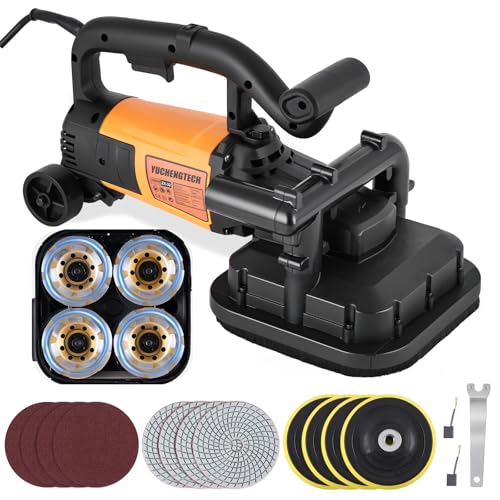
This YUCHENGTECH 4-head system is engineered to maximize coverage with four 4″ diamond wheels, delivering up to three times the efficiency of a single-head grinder. Its 3800W copper motor supports heavy concrete, marble, granite, and cement grinding tasks. A six-speed control allows fine-tuning from delicate polishing to aggressive grinding, making it suitable for a broad range of applications. The dust extraction shroud is designed to fit closely to walls, helping to reduce airborne dust and improve workplace cleanliness when used with industrial vacuums.
Performance considerations include the strong motor and multi-head approach for rapid material removal, as well as dust management compatibility. Users should ensure proper vacuum support and monitor noise levels during extended operation.
Best use cases: large-area floor prep, coating removal, and aggressive leveling in commercial settings where downtime needs to be minimized.
GLAUCUS 4” Three-Axis Grinder Concrete Surface Grinder

The GLAUCUS 4” three-axis grinder emphasizes control and ease of use with six-speed adjustments, a dual-grip design, and a compact 4″ grinding head. It includes a diamond grinding disc and is designed to work with a compatible vacuum system to capture dust during operation. The 2450W motor provides solid performance for standard concrete surface work, including edging and corners where a larger machine may not reach easily.
Key considerations include the ergonomic design and dust-collection compatibility, which can significantly improve comfort and cleanliness on the job. The compact size makes it suitable for smaller rooms or tight spaces where larger units struggle to maneuver.
Best use cases: edge work, small rooms, and projects where precise control and dust management are priorities alongside standard grinding tasks.
3-Head Concrete Grinder Set, 4″ Concrete Floor Grinder

This YUCHENGTECH model features a triple-axis design with a 3.94″ disc footprint, providing a 7.9″ diameter grinding swath for efficient surface removal. The 2800W copper motor ensures strong, consistent power and good heat resistance for longer operation periods. A 6-speed range (800-2800 rpm) allows precise control across projects—from rough grinding to finer finishing. The system supports simultaneous disc configuration to optimize material removal while maintaining a manageable machine footprint.
Important aspects include the triple-axis configuration for balance and efficiency, powerful motor performance, and variable speed control. As with other heavy grinders, adequate dust collection and hearing protection are recommended for prolonged use.
Buying Guide: Key Purchase Considerations And Comparisons
- Power and duty cycle: Higher wattage usually translates to faster material removal and better performance on tough concrete. Look for copper motors for durability and smooth power delivery.
- Grinding head configuration: Single-head grinders are simple but slower; multi-head systems (2, 3, or 4 heads) provide greater coverage and faster work on large areas, though they can be heavier and less maneuverable in tight spaces.
- Dust management: A robust dust collection system or dust hood is essential for indoor use. Ensure compatibility with industrial vacuums and observe dust control features such as dual channels or suction tubes.
- Grinding width and reach: Broader widths (410mm, 7- to 11-inch equivalents) accelerate large-area prep, while smaller heads are better for corners, edges, and detailed work.
- Speed control: Multiple speed settings enable handling a range of materials—from concrete to epoxy coatings to terrazzo. Six-speed or more offers flexibility for different projects.
- Ergonomics and weight: Heavier floor grinders require steady handling and proper technique. Look for models with dual handles, balanced weight distribution, and comfortable grips.
- Dust extraction compatibility: Check that the machine’s shroud or hood design allows close contact to walls and corners and that it supports standard vacuum hoses.
- Durability and maintenance: Copper windings, high-quality bearings, and easily replaceable grinding discs contribute to longer service life and easier maintenance.
- Intended use: For large commercial jobs, prioritize high-output, multiple-head grinders; for home garages or small spaces, lighter, more maneuverable models may suffice.
- Safety: Always wear appropriate PPE, including eye protection, hearing protection, and a respirator when dust is present or ventilation is limited.
When choosing among these options, consider the total job scope: floor size, the presence of coatings or glue, required edge work, and the available dust management setup. The models listed here provide a mix of high-power, multi-head configurations and compact designs to address a range of concrete floor sanding and grinding needs in American projects.