Best RV Sealants for Waterproof, Long-Lasting Roof Seals
Choosing the right sealant for an RV involves weighing adhesion, curing time, weather resistance, and suitability for horizontal versus vertical surfaces. The following products are among the most widely used by owners and professionals to protect roofing, windows, vents, and seams from water intrusion. This guide compares five top options, highlighting where each excels and where it’s best suited in an RV maintenance plan.
| Product | Brand | Typical Use |
|---|---|---|
| Geocel GC28100 Pro Flex RV | Geocel | Flexible, damp-area adhesion; suitable for vertical and overhead applications |
| Dicor 501LSW-1 HAPS-Free | Dicor | Non-staining, HAPS-free self-leveling sealant for horizontal roofs |
| Dicor 501LSW-1 Self-Leveling Lap Sealant, 4 Pack | Dicor | Enhanced horizontal sealing along roof edges, vents, and fasteners |
| Kohree RV Roof Sealant 4 Pack | Kohree | Self-leveling, white; versatile on multiple substrates |
| Erigathe Self-Leveling RV Roof Sealant | Erigathe | Quick-set, UV-resistant, suitable for roof seams and edges |
Geocel GC28100 Pro Flex RV Flexible Sealant
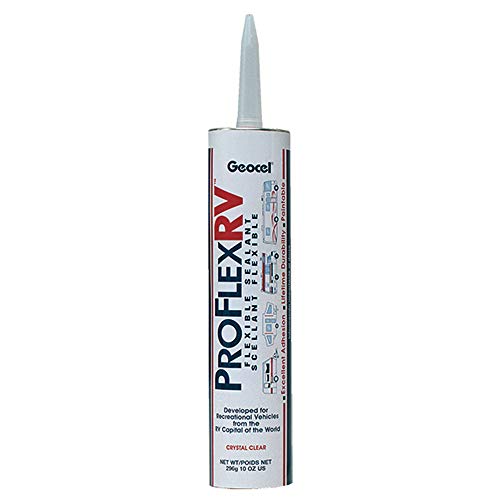
Geocel GC28100 Pro Flex RV is a versatile sealant designed for both horizontal and vertical applications. Its flexible formulation allows it to maintain a seal on joints and seams even as RVs expand and contract with temperature changes. The product is noted for strong adhesion to a wide range of surfaces and remains effective when applied over itself after initial cure. A useful feature is its ability to seal damp surfaces, which can simplify repairs on slightly wet substrates commonly found on roofs and around vents.
Dicor 501LSW-1 HAPS-Free Self-Leveling Lap Sealant

Dicor 501LSW-1 HAPS-Free is a self-leveling sealant formulated for horizontal RV roofing surfaces. It’s stabilized against sun rays to prevent discoloration and staining, and its white color provides a clean, finished look on most RV roofs. The self-leveling characteristic helps create a smooth seal along horizontal areas like roof seams and edges, enhancing water resistance without manual smoothing. Being HAPS-free makes it a favorable choice for those prioritizing low odor and safer indoor use during application.
Dicor 501LSW-1 Self-Leveling Lap Sealant, 4 Pack

ThisDicor 501LSW-1 4-pack expands the popularity of the 501LSW family by providing multiple tubes designed for continuous roof sealing tasks. It creates a secure secondary seal along roof edges, vents, vent pipes, and screw heads, and adheres to a broad range of substrates including aluminum, wood, vinyl, and concrete. The compatibility with EPDM and TPO sheeting ensures it works well with common RV roofing materials used in modern trailers and fifth wheels.
Kohree RV Roof Sealant 4 Pack, Self-Leveling

Kohree’s 4-pack brings a self-leveling, white lap sealant designed for horizontal roofing applications. It forms a flat seal quickly, helping cover gaps and seams efficiently. The formula emphasizes safety with low odor and suitability for indoor and outdoor use. It bonds well with EPDM, TPO, PVC, aluminum, and other substrates, making it a flexible option for various RV roof materials and maintenance scenarios.
Erigathe Self-Leveling RV Roof Sealant

Erigathe Self-Leveling RV Roof Sealant is designed to flow into cracks and laps, creating a watertight barrier that’s UV-resistant. The product touts a quick tack-free time and a broad operating temperature range, making it suitable for use in diverse climates. It’s particularly noted for sealing roof edges, vents, skylights, and exterior trim, with strong adhesion to metal, fiberglass, and EPDM rubber to prevent peeling or shrinking over time.
Buying Guide: Key Purchase Considerations
- Surface compatibility: Determine if you need a self-leveling sealant for horizontal surfaces or a non-leveling formula for vertical joints around windows, doors, and vents. Substrate compatibility (EPDM, TPO, metal, wood, concrete) is crucial for long-term adhesion.
- Sun exposure and UV resistance: For exterior RV roofs exposed to sun, choose products with UV stability to minimize discoloration and degradation over time.
- Ease of application: Self-leveling formulas simplify horizontal installations, while non-leveling options offer more control on vertical surfaces. Consider cure time and handling properties to fit your maintenance schedule.
- Odor and safety: If you work indoors or in enclosed spaces, opt for low-odor or HAPS-free formulations to improve comfort and safety during application.
- Adhesion and flexibility: A flexible sealant that adheres to multiple substrates and remains pliable in temperature fluctuations tends to endure road vibration and weather cycles better.
- Storage and leftovers: Some products are designed to be resealable or come in multi-pack options, which can reduce waste and simplify future repairs.
- Repair strategy: For areas with prior sealants, ensure compatibility to avoid chemical incompatibility that could undermine the new seal.
When selecting a sealant for an RV, it helps to map out your project scope—roof-only repairs, window and door perimeters, or a broader set of repairs around vents and vents’ edges. The products above provide a spectrum of options from high-adhesion, damp-surface use to self-leveling, sun-stable solutions for horizontal roofs. Always follow manufacturer instructions for surface prep, cure times, and re-caulking intervals to maximize waterproof performance.